14.4 Sound Waves and Acoustic Phenomena

🍏Principles of Physics I Unit 14 Review
14.4 Sound Waves and Acoustic Phenomena
🍏 Principles of Physics I
Wave Properties and Sound Characteristics
Sound waves are mechanical waves that carry energy through a medium by creating regions of high and low pressure. Understanding their behavior is central to topics ranging from musical acoustics to medical imaging.
Properties of Sound Waves
Sound waves are longitudinal waves, meaning the particles in the medium oscillate parallel to the direction the wave travels. This creates alternating regions of compression (particles pushed together) and rarefaction (particles spread apart). Because they're mechanical waves, they require a medium to propagate and cannot travel through a vacuum.
Every sound wave can be described by four core properties:
- Frequency (): the number of oscillations per second, measured in hertz (Hz). Higher frequency means higher pitch.
- Wavelength (): the distance between successive compressions (or rarefactions).
- Speed (): how fast the wave moves through the medium, related by .
- Amplitude: the maximum displacement of particles from their equilibrium position. Larger amplitude means louder sound.
The speed of sound depends on the medium and its conditions. In air at 20°C, sound travels at approximately 343 m/s. It moves faster in denser or stiffer media: roughly 1480 m/s in water and about 5960 m/s in steel.
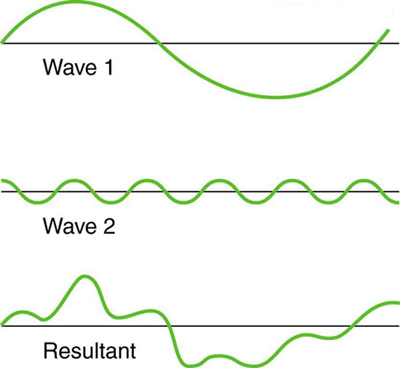
Most real sounds aren't pure single-frequency tones. A guitar string, for instance, vibrates at a fundamental frequency plus higher overtones (integer multiples of the fundamental). This mix of frequencies is what gives different instruments their distinct tonal quality, or timbre.
Sound waves also exhibit reflection (echoing off surfaces), refraction (bending when passing between media at different temperatures or densities), and diffraction (spreading around obstacles or through openings).

Sound Intensity and Decibels
Sound intensity is the power carried by a sound wave per unit area, measured in watts per square meter:
As sound radiates outward from a source, it spreads over an increasingly large spherical area. This gives rise to the inverse square law: intensity decreases proportionally to the square of the distance from the source.
So if you double your distance from a concert speaker, the intensity drops to one-quarter of its original value.
Because the range of intensities the human ear can detect is enormous (roughly a factor of ), we use a logarithmic scale. The decibel (dB) level is defined as:
where W/m² is the reference intensity, corresponding to the threshold of human hearing.
Some reference points to keep in mind:
- 0 dB: threshold of hearing
- 60 dB: normal conversation
- 120 dB: threshold of pain (roughly a jet engine at close range)
One tricky detail: because the scale is logarithmic, sound levels from multiple sources don't add linearly. Two identical 60 dB sources playing together don't produce 120 dB. Instead, doubling the intensity adds about 3 dB, so two 60 dB sources together produce roughly 63 dB.
Acoustic Phenomena
Doppler Effect for Sound
The Doppler effect is the change in observed frequency that occurs when there's relative motion between a sound source and an observer. You've heard this in action when an ambulance siren sounds higher-pitched as it approaches and lower-pitched as it drives away.
The general Doppler formula for sound is:
where:
- = observed frequency
- = source frequency
- = speed of sound in the medium
- = speed of the observer
- = speed of the source
The sign convention here matters. Use the upper signs (+ in numerator, − in denominator) when the source and observer move toward each other, and the lower signs (− in numerator, + in denominator) when they move apart. A helpful way to remember: motion that closes the gap between source and observer always increases the observed frequency.
Applications of the Doppler effect include weather radar (detecting storm movement), medical ultrasound (measuring blood flow velocity), and police radar guns (measuring vehicle speed).
Resonance in Acoustic Systems
Resonance occurs when a system is driven at one of its natural frequencies, causing the amplitude of oscillation to increase dramatically. In acoustic systems, resonance produces standing waves, which are patterns formed by the superposition of two waves traveling in opposite directions.
Standing waves have fixed points of zero displacement called nodes and points of maximum displacement called antinodes.
Vibrating strings (guitar, violin, piano) are fixed at both ends, so both endpoints must be nodes. The resonant frequencies are:
Here gives the fundamental frequency (the lowest pitch the string produces), and higher values of give the harmonics. The wave speed on the string depends on its tension and mass per unit length.
Air columns behave differently depending on their boundary conditions:
- Open at both ends (like a flute): both ends are pressure nodes (displacement antinodes), so all harmonics are present.
- Closed at one end (like a clarinet or a bottle): the closed end is a displacement node and the open end is a displacement antinode. Only odd harmonics are present.
This is why a closed pipe of the same length as an open pipe produces a fundamental frequency that's half as high, and has a distinctly different tonal quality due to the missing even harmonics.
These resonance principles are applied in musical instrument design, concert hall acoustics (shaping how sound reflects and reinforces), and noise reduction strategies like soundproofing, where materials are chosen to absorb rather than reflect sound at specific frequencies.
See Fiveable more often in Google
Mark Fiveable as a preferred source and Google is more likely to show you our guides in Top Stories, with a "preferred" badge in AI Mode and AI Overviews.