14.3 Wave Motion and Types of Waves

🍏Principles of Physics I Unit 14 Review
14.3 Wave Motion and Types of Waves
🍏 Principles of Physics I
Wave Fundamentals
A wave is a disturbance that transfers energy from one place to another without permanently displacing the matter it travels through. Think of a stadium wave: each person stands and sits back down in place, but the "wave" itself travels around the entire arena. This distinction between energy transfer and matter transfer is central to everything in this unit.
Properties of Wave Motion
Every wave can be described by a handful of measurable quantities:
- Amplitude (A): The maximum displacement of a point on the wave from its equilibrium (rest) position. Larger amplitude means more energy carried by the wave.
- Wavelength (): The distance between two consecutive identical points on a wave, such as crest to crest or trough to trough.
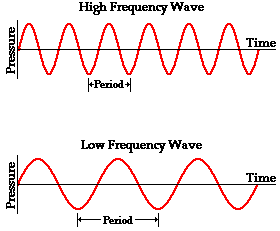
- Frequency (): The number of complete wave cycles passing a fixed point per second, measured in hertz (Hz).
- Period (): The time it takes for one complete cycle to pass. Period and frequency are inverses of each other:
- Wave speed (): How fast the wave pattern moves through the medium.
These quantities are tied together by the wave equation:
This says that wave speed equals frequency times wavelength. If you know any two of these three values, you can find the third.
Transverse vs. Longitudinal Waves
Waves are classified by the direction particles oscillate relative to the direction the wave travels.
- Transverse waves: The medium's particles oscillate perpendicular to the wave's direction of travel. Picture shaking a rope side to side: your hand moves up and down, but the wave pulse travels horizontally along the rope. Water surface waves and electromagnetic waves are transverse.
- Longitudinal waves: The medium's particles oscillate parallel to the wave's direction of travel. A good example is pushing and pulling one end of a Slinky: regions of compression (where coils bunch together) and rarefaction (where coils spread apart) travel along the spring's length. Sound waves in air work the same way, with air molecules compressing and expanding.
Both types obey the same wave equation .

Mechanical and Electromagnetic Waves
Another way to classify waves is by whether they need a medium to travel through.
Mechanical waves require a physical medium (solid, liquid, or gas). The wave energy passes from particle to particle through the medium. Sound is a mechanical wave, which is why it can't travel through the vacuum of space. Water waves and seismic waves are also mechanical.
Electromagnetic (EM) waves do not need a medium. They consist of oscillating electric and magnetic fields and can travel through a vacuum. All EM waves travel at the speed of light in a vacuum (). The electromagnetic spectrum includes radio waves, microwaves, infrared, visible light, ultraviolet, X-rays, and gamma rays, all differing only in frequency and wavelength.
Wavelength, Frequency, and Speed
Wave speed is determined by the properties of the medium (density, tension, temperature, etc.), not by the wave's frequency or amplitude. Once you're in a given medium, stays constant.
Because and is fixed in a medium, wavelength and frequency have an inverse relationship: if frequency goes up, wavelength must go down, and vice versa. For example, a sound wave at 680 Hz in air (where ) has a wavelength of:
Double the frequency to 1360 Hz and the wavelength halves to 0.25 m. The speed stays at 340 m/s.
Superposition and Wave Interference
When two or more waves overlap in the same region, the superposition principle says the resulting displacement at any point is the algebraic sum of the individual displacements. The waves don't permanently alter each other; after passing through one another, each continues on as before.
This leads to two important cases:
- Constructive interference occurs when waves arrive in phase (crests align with crests). Their amplitudes add together, producing a larger combined wave. This happens when the path difference between the two waves is a whole number of wavelengths ().
- Destructive interference occurs when waves arrive out of phase (crests align with troughs). Their amplitudes partially or fully cancel. Complete cancellation happens when the path difference is an odd multiple of half a wavelength ().
Real-world applications of interference include standing waves in musical instruments (where constructive interference at specific frequencies produces resonance), noise-canceling headphones (which generate a wave out of phase with ambient noise to cancel it), and the colorful patterns on soap bubbles (caused by thin-film interference of light waves reflecting off the inner and outer surfaces of the film).
See Fiveable more often in Google
Mark Fiveable as a preferred source and Google is more likely to show you our guides in Top Stories, with a "preferred" badge in AI Mode and AI Overviews.