2.3 Free Fall and Graphical Analysis of Motion

🍏Principles of Physics I Unit 2 Review
2.3 Free Fall and Graphical Analysis of Motion
🍏 Principles of Physics I
Free Fall Motion
Free fall describes the motion of an object moving under the influence of gravity alone, with no air resistance or other forces acting on it. This is one of the most important special cases of one-dimensional kinematics because it gives you a real, physical situation where acceleration is constant, and you can apply all the kinematic equations you've already learned.
Concept of Free Fall
An object is in free fall any time gravity is the only force acting on it. That includes objects falling downward, objects thrown upward (even while they're still rising), and objects at the very top of their arc. As long as air resistance is negligible and nothing else pushes or pulls on the object, it's in free fall.
A few key points:
- The acceleration due to gravity near Earth's surface is , always directed downward.
- Free fall acceleration is the same regardless of the object's mass. A bowling ball and a tennis ball dropped from the same height (in a vacuum) hit the ground at the same time.
- An object's velocity increases by for every second it falls. If you throw something upward, its velocity decreases by each second on the way up.
Equations for Free Fall Motion
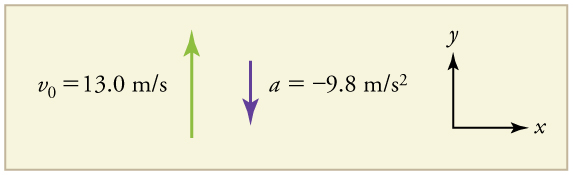
Free fall uses the same kinematic equations from earlier in the unit, just with (since gravity points downward and we typically choose upward as positive).
The three main equations:
Where:
- = final velocity
- = initial velocity
- = final position
- = initial position
- = time
- (negative because it points downward)
Sign convention matters. Choose upward as positive and stick with it. That means , an upward throw has a positive , and positions below your starting point are negative. Most errors in free fall problems come from inconsistent signs.

Graphical Analysis of Free Fall
Graphs of free fall motion follow directly from the fact that acceleration is constant. Each type of graph tells you something different.
Position vs. time: The graph is a parabola (curved), because position depends on . For an object thrown upward, the curve opens downward, with the peak at the maximum height. The slope of this graph at any point gives you the velocity at that instant.
Velocity vs. time: The graph is a straight line with a slope of (about ). The y-intercept is the initial velocity. If the object was thrown upward, the line starts positive, crosses zero at the peak, and continues into negative values on the way down. Two useful readings from this graph:
- The slope gives you the acceleration.
- The area between the line and the time axis gives you the displacement.
Acceleration vs. time: This is simply a horizontal line at . It doesn't change, because free fall acceleration is constant throughout the motion.
Graph relationships to remember: position-time slope = velocity, velocity-time slope = acceleration, velocity-time area = displacement.
Vertical Motion Problems
Different setups require slightly different approaches, but the equations are always the same.
Object thrown upward: The initial velocity is positive. The object slows down, stops momentarily at its maximum height (where ), then falls back down.
- Time to reach maximum height:
- Maximum height above the launch point:
Object dropped from rest: The initial velocity is zero, which simplifies the equations.
- Time to fall a height :
- Speed just before hitting the ground:
Symmetry of vertical motion: For an object launched upward from and returning to the same height, the time going up equals the time coming down, and the speed at launch equals the speed at impact. This symmetry is a useful shortcut and a good way to check your answers.
Solving free fall problems step by step:
- Draw a quick sketch and choose a positive direction (usually upward).
- List your knowns and identify the unknown you need to find.
- Pick the kinematic equation that contains your unknown and doesn't require a variable you don't have.
- Substitute values with correct signs and solve.
- Check that your units work out and your answer is physically reasonable (e.g., a ball shouldn't take 200 seconds to fall off a building).
See Fiveable more often in Google
Mark Fiveable as a preferred source and Google is more likely to show you our guides in Top Stories, with a "preferred" badge in AI Mode and AI Overviews.