1.4 Introduction to Literary Devices and Techniques

📓Intro to Creative Writing Unit 1 Review
1.4 Introduction to Literary Devices and Techniques
📓 Intro to Creative Writing
Literary devices and techniques are the tools writers use to move beyond plain storytelling. They help you create vivid imagery, trigger specific emotions, and layer meaning beneath the surface of your writing. Mastering even a handful of these devices will make your work more engaging and give you more control over how readers experience your stories.
This section covers three categories: figurative language (how you describe things), literary techniques (how you shape the reader's experience), and story elements (how you build the world of your narrative).
Figurative Language
Figurative language is any language that goes beyond the literal meaning of words. It's how writers make descriptions feel fresh and surprising instead of flat.

Top images from around the web for Comparisons and Descriptions
Poetic devices: imagery and the five senses View original
Is this image relevant?
Author's Style Notes by Michele McCaughtry | Teachers Pay Teachers View original
Is this image relevant?
Ms. Henderson's English Wiki - AP Glossary View original
Is this image relevant?
Poetic devices: imagery and the five senses View original
Is this image relevant?
Author's Style Notes by Michele McCaughtry | Teachers Pay Teachers View original
Is this image relevant?
Comparisons and Descriptions
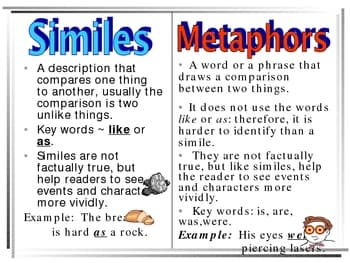
Metaphor directly compares two unlike things without using "like" or "as." It states that one thing is another to highlight a shared quality.
Her eyes were diamonds, sparkling and precious.
The writer isn't saying her eyes are literally gems. The comparison transfers the qualities of diamonds (brightness, value) onto the eyes.
Simile also compares two unlike things, but it uses "like" or "as" to make the comparison explicit.
The moon was like a pearl, luminous and smooth in the night sky.
The difference between metaphor and simile trips people up, but it's straightforward: if you see "like" or "as" making the comparison, it's a simile. If the comparison is stated directly, it's a metaphor.
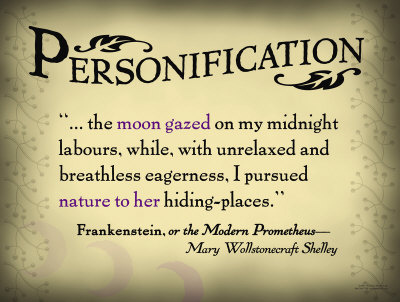
Personification gives human qualities to non-human things, whether objects, animals, or abstract ideas.
The wind whispered secrets through the rustling leaves.
Wind can't literally whisper, but giving it that human action makes the scene feel alive and intimate.
Sensory and Symbolic Language
Imagery uses descriptive language that appeals to one or more of the five senses: sight, sound, smell, taste, and touch. Strong imagery puts the reader inside the scene.
The sweet aroma of freshly baked bread wafted through the kitchen.
That sentence targets smell and almost taste. When you write imagery, ask yourself: which sense am I activating here?
Symbolism uses a concrete object, character, or event to represent something abstract, something beyond its literal meaning.
The white dove symbolized hope and peace amidst the chaos.
Symbols gain power through context. A dove in a war story carries different weight than a dove in a nature poem. As a writer, you don't need to announce your symbols. Let the reader discover them.
Alliteration repeats the same consonant sound at the beginning of nearby words. It creates rhythm and makes phrases more memorable.
The swift, silent snake slithered through the grass.
Notice how all those "s" sounds actually mimic the hissing of a snake. That's alliteration doing double duty: creating rhythm and reinforcing meaning.
Literary Techniques
These are the craft-level choices writers make to shape how a reader experiences the story. Where figurative language is about describing, literary techniques are about structuring the reader's understanding.
Storytelling Devices
Irony creates a gap between what's expected and what actually happens. There are three main types:
- Verbal irony is when a character says the opposite of what they mean. Saying "What a beautiful day!" during a thunderstorm is verbal irony. (This overlaps with sarcasm, but irony doesn't always have sarcasm's biting tone.)
- Situational irony is when the outcome of a situation is the opposite of what you'd expect. A fire station burning down is situational irony because a fire station is the last place you'd expect to be destroyed by fire.
- Dramatic irony is when the audience knows something the characters don't. In Romeo and Juliet, the audience knows Juliet is alive, but Romeo believes she's dead. That knowledge gap is what makes the scene so painful to watch.
Dramatic irony is especially useful in your own writing because it builds tension. When readers know something a character doesn't, they keep reading to see what happens when the truth comes out.
Foreshadowing plants hints or clues about events that will happen later in the story. It builds suspense and makes later plot developments feel earned rather than random.
The dark, ominous clouds foreshadowed the impending storm.
Foreshadowing can be obvious (like that example) or subtle, such as a character casually mentioning a detail that becomes important three chapters later. Subtle foreshadowing is harder to pull off but more rewarding for the reader.

Narrative Perspective and Atmosphere
Point of view (POV) is the perspective from which your story is told. Your choice of POV shapes everything the reader can and can't know.
- First person uses "I" or "we." The narrator is a character in the story. (I walked into the room, unsure of what I would find.) This POV creates intimacy but limits you to what that one character knows and perceives.
- Third person uses "he," "she," or "they." The narrator is outside the story.
- Third-person limited follows one character's thoughts and experiences. You get some distance from the character while still staying close to their inner world.
- Third-person omniscient has access to all characters' thoughts and experiences. This gives you the most flexibility but can feel less intimate.
She nervously entered the room, her heart pounding in her chest. (third-person limited)
Tone is the author's attitude toward the subject, conveyed through word choice and style. A story about the same event could have a mocking tone, a reverent tone, or a detached tone depending on how the writer frames it. Think of tone as the writer's voice coming through on the page.
Mood is the emotional atmosphere the reader feels. Tone is what the writer projects; mood is what the reader experiences. They're related but distinct.
The eerie, fog-filled graveyard created a mood of unease and foreboding.
Writers build mood through setting details, pacing, and word choice. Short, choppy sentences can create anxiety. Long, flowing descriptions can create calm. Your language choices directly shape how the reader feels.
Story Elements
These are the building blocks that hold a narrative together. Every story, no matter how experimental, works with some version of these elements.
Meaning and Characters
Theme is the central message or insight a story explores. Themes are usually universal human experiences: love, loss, identity, power, growing up. A theme isn't a single word, though. "Love" is a topic. "Love requires sacrifice" is a theme.
The theme of love conquering all obstacles is prevalent in many classic romance novels.
Your theme doesn't need to be stated outright. In fact, the strongest themes emerge naturally from the characters' choices and the story's events.
Characterization is how you develop and reveal who your characters are. There are two approaches:
- Direct characterization tells the reader explicitly what a character is like. (She was a kind and generous soul, always putting others before herself.)
- Indirect characterization shows the character's personality through their actions, dialogue, thoughts, and how others react to them. (He slammed the door and stomped away, his face red with anger.)
You've probably heard "show, don't tell." That's the difference between indirect and direct characterization. Both have their place, but indirect characterization tends to be more engaging because it lets readers draw their own conclusions.
Structure and World-Building
Plot is the sequence of events in a story. Most plots follow a five-part structure:
- Exposition introduces the characters, setting, and initial situation
- Rising action develops the conflict and raises the stakes
- Climax is the turning point or moment of highest tension
- Falling action deals with the consequences of the climax
- Resolution concludes the story and ties up loose ends
Not every story follows this structure rigidly, but understanding it gives you a framework to work with (or intentionally break).
Setting is the time, place, and social context of your story. Setting isn't just background decoration. It influences how characters behave, what conflicts are possible, and what mood the story carries.
The dystopian setting of the novel portrayed a bleak, oppressive future society.
A story about rebellion means something very different in a medieval kingdom than in a futuristic police state. When you choose your setting, you're already shaping your story's possibilities.
See Fiveable more often in Google
Mark Fiveable as a preferred source and Google is more likely to show you our guides in Top Stories, with a "preferred" badge in AI Mode and AI Overviews.