8.8 Managing Grievances and Conflicts

💼Intro to Business Unit 8 Review
8.8 Managing Grievances and Conflicts
💼 Intro to Business
8.1
Achieving High Performance through Human Resources Management
8.2
Employee Recruitment
8.3
Employee Selection
8.4
Employee Training and Development
8.5
Performance Planning and Evaluation
8.6
Employee Compensation and Benefits
8.7
The Labor Relations Process
8.8
Managing Grievances and Conflicts
8.9
Legal Environment of Human Resources and Labor Relations
8.10
Trends in Human Resource Management and Labor Relations
Grievance Procedures and Conflict Resolution
Labor disputes can disrupt workplaces and hurt productivity. Grievance procedures give employees a structured path to raise complaints, moving step by step from informal conversations to formal arbitration if needed. Understanding these processes matters because they're the backbone of how unionized workplaces keep conflicts from spiraling out of control.
Unions and employers also have their own tactical playbooks for gaining leverage during negotiations. Knowing both sides helps you see the full picture of labor relations and how disputes actually get resolved.

Top images from around the web for Grievance procedures in unionized workplaces
The Labor Relations Process | OpenStax Intro to Business View original
Is this image relevant?
Managing Grievances and Conflicts | OpenStax Intro to Business View original
Is this image relevant?
The Labor Relations Process | OpenStax Intro to Business View original
Is this image relevant?
The Labor Relations Process | OpenStax Intro to Business View original
Is this image relevant?
Managing Grievances and Conflicts | OpenStax Intro to Business View original
Is this image relevant?
Grievance Procedures in Unionized Workplaces
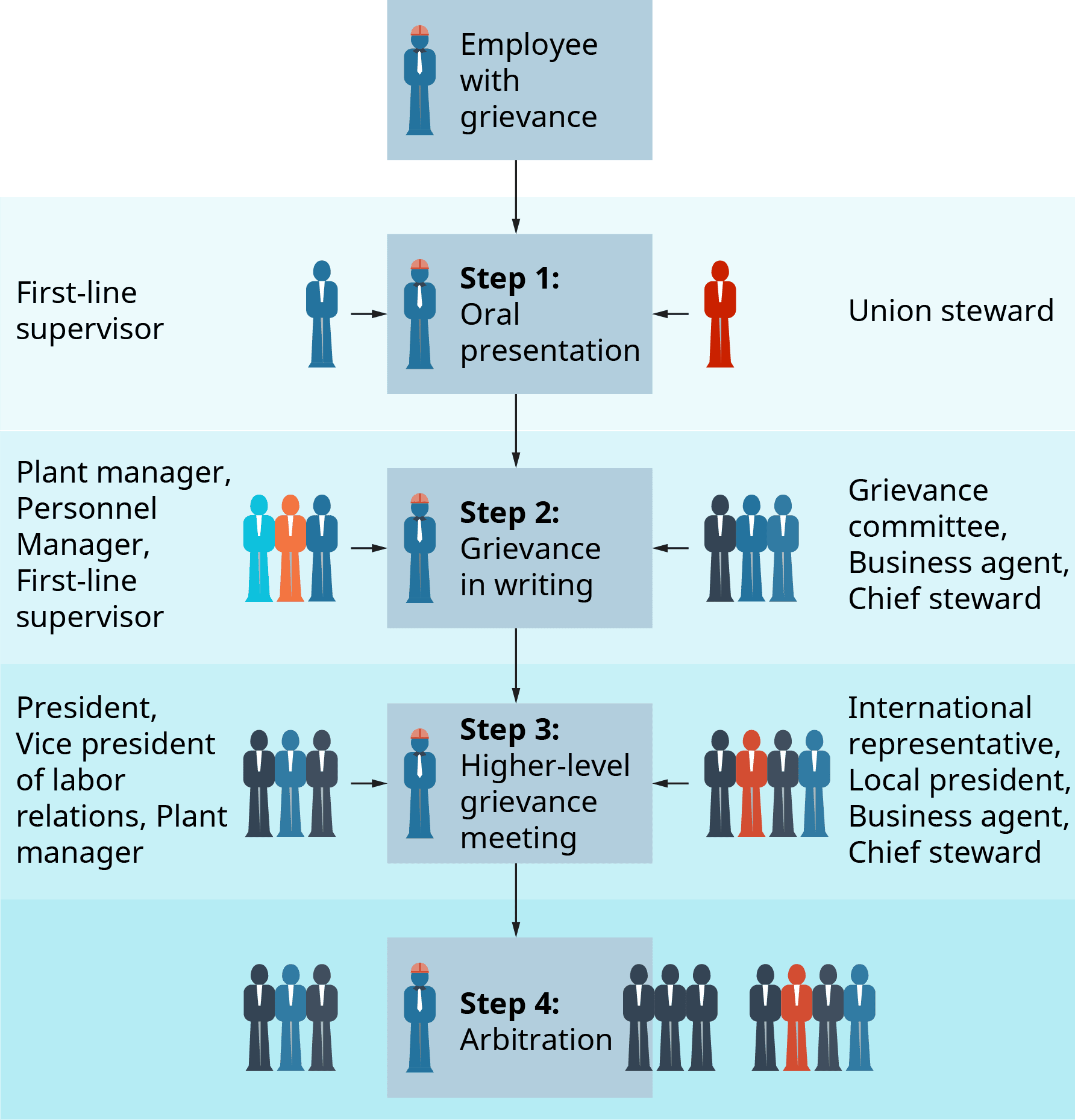
A grievance is a formal complaint that the employer has violated the collective bargaining agreement, employee rights, or labor laws. Most unionized workplaces follow a multi-step process to resolve these complaints, starting small and escalating only when necessary.
- Informal discussion — The employee (sometimes with a union representative) talks directly with their immediate supervisor. The goal is to resolve the issue at the lowest level possible.
- Written grievance filed — If the informal talk doesn't fix things, the employee or union rep submits a formal written complaint to the appropriate manager or labor relations representative.
- Grievance meetings — Management and union representatives meet to investigate the complaint and try to find a solution both sides can accept.
- Escalation to senior management — If still unresolved, the grievance moves up the chain to senior executives or labor relations specialists who have more authority to make decisions.
- Arbitration — As a last resort, a neutral third-party arbitrator hears both sides and issues a binding decision.
The whole system is designed to encourage resolution early. Most grievances never make it past the first couple of steps.

Role of Arbitration in Dispute Resolution
Arbitration is the final step when unions and management can't resolve a dispute on their own. A neutral third party (the arbitrator) listens to both sides and makes a decision that's binding, meaning both parties must follow it.
There are two main types:
- Rights arbitration — Interprets and applies the terms of an existing collective bargaining agreement. For example, did the employer violate the contract when they denied an employee overtime pay?
- Interest arbitration — Resolves disputes that arise during the negotiation of a new contract, such as disagreements over proposed wage increases.
The arbitration process typically works like this:
- Both sides agree on an arbitrator, or one is assigned through an organization like the Federal Mediation and Conciliation Service (FMCS) or the American Arbitration Association (AAA).
- The arbitrator conducts a formal hearing where both sides present arguments, evidence, and witnesses.
- After reviewing everything, the arbitrator issues a written decision called an arbitration award.
Because the decision is final and binding, arbitration gives both sides certainty. It also keeps disputes from dragging on indefinitely, which helps maintain a functional working relationship between labor and management.

Union vs. Employer Negotiation Tactics
When negotiations stall, both unions and employers have tools to pressure the other side into making concessions.
Union tactics focus on collective employee action to create economic pressure:
- Strikes — Employees collectively refuse to work until a settlement is reached. This is the most powerful union tool because it directly halts production.
- Picketing — Union members gather outside the workplace to publicize their grievances, attract public support, and discourage others from crossing the picket line.
- Slowdowns — Employees deliberately work at a reduced pace, cutting productivity without a full work stoppage. This avoids the financial hit workers take during a strike while still pressuring the employer.
- Public campaigns — Unions use media outreach, advertisements, and rallies to build public sympathy for their cause.
Employer tactics emphasize management rights and keeping the business running:
- Lockouts — The employer refuses to let employees work until a settlement is reached, flipping the economic pressure back onto the union and its members.
- Replacement workers — Hiring temporary or permanent replacements to maintain operations during a strike, which reduces the strike's impact.
- Unilateral changes — Implementing changes to wages, benefits, or work rules without union agreement (though this can trigger unfair labor practice charges if done improperly).
- Legal actions — Filing unfair labor practice charges against the union or seeking court injunctions to limit picketing or other union activities.
Both sides are trying to make the status quo painful enough that the other side agrees to terms. The key difference is that unions rely on collective worker action, while employers leverage their control over the workplace and operations.
Conflict Resolution Techniques
Not every labor dispute needs to escalate to strikes or arbitration. Several conflict resolution methods exist to address problems at different stages, and the goal is always to resolve things as early and cooperatively as possible.
- Negotiation — The most common method. Union and management representatives sit down and work through disagreements directly. This is the foundation of collective bargaining itself.
- Conciliation — A neutral third party helps facilitate communication between the two sides but doesn't propose solutions or make decisions. The conciliator's job is simply to keep the conversation productive.
- Mediation — Similar to conciliation, but the mediator takes a more active role by suggesting possible compromises. The mediator's recommendations are not binding.
- Arbitration — As covered above, this is the most formal option, where a third party makes a binding decision.
Effective labor relations practices aim to prevent conflicts before they start through clear communication, well-written contracts, and consistent enforcement of workplace policies. When conflicts do arise, using the right resolution method at the right time keeps small problems from becoming major disruptions.
See Fiveable more often in Google
Mark Fiveable as a preferred source and Google is more likely to show you our guides in Top Stories, with a "preferred" badge in AI Mode and AI Overviews.