7.1 Building Organizational Structures

💼Intro to Business Unit 7 Review
7.1 Building Organizational Structures
💼 Intro to Business
7.1
Building Organizational Structures
7.2
Contemporary Structures
7.3
Using Teams to Enhance Motivation and Performance
7.4
Authority—Establishing Organizational Relationships
7.5
Degree of Centralization
7.6
Organizational Design Considerations
7.7
The Informal Organization
7.8
Trends in Organizational Structure
Key Components of Organizational Structure
Organizational structure defines how work gets divided, coordinated, and controlled within a business. It determines who does what, who reports to whom, and where decisions get made. Getting this right matters because a poorly designed structure leads to confusion, duplicated effort, and slow decision-making.
Three building blocks form the foundation: division of labor, departmentalization, and the line-and-staff model. These work alongside chain of command and span of control to create the framework a company operates within.

Top images from around the web for Components of organizational structure
Building Organizational Structures | OpenStax Intro to Business View original
Is this image relevant?
Organizational Design Considerations | OpenStax Intro to Business View original
Is this image relevant?
Organizational Structures and Their History | Organizational Behavior / Human Relations View original
Is this image relevant?
Building Organizational Structures | OpenStax Intro to Business View original
Is this image relevant?
Organizational Design Considerations | OpenStax Intro to Business View original
Is this image relevant?
Division of Labor, Departmentalization, and Line-and-Staff Organization
Division of labor means breaking work into smaller, distinct tasks and assigning each task to different people. A car manufacturer doesn't have one person build an entire car. Instead, one team handles engines, another handles interiors, and so on. This lets workers specialize, build expertise, and work faster because they're focused on what they do best.
Departmentalization takes those divided tasks and groups related jobs into departments or units. A marketing team handles all marketing activities, a finance team handles budgets and accounting, and so on. Grouping related work together makes coordination easier because the people who need to talk to each other most are already in the same unit.
Line-and-staff organization distinguishes between two types of roles:
- Line positions directly contribute to the company's core goals. These are the people making and selling the product. A sales manager or a production supervisor holds a line position with direct authority to make decisions.
- Staff positions provide support, advice, and specialized expertise to help line positions succeed. Human resources, legal counsel, and IT support are common staff roles. They offer recommendations but don't have direct authority over line operations.
Combining both types creates a structure where line managers drive results while staff specialists provide the knowledge and support needed to make better decisions.
Organizational Structure Elements
Chain of command is the unbroken line of authority that runs from the top of the organization to the bottom. It establishes who reports to whom, creating clear accountability. If a warehouse worker has a problem, the chain of command tells them exactly who to go to, and who that person goes to if the issue needs to be escalated.
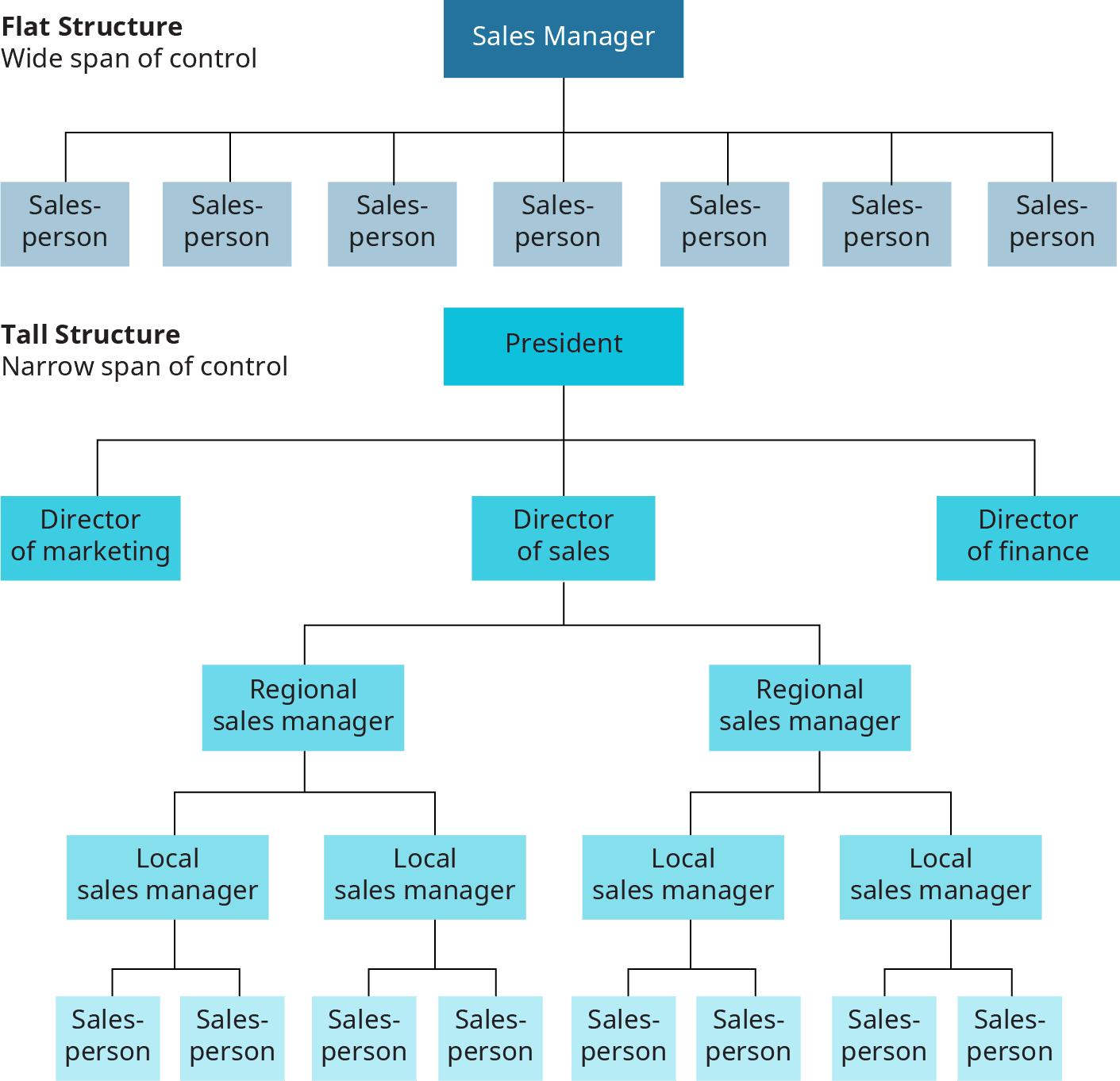
Span of control refers to how many employees a single manager directly supervises. A manager overseeing 4 people has a narrow span of control; one overseeing 20 has a wide span. Narrow spans allow closer supervision but create more management layers. Wide spans give employees more autonomy but can stretch a manager thin.
Organizational chart is the visual diagram that maps all of this out. It shows every department, position, and reporting relationship in the company. Think of it as the blueprint employees can reference to understand where they fit and who they're connected to.
Types of Departmentalization
Companies can group jobs in several different ways, and each approach comes with trade-offs. The right choice depends on the company's size, strategy, and priorities.

Functional Departmentalization
Groups jobs by business function: marketing, finance, operations, etc. This is the most common structure, especially for smaller companies. It builds deep expertise within each area and creates clear career paths (a junior accountant can see a path to CFO). The downside is that departments can become silos, where marketing and production rarely communicate, making cross-functional projects difficult.
Product Departmentalization
Groups jobs around specific products or product lines. Samsung, for example, might have separate divisions for smartphones, televisions, and home appliances. Each division can focus entirely on its product's development and customers. The trade-off is duplication: each product division may need its own marketing team, its own finance people, and so on.
Geographic Departmentalization
Groups jobs by region, such as North America, Europe, and Asia-Pacific. This works well for companies operating across diverse markets because each region can tailor its strategies to local customer preferences, regulations, and competition. The risk is inconsistency: the company might operate very differently in one region compared to another, and coordinating across regions can be challenging.

Customer Departmentalization
Groups jobs around distinct customer segments. A bank might have separate divisions for retail customers, small businesses, and corporate clients. This keeps each group laser-focused on its customers' specific needs. Like product departmentalization, it can lead to duplicated resources across segments.
Process Departmentalization
Groups jobs by stages in a production or operational process. A food manufacturer might have separate departments for receiving raw materials, processing, packaging, and shipping. Each stage develops specialized efficiency, but handoffs between stages can create bottlenecks if communication breaks down.
Matrix Structure
Combines two or more types of departmentalization at the same time. An employee might report to both a functional manager (like the head of engineering) and a product manager (like the lead on a specific project). This allows flexible resource sharing across projects, but it creates dual reporting, which can cause confusion about priorities and authority conflicts between managers.
Impact of Structures on Organizations
The structure a company chooses doesn't just organize people on a chart. It shapes how the entire organization behaves day to day.
Authority can be centralized or decentralized. In a centralized structure, top executives make most decisions. This ensures consistency but can slow things down. In a decentralized structure, decision-making authority is pushed down to managers and employees closer to the action. This speeds up responses but risks inconsistency across the organization.
Communication is heavily influenced by whether a structure is tall or flat. Tall structures have many layers of management, so a message from the front line might pass through five people before reaching a decision-maker, which slows things down and risks distortion. Flat structures have fewer layers, so communication is faster and more direct.
Efficiency depends on what the structure prioritizes. Functional structures maximize efficiency through specialization: grouping all accountants together means shared tools, shared knowledge, and economies of scale. Product and customer structures sacrifice some of that efficiency in exchange for greater responsiveness to market needs. Every structural choice involves this kind of trade-off.
Organizational culture is shaped by structure more than most people realize. A flat, decentralized structure tends to foster collaboration and employee empowerment. A tall, centralized structure tends to emphasize control and consistency. Neither is inherently better; it depends on what the company needs to succeed.
See Fiveable more often in Google
Mark Fiveable as a preferred source and Google is more likely to show you our guides in Top Stories, with a "preferred" badge in AI Mode and AI Overviews.