3.1 Global Trade in the United States

💼Intro to Business Unit 3 Review
3.1 Global Trade in the United States
💼 Intro to Business
3.1
Global Trade in the United States
3.2
Why Nations Trade
3.3
Barriers to Trade
3.4
Fostering Global Trade
3.5
International Economic Communities
3.6
Participating in the Global Marketplace
3.7
Threats and Opportunities in the Global Marketplace
3.8
The Impact of Multinational Corporations
3.9
Trends in Global Competition
Global trade has a major impact on the U.S. economy, shaping prices, job markets, and overall growth. It opens doors for American companies to reach foreign customers while also exposing domestic industries to competition from abroad.
Understanding how trade balances, currency exchange rates, and international agreements work together helps explain why certain industries thrive, why others decline, and why the price of everyday goods fluctuates.
Global Trade and the U.S. Economy

Top images from around the web for Impact of global trade on U.S. economy
The United States’ 65-Year Debt Bubble | Our Finite World View original
Is this image relevant?
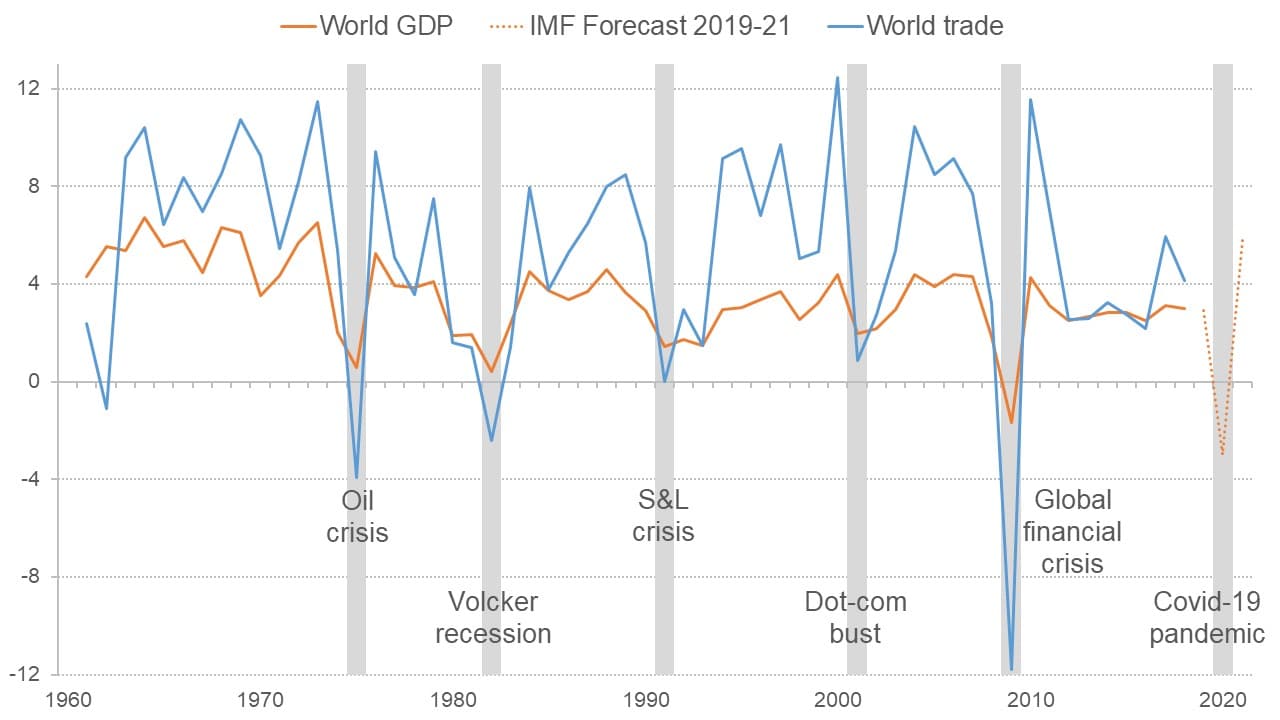
What happens to trade in a global downturn? - Economics Observatory View original
Is this image relevant?
Gains from Trade | Boundless Economics View original
Is this image relevant?
The United States’ 65-Year Debt Bubble | Our Finite World View original
Is this image relevant?
What happens to trade in a global downturn? - Economics Observatory View original
Is this image relevant?
Impact of global trade on U.S. economy
Global trade reshapes the U.S. economy in two directions at once. On one hand, competition from foreign firms pushes prices down and quality up for American consumers, especially in industries like automobiles and electronics. On the other hand, domestic companies in less competitive industries (textiles, certain types of manufacturing) can lose market share and shed jobs.
At the same time, trade creates growth. U.S. companies gain access to billions of potential customers overseas. Export-oriented industries like aerospace, pharmaceuticals, and agriculture benefit directly from this expanded market, generating jobs and revenue that wouldn't exist in a closed economy.
Comparative advantage is the idea that countries should specialize in producing goods they can make most efficiently relative to other goods. The U.S. tends to specialize in high-tech products and services, while countries like China focus on labor-intensive manufacturing. This specialization raises productivity on both sides.
Trade also shifts what kinds of jobs are available. As trade patterns change, demand for low-skilled manufacturing workers has declined, while demand for high-skilled service and technology workers has grown. These shifts don't happen evenly across regions, which is why trade can be politically contentious even when it grows the economy overall.
How trade affects GDP:
- Exports add to GDP because they represent domestic production sold abroad (agricultural products, industrial goods).
- Imports are subtracted from GDP because they represent domestic demand met by foreign production (consumer goods, raw materials).
- Net exports (exports minus imports) directly affect GDP:
- Positive net exports (trade surplus) increase GDP
- Negative net exports (trade deficit) decrease GDP
Global supply chains further complicate this picture. A single product might be designed in the U.S., assembled in Mexico with components from China, and sold in Europe. These cross-border production networks mean that trade statistics don't always capture the full story of where value is created.

Key measures of international trade
- Exports are goods and services produced domestically and sold to foreign countries (soybeans, aircraft). They contribute positively to GDP and support employment in producing industries.
- Imports are goods and services purchased from foreign countries for domestic consumption (oil, apparel). They give consumers more variety and can help keep inflation in check by increasing supply, but they subtract from GDP.
- Balance of trade is the difference between a country's exports and imports of goods and services.
- A trade surplus occurs when exports exceed imports.
- A trade deficit occurs when imports exceed exports. The U.S. has run a trade deficit for decades, meaning it imports more than it exports.
The balance of payments is a broader measure. It's a record of all international transactions a country makes over a specific period, not just trade in goods and services. It has three main accounts:
- Current account: covers trade in goods and services, income earned abroad, and current transfers (like foreign aid)
- Capital account: involves transactions of non-financial assets such as land or intellectual property
- Financial account: involves transactions of financial assets and liabilities, including foreign direct investment (a company building a factory overseas) and portfolio investment (buying foreign stocks or bonds)
The balance of trade gets the most attention in the news, but the balance of payments gives a more complete picture of a country's financial relationship with the rest of the world.

Currency exchange rates in trade
A currency exchange rate is the price of one currency expressed in terms of another. These rates are determined by supply and demand in foreign exchange markets (often called forex markets), and they have a direct effect on how competitive a country's goods are internationally.
The key relationship to remember works in two directions:
- When a currency appreciates (gains value), exports become more expensive for foreign buyers, making them less competitive. At the same time, imports become cheaper for domestic consumers. For example, if the U.S. dollar strengthens against the euro, American goods cost more in Europe, but European goods cost less in the U.S.
- When a currency depreciates (loses value), the opposite happens. Exports become cheaper and more attractive to foreign buyers, while imports become more expensive. If the Chinese yuan weakens against the dollar, Chinese goods become cheaper for American consumers.
Exchange rates can create real economic consequences over time:
- An overvalued currency can lead to persistent trade deficits because exports are too expensive and imports are too cheap (the U.S. dollar in the 1980s is a classic example).
- An undervalued currency can boost exports and improve competitiveness, but it risks causing inflation and other economic imbalances (the Chinese yuan in the 2000s).
Some governments actively intervene in forex markets to manage their currency's value. China and Japan have both done this, aiming to keep exchange rates favorable for their exporters or to control domestic inflation.
Trade agreements and policies
Trade agreements reduce barriers between countries to make international commerce easier. The most significant recent example for the U.S. is the USMCA (United States-Mexico-Canada Agreement), which replaced NAFTA in 2020. These agreements typically lower tariffs, set common standards, and establish rules for resolving disputes.
Trade policy is the broader set of tools a government uses to shape its approach to international trade. This includes setting tariffs (taxes on imports), imposing quotas (limits on import quantities), and creating regulations that affect how goods move across borders.
International trade law governs cross-border commercial transactions and provides frameworks for resolving disputes. The World Trade Organization (WTO) is the main international body that oversees trade rules between nations.
Economic sanctions are restrictions a country places on trade with another nation, typically to influence foreign policy or address issues like human rights violations. Sanctions can include trade embargoes, asset freezes, or restrictions on specific industries. They're a tool of foreign policy as much as economic policy.
See Fiveable more often in Google
Mark Fiveable as a preferred source and Google is more likely to show you our guides in Top Stories, with a "preferred" badge in AI Mode and AI Overviews.