14.7 Analyzing Financial Statements

💼Intro to Business Unit 14 Review
14.7 Analyzing Financial Statements
💼 Intro to Business
Financial Statement Analysis
Financial statement analysis helps you figure out how well a company is actually doing. By calculating key ratios from the numbers on financial statements, you can assess whether a business can pay its bills, turn a profit, handle its debt, and use its resources well.
These ratios become especially useful when you compare them to industry averages or the company's own past performance. That's how managers spot problems early and how investors decide whether a company is worth their money.

Top images from around the web for Ratio Analysis
Basic Accounting Procedures | OpenStax Intro to Business View original
Is this image relevant?
Analyzing Forecasts | Boundless Finance View original
Is this image relevant?
Ratio Analysis of Tesco Plc Financial Performance between 2010 and 2014 in Comparison to Both ... View original
Is this image relevant?
Basic Accounting Procedures | OpenStax Intro to Business View original
Is this image relevant?
Analyzing Forecasts | Boundless Finance View original
Is this image relevant?
Ratio Analysis
Ratio analysis is the process of calculating and interpreting financial ratios drawn from a company's financial statements. The audience for these ratios includes managers, investors, and creditors, each of whom cares about different aspects of performance.
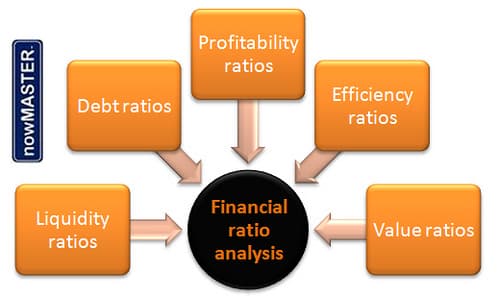
Ratios fall into four main categories:
- Liquidity — Can the company meet its short-term obligations?
- Profitability — Is the company generating adequate profits from its operations?
- Solvency — Can the company handle its long-term debt?
- Efficiency — How well is the company managing its assets and liabilities?
A single ratio on its own doesn't tell you much. The real value comes from comparison. You might compare a company's current ratio to the industry average, or track its net profit margin over the last five years. Ratios that consistently outperform benchmarks signal strengths; ratios that fall short point to areas that need attention.

Liquidity Ratios
Liquidity ratios tell you whether a company has enough short-term resources to cover its upcoming obligations. The three main liquidity ratios differ in how strictly they define "available resources."
Current Ratio measures the company's ability to pay short-term obligations using all current assets (cash, inventory, receivables, etc.):
A ratio of 1.5 or higher is generally considered healthy. For example, if a company has $300,000 in current assets and $200,000 in current liabilities, its current ratio is 1.5, meaning it has $1.50 in current assets for every $1.00 it owes short-term.
Quick Ratio (Acid-Test Ratio) is more conservative because it excludes inventory and other less-liquid current assets. It only counts cash, marketable securities, and accounts receivable:
A ratio of 1.0 or higher is generally considered good. This ratio matters most for companies whose inventory can't be sold quickly (think heavy equipment manufacturers vs. grocery stores).
Cash Ratio is the strictest test, using only cash and cash equivalents:
A higher cash ratio means stronger liquidity, but a ratio that's too high can signal that the company is sitting on cash instead of investing it productively.

Profitability Ratios
Profitability ratios measure how effectively a company turns revenue into profit. Each ratio captures a different "layer" of profitability, from the broadest (gross profit) down to the bottom line (net income).
Gross Profit Margin shows the percentage of revenue left after subtracting the cost of goods sold (COGS). It reflects pricing power and production efficiency:
A company with $800,000 in net sales and $500,000 in COGS has a gross profit of $300,000 and a gross profit margin of 37.5%.
Operating Profit Margin goes a step further by also subtracting operating expenses (rent, salaries, utilities). It tells you how well the company manages its day-to-day costs:
Net Profit Margin captures what's left after all expenses, including interest and taxes. This is the bottom-line measure of profitability:
These three margins work together. If gross margin is strong but net margin is weak, the problem likely isn't pricing or production costs; it's somewhere in operating expenses, interest payments, or taxes.
Return on Assets (ROA) measures how efficiently a company uses its total assets to generate profit:
Higher ROA means the company is squeezing more profit out of every dollar of assets it owns.
Return on Equity (ROE) measures how efficiently a company generates profit relative to shareholders' equity (the owners' investment):
ROE is one of the most-watched ratios among investors because it directly reflects the return on their investment. A company with a 15% ROE is generating $0.15 in profit for every $1.00 of shareholders' equity.
See Fiveable more often in Google
Mark Fiveable as a preferred source and Google is more likely to show you our guides in Top Stories, with a "preferred" badge in AI Mode and AI Overviews.