1.6 Microeconomics: Zeroing in on Businesses and Consumers

💼Intro to Business Unit 1 Review
1.6 Microeconomics: Zeroing in on Businesses and Consumers
💼 Intro to Business
1.1
The Nature of Business
1.2
Understanding the Business Environment
1.3
How Business and Economics Work
1.4
Macroeconomics: The Big Picture
1.5
Achieving Macroeconomic Goals
1.6
Microeconomics: Zeroing in on Businesses and Consumers
1.7
Competing in a Free Market
1.8
Trends in the Business Environment and Competition
Market dynamics drive the business world through supply and demand. These two forces determine prices and quantities of goods and services, and when they balance, the market reaches equilibrium. Understanding how this works gives you a foundation for nearly every business decision you'll encounter in this course.
External events like natural disasters, government policies, and economic shocks can knock markets out of equilibrium. When that happens, supply and demand curves shift, prices change, and businesses have to adapt. This section covers how those mechanics work and what they look like in practice.
Market Dynamics and Equilibrium

Top images from around the web for Demand and supply interaction
Supply and demand - Wikipedia View original
Is this image relevant?
File:Supply and demand curves.svg - Wikimedia Commons View original
Is this image relevant?
Consumer Choice – Introduction to Microeconomics View original
Is this image relevant?
Supply and demand - Wikipedia View original
Is this image relevant?
File:Supply and demand curves.svg - Wikimedia Commons View original
Is this image relevant?
Demand and supply interaction
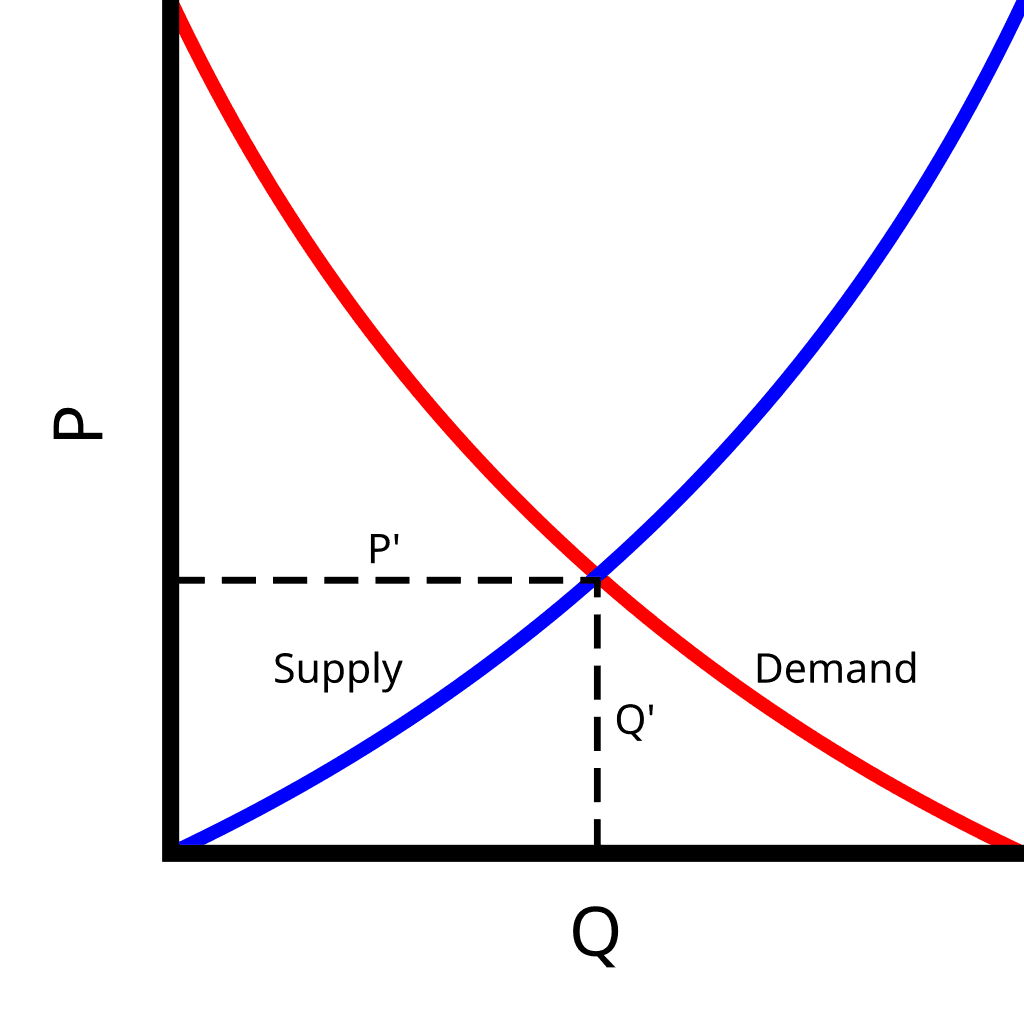
Demand is the quantity of a good or service that consumers are willing and able to buy at various prices. The law of demand says that as price goes up, the quantity people want to buy goes down, and vice versa. If you graph this relationship with price on the vertical axis and quantity on the horizontal axis, you get a downward-sloping demand curve.
Supply is the quantity of a good or service that producers are willing and able to sell at various prices. The law of supply works in the opposite direction: as price goes up, producers want to supply more (because they can earn more), and as price drops, they supply less. The supply curve slopes upward.
Market equilibrium is the point where the demand curve and supply curve cross. At this price, the quantity consumers want to buy exactly matches the quantity producers want to sell.
- Equilibrium price: the specific price where quantity demanded equals quantity supplied
- Equilibrium quantity: the amount actually bought and sold at that price
When the market price isn't at equilibrium, you get disequilibrium:
- Surplus: the price is above equilibrium, so producers supply more than consumers want to buy. Unsold goods pile up, which puts downward pressure on price.
- Shortage: the price is below equilibrium, so consumers want to buy more than producers are supplying. Think of a hot new product that sells out instantly. This puts upward pressure on price.

Factors shifting market curves
A shift in the demand or supply curve is different from a movement along the curve. A movement along the curve happens when the good's own price changes. A shift means the entire curve moves left or right because of some outside factor.
Factors that shift the demand curve:
- Consumer income: For most products (called normal goods), demand rises when people earn more. Organic food is a good example. But for inferior goods like instant ramen, demand actually falls when income rises because people switch to something better.
- Prices of related goods: Substitutes are goods you'd use in place of each other, like Pepsi and Coca-Cola. If Pepsi's price jumps, demand for Coca-Cola increases. Complements are goods used together, like smartphones and phone cases. If smartphone prices spike, demand for phone cases drops too.
- Consumer preferences and tastes: Fashion trends, health studies, or viral social media moments can all shift what people want to buy.
- Population and demographics: A growing population increases demand for housing; an aging population (like baby boomers retiring) shifts demand toward healthcare services.
- Expectations about the future: If consumers expect prices to rise next month, they may buy more now. If they anticipate a tax refund, they might spend more freely.
Factors that shift the supply curve:
- Input prices: If the cost of labor or raw materials goes up (say, a minimum wage increase), it becomes more expensive to produce goods, and supply decreases (shifts left).
- Technology and productivity: Automation in manufacturing lowers production costs and increases supply (shifts right).
- Government policies: A carbon tax raises production costs and decreases supply. A subsidy for solar panels lowers costs and increases supply.
- Prices of related goods in production: If corn prices rise because of biofuel demand, farmers may grow more corn and less of something else, reducing supply of that other crop.
- Number of suppliers: New companies entering a market increase supply; companies going out of business decrease it.
- Producer expectations: If manufacturers expect tariffs to raise costs next quarter, they might adjust production now.

Economic Concepts and Market Behavior
These core concepts come up repeatedly in microeconomics:
Scarcity is the fundamental economic problem: resources are limited, but human wants are unlimited. Every society has to make choices about how to allocate what it has.
Opportunity cost is the value of the next best alternative you give up when you make a choice. If you spend your evening studying for this class instead of working a shift that pays $50, your opportunity cost is that $50.
Utility is the satisfaction or benefit a consumer gets from consuming a good or service. Economists use this concept to explain why people make the purchasing decisions they do.
Price elasticity measures how sensitive quantity demanded (or supplied) is to a change in price. If a small price increase causes a big drop in sales, demand is elastic. If sales barely change, demand is inelastic. Gasoline tends to be inelastic because people need it regardless of price; luxury vacations tend to be elastic.
Profit maximization is the primary goal of firms. In theory, a firm maximizes profit by producing at the level where marginal revenue (the revenue from selling one more unit) equals marginal cost (the cost of producing one more unit).
Market structure describes the characteristics of a market that shape competition and pricing. The main types range from perfect competition (many sellers, identical products, no one controls price) to monopoly (one seller controls the market), with oligopoly (a few large firms dominate) in between.
Real-World Applications
External events in market dynamics
Real-world events constantly push supply and demand curves around. Here are the major categories with concrete examples:
Natural disasters disrupt supply chains and reduce the supply of affected goods, driving prices up.
- Hurricane damage to Gulf Coast oil refineries can cut gasoline supply sharply, causing price spikes at the pump nationwide.
- Droughts reduce agricultural yields. California produces about 80% of the world's almonds, so a severe drought there pushes almond prices up globally.
Government policies directly affect supply, demand, and prices.
- Subsidies for renewable energy increase the supply of solar panels and wind turbines, lowering their prices and boosting demand.
- Taxes on sugary drinks reduce demand. Mexico's soda tax, introduced in 2014, led to a measurable decline in sugary drink consumption.
Economic shocks change consumer income and spending patterns, which shifts demand.
- During the 2008 financial crisis, demand for luxury goods dropped as consumers cut back to essentials.
- During economic booms like the 1990s dot-com era, demand for high-end products surged as incomes and consumer confidence rose.
Technological advancements lower production costs and shift supply curves.
- Improvements in smartphone manufacturing have driven down production costs over time, increasing supply and making phones more affordable and accessible.
- The growth of electric vehicles has increased demand for lithium-ion batteries, pushing companies like Tesla's suppliers to scale up production.
Global trade and international events can disrupt supply chains and reshape markets.
- Trade disputes lead to tariffs on imported goods. During the US-China trade war, tariffs raised prices on thousands of products, reducing demand for those goods in affected markets.
- Geopolitical disruptions like the 2021 Suez Canal blockage (when a single container ship ran aground) delayed billions of dollars in global trade and temporarily drove up prices for affected goods.
See Fiveable more often in Google
Mark Fiveable as a preferred source and Google is more likely to show you our guides in Top Stories, with a "preferred" badge in AI Mode and AI Overviews.