4.2 Partnerships: Sharing the Load

💼Intro to Business Unit 4 Review
4.2 Partnerships: Sharing the Load
💼 Intro to Business
Partnerships
Partnerships let two or more people co-own a business, sharing profits, responsibilities, and risk. They're one of the most common ownership structures because they're relatively easy to set up and let owners combine money, skills, and effort. The tricky part is understanding which type of partnership you're dealing with, because the level of personal liability changes dramatically depending on the structure.

Top images from around the web for Key characteristics of partnerships
key partners | Value Chain Generation View original
Is this image relevant?
Reading: Sole Proprietorship and Partnerships | Introduction to Business View original
Is this image relevant?
How Limited Liability Partnership (LLP) Works? | KnowThyMoney View original
Is this image relevant?
key partners | Value Chain Generation View original
Is this image relevant?
Reading: Sole Proprietorship and Partnerships | Introduction to Business View original
Is this image relevant?
Key Characteristics of Partnerships
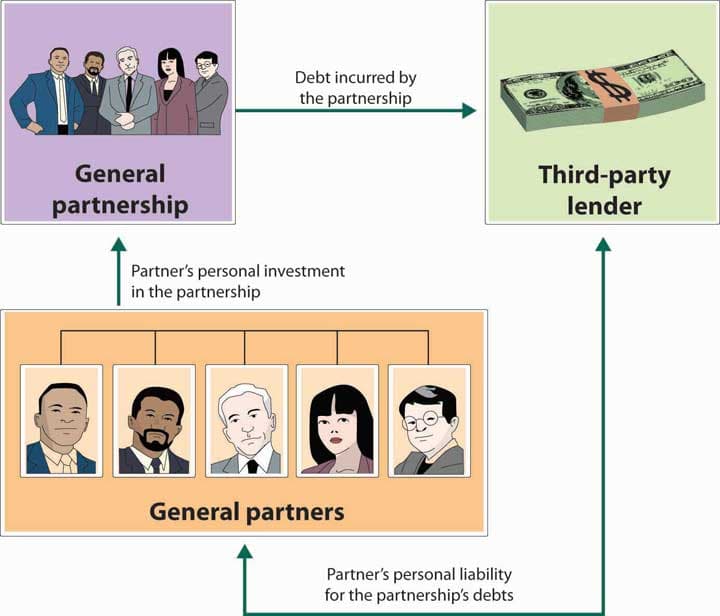
General Partnership is the simplest form. Two or more owners share management duties and split profits and losses according to their ownership percentages. The catch: every partner has unlimited personal liability, meaning creditors can go after your personal assets (house, car, savings) if the business can't pay its debts. All partners also have equal rights in running the business, from signing contracts to making daily decisions.
Limited Partnership (LP) adds a layer of protection for some partners. There must be at least one general partner who runs the business and takes on unlimited personal liability. The remaining limited partners invest money but stay out of management decisions. In exchange, their liability is capped at what they invested. You'll see LPs frequently in real estate, venture capital, and family businesses where some members want to invest without managing day-to-day operations.
Limited Liability Partnership (LLP) protects all partners from being personally responsible for another partner's mistakes or malpractice. This is why professional service firms (law firms, accounting firms, consulting firms) favor LLPs. If one partner gets sued for malpractice, the other partners' personal assets are shielded. Profit-sharing in an LLP can be based on factors like seniority, individual performance, or capital contributions.
Limited Liability Limited Partnership (LLLP) is a hybrid that blends features of LPs and LLPs. It still requires at least one general partner, but unlike a standard LP, even the general partner can receive some liability protection. The remaining partners have limited liability similar to limited partners in an LP. Not all states recognize LLLPs, so availability depends on where the business is formed.

Advantages vs. Disadvantages of Partnerships
- Advantages
- Simpler and cheaper to form and dissolve than a corporation
- Partners pool financial resources, skills, and expertise, making the business stronger than one person could alone
- Pass-through taxation: profits are taxed only once on each partner's individual tax return, avoiding the double taxation that corporations face
- Flexible management structures that partners can tailor to fit their needs
- Disadvantages
- General partners face unlimited personal liability for all business debts (this applies in general partnerships and LPs)
- Disagreements between partners can stall decisions and disrupt operations
- Harder to raise large amounts of capital compared to corporations, which can issue stock to outside investors
- A partnership can dissolve unexpectedly if a partner dies, withdraws, or goes bankrupt, unless the partnership agreement addresses these events

Components of Partnership Agreements
A partnership agreement is a written contract that spells out each partner's rights, responsibilities, and obligations. While you can operate without one, that's a recipe for conflict. Without a written agreement, state default rules apply, and those rules may not match what the partners actually intended.
A solid partnership agreement covers these key areas:
- Business name and purpose of the partnership
- Capital contributions from each partner (money, property, skills, or expertise)
- Profit and loss allocation (by ownership percentage, performance, or another agreed method)
- Roles and responsibilities for managing and operating the business
- Dispute resolution procedures, such as mediation or arbitration, so conflicts don't end up in court
- Entry and exit terms for admitting new partners or allowing current partners to withdraw
- Dissolution conditions, including what triggers the end of the partnership and how assets get distributed
Having this agreement in writing protects every partner's investment, sets clear expectations from the start, and gives the partnership a roadmap for handling problems. It also helps the business maintain continuity when changes happen, like a partner leaving or a new one joining.
Additional Partnership Considerations
- Joint ventures are temporary partnerships formed for a specific project or business opportunity. Once the project ends, so does the joint venture.
- Profit sharing can go beyond simple ownership percentages. Some partnerships use performance-based incentives to reward partners who bring in more business or contribute more work.
- Partnership dissolution is the formal process of ending a partnership. Depending on the agreement, this may require unanimous consent from all partners, and it involves settling debts and distributing remaining assets.
- Buy-sell agreements are contracts that outline what happens when a partner wants to leave, retires, or dies. They set procedures for the remaining partners to buy out that person's share, preventing outsiders from suddenly becoming co-owners.
See Fiveable more often in Google
Mark Fiveable as a preferred source and Google is more likely to show you our guides in Top Stories, with a "preferred" badge in AI Mode and AI Overviews.