6.3 Inverse Trigonometric Functions

📏Honors Pre-Calculus Unit 6 Review
6.3 Inverse Trigonometric Functions
📏 Honors Pre-Calculus
continue practicing 6.3
Multiple choice
Inverse Trigonometric Functions
Inverse trigonometric functions work in the opposite direction from regular trig functions. Instead of plugging in an angle and getting a ratio, you plug in a ratio and get an angle back. This reversal requires restricting domains and ranges to keep the functions well-defined, and it shows up constantly in physics, engineering, and navigation whenever you need to find an unknown angle.
Inverse Trigonometric Functions
Inverse trigonometric function applications
Inverse trig functions reverse what standard trig functions do. A regular trig function takes an angle and returns a ratio of sides. An inverse trig function takes that ratio and returns the angle.
- Denoted as , , or equivalently , ,
- They answer the question: what angle produces this ratio?
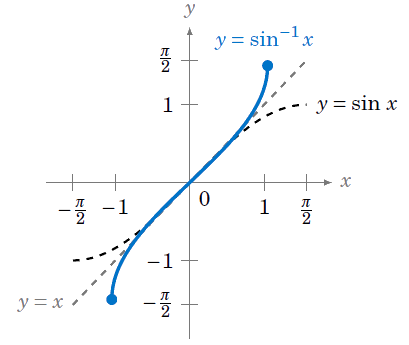
Because trig functions are periodic (they repeat), they aren't one-to-one over their full domains. To create true inverse functions, you have to restrict the output to a specific interval. These restricted ranges are something you need to memorize:
- (quadrants I and IV)
- (quadrants I and II)
- (quadrants I and IV, open interval since the endpoints are never reached)
Notice that and only accept inputs between and , since sine and cosine never produce values outside that range. accepts any real number because tangent can output any real value.
Where these show up:
- Physics: finding the launch angle in projectile motion, or the angle of an inclined plane
- Engineering: determining angles in structural supports or phase angles in circuits
- Navigation: calculating bearing angles and course corrections
Exact values of inverse expressions
You should be able to evaluate inverse trig functions at common values without a calculator. These all come from the unit circle angles you already know.
- , , ,
- , , ,
- , , ,
The trick is to ask yourself: what angle in the restricted range has this trig value? For example, because and falls within .
Two useful identities for simplifying expressions:
- for all
- for
These can save time on problems where you know one inverse value and need the other.
Technology for inverse trig analysis
Graphing these functions helps you see the domain and range restrictions visually.
- The graph of is an increasing curve from to
- The graph of is a decreasing curve from to
- The graph of has horizontal asymptotes at and (not vertical asymptotes; the original guide had this wrong)
On a scientific calculator, look for the , , and buttons (usually accessed with a shift or second-function key). Make sure your calculator is set to radian mode when working with radian answers.

Composite functions with inverse trig
Composite functions apply two functions in sequence: . You always evaluate the inner function first, then feed that result into the outer function.
Example 1: Evaluating a composite
If and , find :
- Evaluate the inner function:
- Apply the outer function:
- So
Example 2: Solving an equation
Solve :
- Apply to both sides to cancel the :
- Simplify:
- Solve:
Always check that your answer keeps the argument of the inverse trig function within its domain. In this case, , and is defined, so is valid.
A common type of composite to watch for: expressions like . You can evaluate these by drawing a right triangle where the known inverse trig value defines one angle, then reading off the ratio you need from the triangle.
Inverse Functions and Radian Measure
- Inverse trig functions "undo" their corresponding trig functions, but only over the restricted ranges listed above. Outside those ranges, the cancellation doesn't work directly.
- Radian measure is the standard for inverse trig outputs. Unless a problem specifically asks for degrees, give your answers in radians.
- The unit circle ties everything together: the exact values, the range restrictions, and the geometric meaning of each inverse function all come from understanding where angles and coordinates sit on the unit circle.
See Fiveable more often in Google
Mark Fiveable as a preferred source and Google is more likely to show you our guides in Top Stories, with a "preferred" badge in AI Mode and AI Overviews.