9.3 Systems of Nonlinear Equations and Inequalities: Two Variables

📏Honors Pre-Calculus Unit 9 Review
9.3 Systems of Nonlinear Equations and Inequalities: Two Variables
📏 Honors Pre-Calculus
9.1
Systems of Linear Equations: Two Variables
9.2
Systems of Linear Equations: Three Variables
9.3
Systems of Nonlinear Equations and Inequalities: Two Variables
9.4
Partial Fractions
9.5
Matrices and Matrix Operations
9.6
Solving Systems with Gaussian Elimination
9.7
Solving Systems with Inverses
9.8
Solving Systems with Cramer's Rule
continue practicing 9.3
Multiple choice
Solving Systems of Nonlinear Equations
Solving nonlinear equation systems
A nonlinear system contains at least one equation that isn't a straight line. Think parabolas, circles, ellipses, or any equation where a variable is raised to a power other than 1 (or where variables are multiplied together). The goal is the same as with linear systems: find the ordered pair(s) that satisfy all equations at once.
Substitution Method
This is usually your go-to approach, especially when one equation is already solved for a variable (or can be easily rearranged).
- Isolate one variable in whichever equation makes it easiest (e.g., solve , which is already isolated for ).
- Substitute that expression into the other equation. This gives you a single equation in one variable.
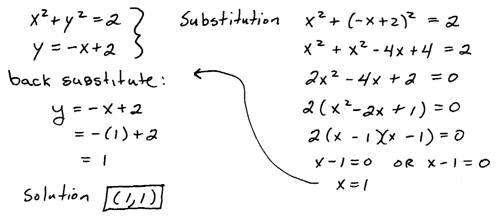
- Solve the resulting equation. You may get 0, 1, or multiple solutions depending on the curves involved.
- Plug each solution back into the isolation equation from Step 1 to find the corresponding value of the other variable.
- Write your answers as ordered pairs and verify them in both original equations.
Example: Solve and . Substitute: . So or , giving solutions and .
Elimination Method
Elimination works well when both equations have a matching term you can cancel out, such as or .
- Multiply one or both equations by constants so that one variable's terms have equal (or opposite) coefficients.
- Add or subtract the equations to eliminate that variable.
- Solve for the remaining variable.
- Substitute back into either original equation to find the other variable.
Example: Solve and . From the second equation, . Substitute into the first: , which simplifies to . Factor or use the quadratic formula from there.
One thing to watch for: nonlinear systems can have no solution, one solution, or several solutions. A line and a parabola can intersect at 0, 1, or 2 points. Two circles can intersect at 0, 1, or 2 points. Always check how many valid answers you get.
Graphing of nonlinear inequalities
Graphing a nonlinear inequality is similar to graphing a linear inequality, but the boundary is a curve instead of a line.
-
Graph the boundary curve by treating the inequality as an equation (e.g., graph for the inequality ).
- Use a solid curve for or (boundary included).
- Use a dashed curve for or (boundary not included).
-
Pick a test point not on the boundary (the origin works if it's not on the curve). Plug it into the inequality.
-
If the test point satisfies the inequality, shade the region containing that point. If not, shade the opposite side.
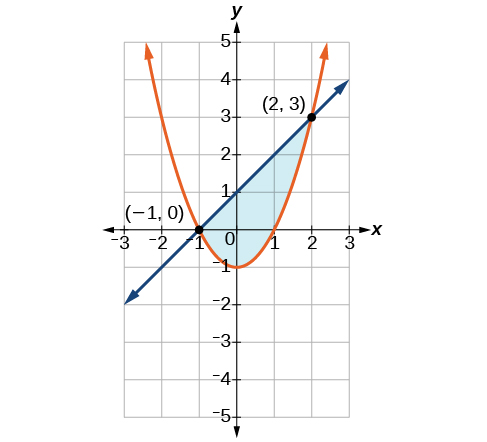
For a system of nonlinear inequalities, graph each inequality separately and then identify the overlapping shaded region. That overlap is your solution set.
A few orientation tips:
- : shade below the parabola (inside the "bowl")
- : shade above the parabola (outside the "bowl")
- : shade inside the circle
- : shade outside the circle
Interpretation of nonlinear solutions
Solutions to nonlinear systems have both a geometric and algebraic meaning.
Geometrically, each solution to a system of equations corresponds to an intersection point of the curves on the graph. For a system of inequalities, the solution set is the region where all shaded areas overlap.
Algebraically, each solution is an ordered pair that makes every equation (or inequality) in the system true when you substitute the values in. Always verify by plugging your answers back into all original equations, since the algebra with nonlinear systems can produce extraneous solutions.
Applications of nonlinear systems
Real-world problems often involve nonlinear relationships. Projectile motion, area constraints, and supply-demand curves are common examples. Here's a general approach:
- Identify the unknowns and assign variables.
- Translate the problem's conditions into equations or inequalities. Look for squared terms (area, distance formulas) or other nonlinear relationships.
- Solve the system using substitution, elimination, or graphing.
- Interpret your answers in context. Discard solutions that don't make physical sense (negative lengths, for instance), and include appropriate units (, , etc.).
Types of nonlinear equations and solution methods
Different types of curves show up in these systems, and recognizing them helps you choose a strategy:
- Quadratic equations () produce parabolas. These are the most common nonlinear equations you'll see in systems.
- Circles follow the form , where is the center and is the radius.
- Ellipses and hyperbolas can also appear, following their standard forms.
When deciding between methods:
- Substitution is best when one equation is easily solved for a single variable.
- Elimination is best when both equations share a common term like or that you can cancel.
- Graphing gives a visual estimate and helps you confirm how many solutions to expect, but it's rarely precise enough on its own for exact answers.
See Fiveable more often in Google
Mark Fiveable as a preferred source and Google is more likely to show you our guides in Top Stories, with a "preferred" badge in AI Mode and AI Overviews.