5.3 The Other Trigonometric Functions

📏Honors Pre-Calculus Unit 5 Review
5.3 The Other Trigonometric Functions
📏 Honors Pre-Calculus
continue practicing 5.3
Multiple choice
Trigonometric Functions
This section covers the four "other" trig functions: tangent, cotangent, secant, and cosecant. You already know sine and cosine; these four are built directly from them using reciprocal and quotient relationships. Their exact values, sign behavior across quadrants, and key identities show up throughout pre-calc and calculus.
Exact Values of Trigonometric Functions
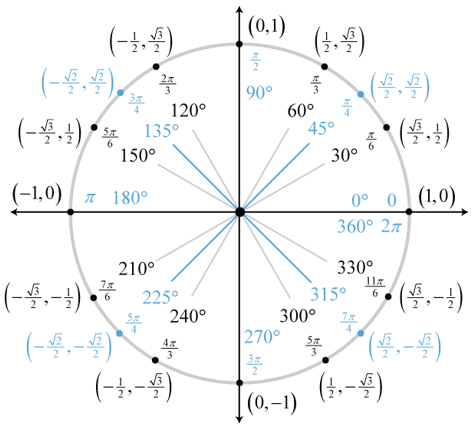
The fastest way to find exact values of these functions is to start from the sine and cosine values you already know from the unit circle, then apply the reciprocal and quotient relationships.
Tangent () is the ratio of sine to cosine, which in a right triangle equals opposite over adjacent:
- (30° angle)
- (45° angle)
- (60° angle)
Cotangent () is the reciprocal of tangent (adjacent over opposite):
Secant () is the reciprocal of cosine (hypotenuse over adjacent):
Cosecant () is the reciprocal of sine (hypotenuse over opposite):
The unit circle ties all of this together. If you know that at the coordinates are , you can derive every one of these values on the spot using the reciprocal and quotient definitions.
Reference Angles in Trigonometry
A reference angle is the acute angle (between 0 and ) formed between the terminal side of your angle and the x-axis. It lets you reuse the first-quadrant values you've memorized for angles in any quadrant.
To find a reference angle:
-
Determine which quadrant the angle falls in.
-
Find the acute angle between the terminal side and the nearest part of the x-axis:
- Quadrant I: reference angle = the angle itself
- Quadrant II: reference angle =
- Quadrant III: reference angle =
- Quadrant IV: reference angle =
-
Evaluate the trig function at the reference angle, then attach the correct sign based on the quadrant.
Here's how the signs work for each function by quadrant:
- Tangent and cotangent: positive in Quadrants I and III, negative in Quadrants II and IV. (Both depend on the sine/cosine ratio, and both sine and cosine are negative in QIII, making their ratio positive.)
- Secant (reciprocal of cosine): positive in Quadrants I and IV, negative in Quadrants II and III. Follows cosine's sign.
- Cosecant (reciprocal of sine): positive in Quadrants I and II, negative in Quadrants III and IV. Follows sine's sign.
A common mnemonic is "All Students Take Calculus" (All trig positive in QI, Sine/csc in QII, Tan/cot in QIII, Cos/sec in QIV).
Even vs. Odd Trigonometric Functions
Knowing whether a trig function is even or odd helps you simplify expressions with negative angles.
Even functions satisfy . Their graphs are symmetric about the y-axis.
Odd functions satisfy . Their graphs are symmetric about the origin (a 180° rotation looks the same).
A quick way to remember: cosine and its reciprocal (secant) are the only even ones. Everything else is odd.

Trigonometric Identities
Fundamental Trigonometric Identities
These identities show up constantly in simplification problems and proofs. You should know them cold.
Reciprocal identities connect each function to its reciprocal pair:
Quotient identities define tangent and cotangent in terms of sine and cosine:
Pythagorean identities are derived from by dividing through:
- (divide the first identity by )
- (divide the first identity by )
You don't need to memorize all three Pythagorean identities separately. If you remember the first one, you can derive the other two in seconds by dividing.
Calculator Use for Trigonometric Functions
A few practical tips to avoid common mistakes:
- Check your angle mode. Before evaluating anything, confirm whether your calculator is set to degrees or radians. Getting this wrong is the single most common calculator error in trig. Look for a DEG or RAD indicator on the display.
- Use reciprocals for csc, sec, and cot. Most calculators don't have dedicated buttons for these. To find , compute . Same idea for and .
- Watch out for undefined values. If you try to evaluate or , you'll get an error because you're dividing by zero. That's not a calculator glitch; the function genuinely doesn't exist at that input.
- Use exact values when possible. For standard angles (multiples of and ), your teacher will usually want exact answers like rather than decimal approximations like 1.732.
Advanced Trigonometric Concepts
Periodic Functions and Graphing Techniques
All six trig functions are periodic, meaning they repeat their values at regular intervals.
- Sine, cosine, secant, and cosecant have a period of .
- Tangent and cotangent have a period of (they repeat twice as fast).
The period of a function is the smallest positive value such that for all in the domain.
When graphing transformed trig functions, identify these features in order:
- Amplitude (for sine and cosine only): the distance from the midline to a peak. Secant, cosecant, tangent, and cotangent don't have a true amplitude.
- Period: determined by the coefficient of inside the function. For , the period is .
- Vertical shift: moves the entire graph up or down.
- Phase shift: a horizontal translation determined by what's added or subtracted inside the argument.
Inverse Trigonometric Functions
Inverse trig functions let you work backward: given a ratio, find the angle.
- or : returns an angle in
- or : returns an angle in
- or : returns an angle in
The domains and ranges are restricted so that each inverse function gives exactly one output. Without these restrictions, they wouldn't be functions (since, for example, and both equal ).
Be careful with notation: means the inverse sine function, not . That reciprocal is .