9.2 Systems of Linear Equations: Three Variables

📏Honors Pre-Calculus Unit 9 Review
9.2 Systems of Linear Equations: Three Variables
📏 Honors Pre-Calculus
9.1
Systems of Linear Equations: Two Variables
9.2
Systems of Linear Equations: Three Variables
9.3
Systems of Nonlinear Equations and Inequalities: Two Variables
9.4
Partial Fractions
9.5
Matrices and Matrix Operations
9.6
Solving Systems with Gaussian Elimination
9.7
Solving Systems with Inverses
9.8
Solving Systems with Cramer's Rule
continue practicing 9.2
Multiple choice
Solving Systems of Linear Equations with Three Variables
Solving three-variable linear systems
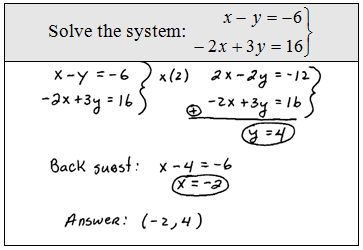
Three-variable systems work the same way as two-variable systems, just with an extra variable () and an extra equation. The goal is to reduce the system down to something you already know how to solve. Two methods show up most often.
Elimination method:
- Pick a variable to eliminate first (say ).
- Multiply equations by constants so that when you add or subtract two of them, cancels out. Do this with two different pairs of equations to get two new equations in just and .
- Solve that two-variable system using elimination or substitution.
- Substitute your values for and back into any original equation to find .
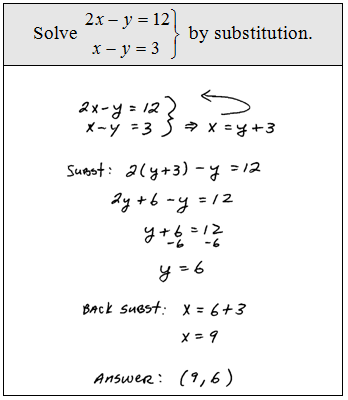
Substitution method:
- Solve one equation for one variable in terms of the other two (e.g., solve for ).
- Substitute that expression into the other two equations. You now have a two-variable system.
- Solve the two-variable system.
- Plug those values back into your expression from step 1 to find the third variable.
Both methods should give you the same answer. For example, a system might have the solution . Always check your solution by substituting all three values into every original equation.
The term "linear combination method" just refers to adding multiples of equations together, which is really what elimination does. You'll see these terms used interchangeably.
Consistency of three-equation systems
Each equation in a three-variable system represents a plane in 3D space. The solution to the system is wherever all three planes meet. There are three possible outcomes:
- Consistent with a unique solution: The three planes intersect at exactly one point.
- Example: , , has the unique solution .
- Inconsistent (no solution): The three planes never all meet at the same place. When you try to solve the system, you'll hit a contradiction like .
- Example: , , . The first equation says , but the second says . Those can't both be true.
- Dependent (infinitely many solutions): At least one equation is a multiple or combination of the others, so you effectively have fewer than three independent equations. The planes overlap along a line or coincide entirely.
- Example: , , . All three equations simplify to , so any point on that plane is a solution.
Interpreting Solutions for Dependent Systems
Solutions for dependent linear systems
When a system is dependent, you can't pin down a single answer. Instead, you express the solution set using parameters (free variables, usually called or ).
How this works depends on how many independent equations you actually have:
- Two independent equations (solution is a line): Set one variable equal to and express the other two in terms of .
- Example: If reducing the system gives you and with , the full solution is for any real number . Each value of gives a different point on the line.
- One independent equation (solution is a plane): You need two parameters. Set two variables free and express the third.
- Example: The system , , reduces to just . The solution is for any real values of and .
Every point in the parametric solution satisfies all three original equations. You can verify this by plugging a specific parameter value back in.
Matrix Representation and Analysis
Matrices give you a compact way to organize and solve these systems.
- The coefficient matrix holds just the coefficients of , , and from each equation. The augmented matrix includes the constants on the right side as well.
- Using row operations, you can reduce the augmented matrix to reduced row echelon form (RREF). This is equivalent to doing elimination but in a more systematic format.
- The rank of the coefficient matrix tells you how many independent equations you have. If the rank equals 3, there's a unique solution. If the rank is less than 3, the system is either dependent or inconsistent (compare the rank of the coefficient matrix to the rank of the augmented matrix to tell which).
- A homogeneous system is one where every equation equals zero (e.g., ). Homogeneous systems always have at least the trivial solution , so they're never inconsistent.
See Fiveable more often in Google
Mark Fiveable as a preferred source and Google is more likely to show you our guides in Top Stories, with a "preferred" badge in AI Mode and AI Overviews.