11.4 Series and Their Notations

📏Honors Pre-Calculus Unit 11 Review
11.4 Series and Their Notations
📏 Honors Pre-Calculus
continue practicing 11.4
Multiple choice
Series Notation and Formulas
Series notation gives you a compact way to write sums that would otherwise take up an entire page. Instead of writing out dozens (or infinitely many) terms, you use sigma notation to express the whole thing in a single expression. The formulas in this section let you calculate those sums without adding every term individually.
Summation notation for series
Summation notation uses the Greek letter sigma () to represent the sum of a series of terms. Here's how to read it:
- The index of summation (usually , , or ) is the variable that changes with each term.
- The lower limit appears below the symbol and tells you where to start.
- The upper limit appears above and tells you where to stop.
- The general term is the expression to the right of that depends on the index.
For example, means "plug in into and add the results," giving you .
Sigma notation can represent finite series (fixed number of terms) or infinite series (upper limit is ).
A partial sum is the sum of the first terms of a series, written .
Three properties make sigma notation easier to manipulate:
- Constant multiple rule:
- Sum rule:
- Difference rule:
These work just like distributing and splitting apart regular addition. You can factor constants out of a summation and break a sum of two expressions into two separate sums.
Arithmetic series sum formula
An arithmetic series is the sum of terms in an arithmetic sequence, where each term differs from the previous one by a constant called the common difference ().
The general term is:
To find the sum of the first terms, use either form of the formula:
This version is convenient when you already know the last term . If you don't, substitute the general term formula to get the equivalent version:
Example: Find the sum of the first 20 terms of the arithmetic series where and .
- You know , , and .
- Plug into the formula:
- Simplify:
The intuition behind the formula: you're taking the average of the first and last terms, then multiplying by how many terms there are.
Finite geometric series sums
A geometric series is the sum of terms in a geometric sequence, where each term is found by multiplying the previous one by a constant called the common ratio ().
The general term is:
The sum of the first terms of a finite geometric series (where ) is:
Example: Find the sum of the first 6 terms of the geometric series where and .
- Identify: , , .
- Plug in:
A common mistake: forgetting that the exponent on is (the number of terms), not like in the general term formula.
Convergent infinite geometric series
When a geometric series goes on forever, it can either converge (approach a finite sum) or diverge (grow without bound).
The rule is straightforward:
- If , the series converges.
- If , the series diverges (no finite sum exists).
When , each successive term gets smaller and smaller, so the total approaches a limit. The sum of a convergent infinite geometric series is:
Steps to evaluate an infinite geometric series:
- Identify the first term and the common ratio .
- Check whether .
- If yes, calculate . If no, state that the series diverges.
Example: Find the sum of .
Here and . Since , the series converges:

Annuities and compound interest applications
Series show up naturally in finance. Whenever you make repeated payments or earn interest over time, you're dealing with geometric series.
Compound interest calculates the future value of a single lump sum:
where is the principal (initial amount), is the annual interest rate (as a decimal), is the number of compounding periods per year, and is the number of years.
An annuity is a series of equal payments made at regular intervals. Two key formulas:
Future value of an annuity (how much you'll have after making regular deposits):
Present value of an annuity (how much a stream of future payments is worth right now):
In both formulas, is the periodic payment amount. The connection to geometric series: each payment earns interest for a different length of time, and summing all those values uses the finite geometric series formula.
Special Series Types
These series types come up less frequently at this level, but they're worth recognizing:
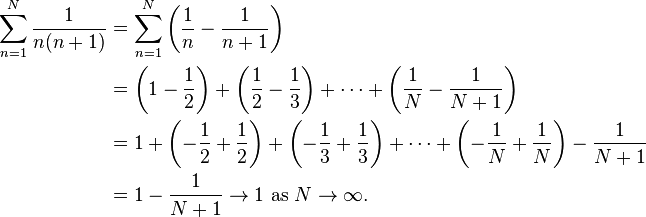
- Telescoping series: Most terms cancel with adjacent terms when you write out the partial sums, leaving only a few terms at the beginning and end. For example, simplifies to because nearly everything cancels.
- Harmonic series: The series diverges, even though the terms approach zero. This is a classic example showing that terms getting smaller doesn't guarantee convergence.
- Power series: An infinite series of the form , where the sum depends on the value of . You'll work with these more in calculus, but they build directly on the geometric series concepts here.
See Fiveable more often in Google
Mark Fiveable as a preferred source and Google is more likely to show you our guides in Top Stories, with a "preferred" badge in AI Mode and AI Overviews.