3.5 Dividing Polynomials

📏Honors Pre-Calculus Unit 3 Review
3.5 Dividing Polynomials
📏 Honors Pre-Calculus
continue practicing 3.5
Multiple choice
Polynomial Division
Polynomial division extends the long division you already know from arithmetic into the world of polynomials. It's a core technique for simplifying expressions, finding factors, and analyzing polynomial behavior, all of which come up repeatedly in later units and in calculus.
Two main methods handle this: long division (works for any divisor) and synthetic division (a faster shortcut when the divisor is linear). Both rely on the same underlying relationship between dividend, divisor, quotient, and remainder.
Long Division of Polynomials
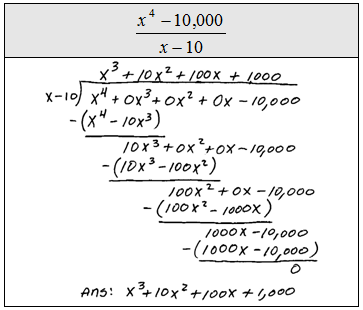
Long division of polynomials works just like dividing whole numbers. You repeatedly divide, multiply, subtract, and bring down until you've worked through every term.
The Division Algorithm:
where is the dividend, is the divisor, is the quotient, and is the remainder. The degree of is always less than the degree of . If the remainder is zero, the divisor divides evenly into the dividend.
Step-by-step process:
- Write the dividend and divisor in standard form (descending powers). If any powers are missing, insert them with a coefficient of 0.
- Divide the leading term of the dividend by the leading term of the divisor. Write the result above the division bar.
- Multiply the entire divisor by that result.
- Subtract the product from the current dividend. Be careful with signs here; this is the most common place for errors.
- Bring down the next term.
- Repeat steps 2–5 until the degree of what remains is less than the degree of the divisor. Whatever is left is your remainder.
Example: Divide by .
- Divide . Multiply: . Subtract: . Bring down .
- Divide . Multiply: . Subtract: . Bring down .
- Divide . Multiply: . Subtract: .
Result: with remainder , or equivalently: .
Common mistake: Forgetting to insert placeholder terms. If you're dividing by something, rewrite it as before starting.

Synthetic Division for Linear Factors
Synthetic division is a streamlined shortcut that only works when the divisor is a linear factor of the form . It skips the variable writing entirely and operates on coefficients alone, making it faster and less error-prone.
Step-by-step process:
- Write the coefficients of the dividend in descending order of degree. Include 0 for any missing terms.
- Identify from the divisor . If your divisor is , then . Write to the left.
- Bring down the leading coefficient to the bottom row.
- Multiply by that bottom-row value and write the product under the next coefficient.
- Add the column (the original coefficient plus the product from step 4). Write the sum in the bottom row.
- Repeat steps 4–5 for each remaining coefficient.
- The bottom row gives the coefficients of the quotient (which is one degree lower than the dividend), and the last number is the remainder.
Example: Divide by .
Set and list coefficients: .
| Multiply by 3 | ||||
| Bottom row |
The quotient is with remainder .
When to use which method:
- Use synthetic division whenever the divisor is linear . It's faster and cleaner.
- Use long division when the divisor has degree 2 or higher (like ), since synthetic division doesn't apply in those cases.
Applications in Area and Volume
Polynomial division shows up in geometry problems where dimensions are expressed as polynomials.
- Area problems: If the area of a rectangle is given as a polynomial and one side length is known, divide the area polynomial by the known dimension to find the other.
- Volume problems: For a rectangular prism, . If the volume is a polynomial and two dimensions are known, divide the volume by the product of those two dimensions to find the third.
Example: A rectangular prism has volume , length , and width . To find the height:
- Multiply the length and width: .
- Divide the volume by this product using long division: .
- The quotient gives the height polynomial.
Since the divisor is degree 2, you'd need long division here rather than synthetic division.
Connecting Division to Rational Functions and Factoring
A few broader connections worth knowing:
- Rational functions are formed when one polynomial is divided by another, written as a fraction like . Performing the division can reveal the end behavior of the rational function (the quotient becomes the slant or polynomial asymptote).
- Factoring connection: If dividing by gives a remainder of 0, then is a factor of . This ties directly to the Remainder Theorem, which states that equals the remainder when is divided by . Synthetic division is one of the fastest ways to test potential factors.
- Factor Theorem: A special case of the Remainder Theorem. If , then is a factor. You'll use this constantly when finding roots of higher-degree polynomials.
See Fiveable more often in Google
Mark Fiveable as a preferred source and Google is more likely to show you our guides in Top Stories, with a "preferred" badge in AI Mode and AI Overviews.