12.1 Finding Limits: Numerical and Graphical Approaches

📏Honors Pre-Calculus Unit 12 Review
12.1 Finding Limits: Numerical and Graphical Approaches
📏 Honors Pre-Calculus
continue practicing 12.1
Multiple choice
Limits are a fundamental concept in calculus, helping us understand function behavior near specific points. They describe what happens as we get closer and closer to a value, even if the function isn't defined there.
Numerical and graphical approaches offer practical ways to explore limits. By using tables of values or examining function graphs, you can estimate limits and gain insights into function behavior, continuity, and potential discontinuities.
Limits: Numerical and Graphical Approaches
Limit notation interpretation
The notation means that the function approaches the value as the input gets closer to . This describes the function's behavior near , not necessarily the value of itself. The function doesn't even need to be defined at for the limit to exist.
- Example: , even though is undefined. If you factor the numerator, you get , which simplifies to for all . As approaches 2, that expression approaches 4.
One-sided limits consider the function's behavior when approaching from only one direction:
- Left-hand limit : examines function values as approaches from values smaller than
- Right-hand limit : examines function values as approaches from values larger than
- Example: For , and . Since the two sides disagree, the two-sided limit does not exist.
Limit laws let you break apart limits involving arithmetic operations, provided the individual limits exist:
- Sum/Difference:
- Product:
- Quotient: , provided
- Composition: , provided is continuous at
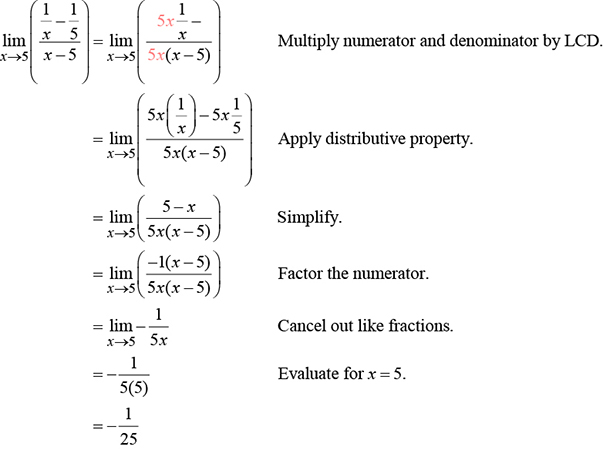
Graphical analysis for limits
Graphically, exists if the graph of approaches the same -value as approaches from both the left and right. The function does not need to be defined at for the limit to exist. You might see an open circle (hole) on the graph at that point, and the limit can still be perfectly well-defined.
- Example: simplifies to for . The graph looks like the line with a hole at , so even though is undefined.
Types of limit behavior you'll see on graphs:
- Finite limits: The graph settles toward a specific finite value. For instance, .
- Infinite limits: The graph grows without bound near , often signaling a vertical asymptote. For example, . (Note: we say the limit "does not exist" as a finite number, but we can describe the behavior as approaching infinity.)
- Limit does not exist (DNE): This happens when the left-hand and right-hand limits disagree (a jump discontinuity), or when the graph oscillates without settling down near .
- Example: For , the left-hand limit at 0 is 0 and the right-hand limit is 1, so does not exist.
Continuity at a point ties limits and function values together. A function is continuous at when three conditions are met:
- is defined
- exists
For example, is continuous at because .
The Intermediate Value Theorem (IVT) says that if a function is continuous on a closed interval , then it takes on every value between and at least once. This is useful for showing that solutions to equations exist within an interval, even when you can't solve for them directly.

Numerical approximation of limits
Tables give you a hands-on way to estimate limits by plugging in values that get closer and closer to the point of interest. Here's the process:
- Choose -values approaching from both sides (e.g., for : use from the left and from the right)
- Calculate the corresponding value for each chosen
- Look at the trend: if the values from both sides are converging toward the same number, that's your estimated limit
For example, to approximate :
| 1.9 | 1.99 | 1.999 | 2.001 | 2.01 | 2.1 | |
|---|---|---|---|---|---|---|
| 3.9 | 3.99 | 3.999 | 4.001 | 4.01 | 4.1 |
The values clearly approach 4 from both sides, so we estimate the limit is 4.
One-sided limits can be approximated the same way by only choosing values from one direction:
- Left-hand limit: pick -values slightly less than
- Right-hand limit: pick -values slightly greater than
Limitations of the numerical approach:
- Tables give estimates, not exact values. You're observing a trend, not proving a result.
- Some functions behave erratically near the point of interest, making the trend hard to read. For instance, oscillates wildly as approaches 0, so no table will show a clear pattern (this limit does not exist).
- Very slowly converging limits, like , require extremely large -values before the trend becomes apparent (this one converges to ).
Function properties and limits
- Domain is the set of all input values for which a function is defined. Knowing the domain helps you spot where limits might involve undefined points, holes, or asymptotes.
- Range is the set of all output values a function can produce. The range can give you a sense of what limit values are plausible and how the function behaves overall.
Both properties are worth checking before you start evaluating limits, since they tell you where to expect trouble spots in the function's behavior.
See Fiveable more often in Google
Mark Fiveable as a preferred source and Google is more likely to show you our guides in Top Stories, with a "preferred" badge in AI Mode and AI Overviews.