3.2 Acid and base strength, Ka and Kb

⏱️General Chemistry II Unit 3 Review
3.2 Acid and base strength, Ka and Kb
⏱️ General Chemistry II
Acids and bases are central to chemistry, and their strength determines how they behave in solution. Strong acids and bases fully dissociate in water, while weak ones only partially dissociate, setting up an equilibrium between the intact molecule and its ions.
Understanding acid and base strength is crucial for predicting chemical reactions. The dissociation constants and let you quantitatively compare the strength of different acids and bases, and they reveal how conjugate pairs will behave.
Acid and Base Strength

Top images from around the web for Strong vs weak acids and bases
14.3 Percent Ionization and Relative Strengths of Acids and Bases | Chemistry View original
Is this image relevant?
14.3 Relative Strengths of Acids and Bases – General Chemistry 1 & 2 View original
Is this image relevant?
Strong Acids | Introduction to Chemistry View original
Is this image relevant?
14.3 Percent Ionization and Relative Strengths of Acids and Bases | Chemistry View original
Is this image relevant?
14.3 Relative Strengths of Acids and Bases – General Chemistry 1 & 2 View original
Is this image relevant?
Strong vs weak acids and bases
The key distinction here is how completely an acid or base ionizes when dissolved in water.
Strong acids and bases completely ionize in aqueous solution. There's no equilibrium to speak of; the reaction goes entirely to products:
Weak acids and bases only partially ionize. Most of the molecules remain in their undissociated form, and the system reaches an equilibrium that favors the reactant side:
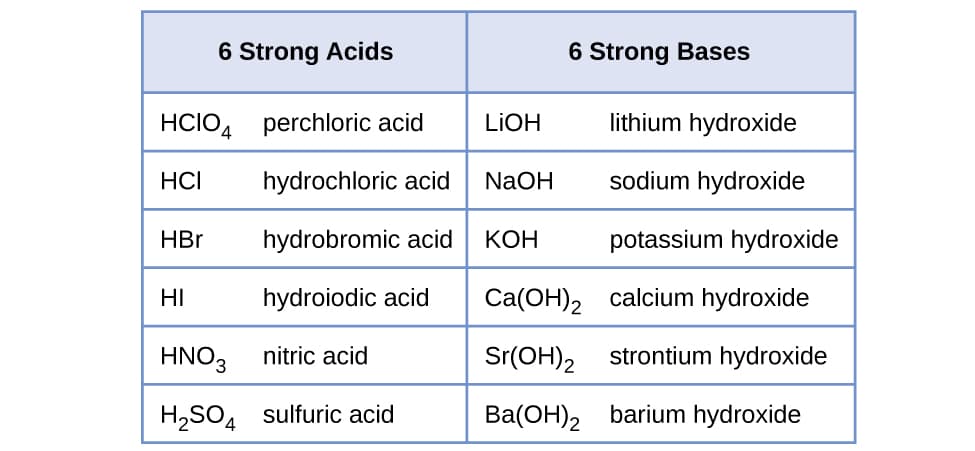
Common strong acids you should know:
- (hydrochloric acid), (sulfuric acid), (nitric acid), (hydrobromic acid), (hydroiodic acid), (perchloric acid)
Common strong bases:
- (sodium hydroxide), (potassium hydroxide), (calcium hydroxide)
Common weak acids:
- (acetic acid, ), (hydrofluoric acid, ), (carbonic acid)
Common weak bases:
- (ammonia, ), (methylamine), (pyridine)

Acid and base dissociation constants
Since strong acids and bases dissociate completely, and are most useful for characterizing weak acids and bases. These constants tell you where the equilibrium lies.
Acid dissociation constant () is the equilibrium constant for a weak acid donating a proton to water:
Water is the solvent, so its concentration is incorporated into the constant and doesn't appear in the expression. A larger means more of the acid has dissociated at equilibrium, which means a stronger acid.
Base dissociation constant () is the equilibrium constant for a weak base accepting a proton from water:
Same logic: a larger means more dissociation and a stronger base.

Relationship of Ka and Kb to strength
Acid strength is directly proportional to . For example, has , while has . Since has the larger , it's the stronger acid: more molecules dissociate, producing a higher concentration.
Base strength works the same way with . Methylamine () is a much stronger base than ammonia ().
There's also an important inverse relationship between conjugate pairs:
- A stronger acid produces a weaker conjugate base. is a strong acid, so is an extremely weak base (essentially neutral in water).
- A weaker acid produces a stronger conjugate base. is a weak acid, so is a measurably basic anion.
This inverse relationship is quantified by the equation:
This means if you know for an acid, you can calculate for its conjugate base, and vice versa.
Predicting strengths with Ka and Kb
To compare acid or base strength using dissociation constants:
- To rank acids, compare their values directly. The acid with the larger is stronger. For example, () is stronger than ().
- To rank bases, compare their values. () is a much stronger base than ().
- To predict conjugate pair behavior, use . If has , then its conjugate base has . The small confirms that is a weak base.
- To predict which side of a reaction is favored, the equilibrium favors the side with the weaker acid and weaker base. The stronger acid will donate its proton to the stronger base, producing their weaker conjugates.
See Fiveable more often in Google
Mark Fiveable as a preferred source and Google is more likely to show you our guides in Top Stories, with a "preferred" badge in AI Mode and AI Overviews.