7.2 Electrochemical cells and standard reduction potentials

⏱️General Chemistry II Unit 7 Review
7.2 Electrochemical cells and standard reduction potentials
⏱️ General Chemistry II
Electrochemical cells convert chemical energy into electrical energy by separating a redox reaction into two half-cells. Understanding how these cells work and how to calculate their potentials lets you predict whether a reaction is spontaneous, which is the foundation for understanding batteries, corrosion, and electrolysis.
Electrochemical Cells

Top images from around the web for Components of galvanic cells
Galvanic Cells · Chemistry View original
Is this image relevant?
Electrochemistry: cells and electrodes View original
Is this image relevant?
Electrochemical Cells | Boundless Chemistry View original
Is this image relevant?
Galvanic Cells · Chemistry View original
Is this image relevant?
Electrochemistry: cells and electrodes View original
Is this image relevant?
Components of galvanic cells
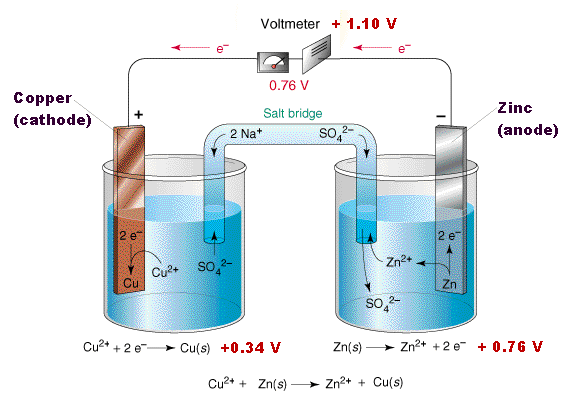
A galvanic (voltaic) cell uses a spontaneous redox reaction to generate electrical current. The reaction is split into two half-cells, each containing an electrode dipped in a solution of its ions.
- Anode half-cell: where oxidation occurs. The electrode loses electrons. In a Zn-Cu cell, this is the Zn electrode ().
- Cathode half-cell: where reduction occurs. The electrode gains electrons. In a Zn-Cu cell, this is the Cu electrode ().
Electrons flow from the anode to the cathode through an external circuit (a wire connected to a light bulb, voltmeter, etc.). That flow of electrons is the electric current you can measure or use.
A salt bridge connects the two solutions and maintains electrical neutrality. Without it, positive charge would build up in the cathode compartment and negative charge in the anode compartment, and the reaction would stop almost immediately. The salt bridge contains an inert electrolyte like or that lets ions migrate between compartments to balance the charge.
Memory aid: An Ox, Red Cat. Anode = Oxidation, Reduction = Cathode.

Calculation of standard cell potentials
The standard cell potential () is the voltage a cell produces when all species are at standard conditions: 1 M concentration, 1 atm pressure, and 25°C.
You calculate it from the standard reduction potentials () listed in a reference table:
Both values you plug in are the reduction potentials from the table. You don't flip the sign of the anode value yourself; the subtraction takes care of it.
Step-by-step for a Zn-Cu cell:
-
Look up the standard reduction potentials:
- ,
- ,
-
Identify which half-reaction is the cathode and which is the anode. The species with the more positive gets reduced (cathode). The species with the more negative gets oxidized (anode).
- Cathode: Cu (higher )
- Anode: Zn (lower )
-
Apply the formula:
A positive confirms the reaction is spontaneous under standard conditions.
One common mistake: do not multiply values by the number of electrons transferred. Standard reduction potentials are intensive properties (they don't change when you scale the reaction).

Spontaneity in redox reactions
The sign of tells you directly about spontaneity:
- : spontaneous (galvanic cell, produces electricity)
- : non-spontaneous (requires energy input, like an electrolytic cell)
- : system is at equilibrium
You can connect cell potential to thermodynamics through Gibbs free energy:
- = number of moles of electrons transferred in the balanced equation
- = Faraday's constant = 96,485 C/mol
This equation shows why the signs work out: a positive gives a negative , which is the thermodynamic condition for spontaneity. For the Zn-Cu cell with :
That large negative value confirms a strongly spontaneous reaction.
Notation for electrochemical cells
Cell diagrams follow a standard convention so anyone can read them at a glance:
- The anode is drawn on the left; the cathode is on the right.
- Electrodes are labeled with chemical species and physical states.
- A double vertical line (‖) represents the salt bridge.
- An arrow shows electron flow from anode to cathode through the external wire.
Shorthand (line) notation compresses all of this into one line:
How to read it:
- A single vertical line ( | ) represents a phase boundary (solid electrode touching its aqueous ion solution).
- The double line ( ‖ ) represents the salt bridge.
- Read left to right: oxidation happens on the left side, reduction on the right.
So for this cell: zinc metal is oxidized to ions at the anode, and ions are reduced to copper metal at the cathode.
If a half-cell involves species that are both in solution (like being reduced to ), you'd use an inert electrode such as platinum, and separate the aqueous species with a comma:
See Fiveable more often in Google
Mark Fiveable as a preferred source and Google is more likely to show you our guides in Top Stories, with a "preferred" badge in AI Mode and AI Overviews.