10.1 Green chemistry and sustainable processes

⏱️General Chemistry II Unit 10 Review
10.1 Green chemistry and sustainable processes
⏱️ General Chemistry II
Green Chemistry Principles and Practices
Green chemistry is about designing chemical processes and products that reduce or eliminate hazardous substances from the start. Rather than cleaning up pollution after it happens, the goal is to prevent it at the molecular level. This matters because the chemical industry touches nearly every product you use, and smarter design at the chemistry stage has ripple effects across manufacturing, health, and the environment.

Top images from around the web for Principles of green chemistry
Green chemistry – All About Drugs View original
Is this image relevant?
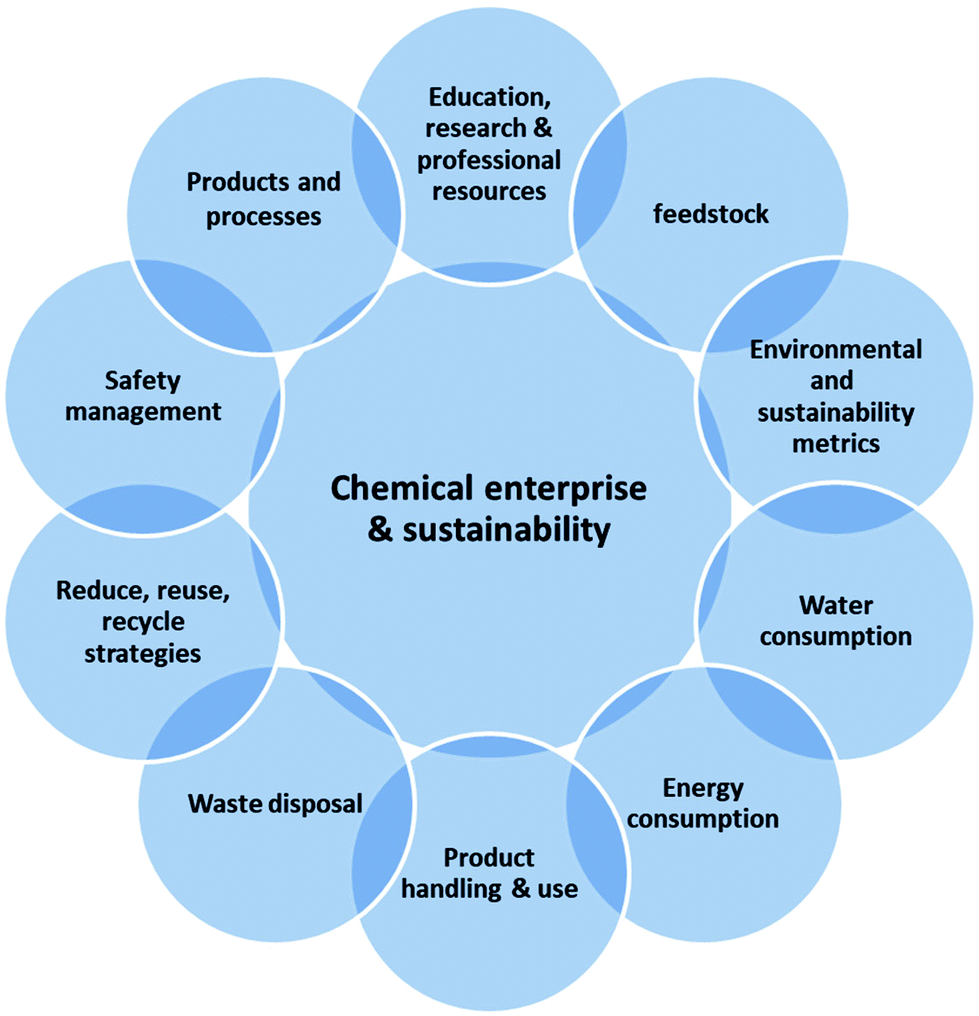
Education in green chemistry and in sustainable chemistry: perspectives towards sustainability ... View original
Is this image relevant?
Green chemistry – All About Drugs View original
Is this image relevant?
Education in green chemistry and in sustainable chemistry: perspectives towards sustainability ... View original
Is this image relevant?
Principles of Green Chemistry
Paul Anastas and John Warner laid out 12 principles that guide green chemistry. The overarching idea: prevent waste and hazards by design, rather than dealing with them after the fact.
- Prevention — Preventing waste is better than treating or cleaning it up after it forms.
- Atom economy — Design reactions so that as much of the starting materials as possible ends up in the final product, not in byproducts.
- Less hazardous syntheses — Use and generate substances with little or no toxicity to people or the environment.
- Designing safer chemicals — Chemical products should be effective for their intended function while minimizing toxicity.
- Safer solvents and auxiliaries — Favor safer alternatives like water, supercritical fluids, or ionic liquids over traditional organic solvents.
- Design for energy efficiency — Run reactions at ambient temperature and pressure when feasible to minimize energy demands.
- Use of renewable feedstocks — Choose renewable raw materials (e.g., corn starch, sugarcane) over non-renewable ones.
- Reduce derivatives — Avoid unnecessary steps like protection/deprotection sequences, since each extra step generates waste.
- Catalysis — Prefer catalytic reagents over stoichiometric ones. Catalysts are used in small amounts and can be reused, while stoichiometric reagents are consumed entirely and often produce more waste.
- Design for degradation — Products should break down into harmless substances after use, avoiding persistent environmental contamination.
- Real-time analysis for pollution prevention — Monitor reactions in real time so you can catch and correct problems before hazardous substances form.
- Inherently safer chemistry for accident prevention — Choose substances and reaction conditions that minimize the risk of explosions, fires, and toxic releases.
A useful way to remember the spirit of these principles: design it right the first time so you don't need to fix problems downstream.
Benefits of Sustainable Processes
Green chemistry isn't just about being environmentally responsible. It often makes good economic and practical sense too.
- Reduced environmental impact — Less waste generation and fewer hazardous byproducts mean less pollution entering air, water, and soil.
- Improved safety — Workers and surrounding communities face lower risks of chemical exposure and accidents.
- Cost savings — Higher efficiency, lower waste disposal costs, and opportunities to recycle or reuse materials all cut expenses. The redesigned ibuprofen synthesis (discussed below) is a classic example.
- Public trust — Demonstrating environmental stewardship strengthens the chemical industry's reputation.
Several practical techniques help achieve these benefits:
- Green solvents — Water, supercritical , or ionic liquids replace traditional volatile organic solvents.
- Biocatalysis — Enzymes or whole-cell systems carry out reactions under mild conditions (low temperature, neutral pH), which saves energy and reduces harsh reagent use.
- Microwave-assisted reactions — Microwave irradiation heats reactions more efficiently, often cutting reaction times and energy consumption.
- Flow chemistry — Continuous flow reactors give better control over temperature and mixing compared to batch reactors, improving both safety and selectivity.

Environmental Impact Assessment
To know whether a process is truly "green," you need to measure its impact. Life Cycle Assessment (LCA) is the standard tool. It evaluates environmental impact across a product's entire life: raw material extraction, manufacturing, use, and disposal or recycling.
Key factors in an LCA:
- Greenhouse gas emissions — The carbon footprint of the process and its contribution to climate change.
- Resource depletion — Consumption of non-renewable resources like fossil fuels or rare earth elements.
- Ecosystem toxicity — Potential for released substances to harm ecosystems (aquatic toxicity, soil contamination, etc.).
- Human health impacts — Risks to workers during production and to the public during product use or disposal.
Quantitative metrics help compare processes directly:
- E-factor — The mass ratio of waste to desired product. A lower E-factor means less waste. For example, bulk chemical production might have an E-factor of less than 5, while pharmaceutical manufacturing can exceed 100.
- Atom economy — The molecular weight of the desired product divided by the total molecular weight of all products, expressed as a percentage. A reaction with 100% atom economy converts every atom of reactant into useful product.
Waste Reduction Strategies
These six strategies work together to minimize waste at every stage of a chemical process:
- Optimize reaction conditions — Adjust temperature, pressure, concentration, and reaction time to maximize yield and minimize side reactions. Design of Experiments (DoE) is a systematic approach for finding optimal conditions.
- Employ catalysts — Catalysts lower activation energy, speed up reactions, and improve selectivity toward the desired product. Heterogeneous catalysts are especially useful because they're easy to separate and reuse.
- Maximize atom economy — Choose synthetic routes where most atoms from the reactants end up in the product. Avoid stoichiometric reagents that generate large amounts of byproduct.
- Use green solvents — Replace hazardous organic solvents with water, supercritical , ionic liquids, or run solvent-free reactions when possible.
- Adopt continuous flow processes — Flow reactors offer better heat and mass transfer than batch reactors, leading to more consistent products and less waste.
- Implement process intensification — Combine multiple steps into one unit operation. Reactive distillation, for instance, carries out reaction and separation simultaneously, cutting equipment needs and waste.
Green Chemistry Case Studies
These real-world examples show how green chemistry principles translate into practice.
1. Ibuprofen Synthesis (BHC Company)
The original industrial synthesis of ibuprofen required six steps, used hazardous reagents, and had poor atom economy. BHC Company redesigned it into a three-step process that:
- Improved atom economy significantly (fewer wasted atoms per molecule of product)
- Replaced hazardous reagents with safer alternatives
- Cut waste generation by roughly 50% while improving overall yield
This is one of the most cited examples of green chemistry saving both money and environmental impact.
2. Chitosan from Shrimp Shell Waste (Tidal Vision)
Shrimp shells are a massive waste product from the seafood industry. Tidal Vision extracts chitosan, a biodegradable polymer, using a process that avoids the harsh acids and bases traditionally required. Chitosan has applications in water treatment (it binds heavy metals), agriculture, and biomedicine.
3. Biobased Plastics (NatureWorks)
NatureWorks produces polylactic acid (PLA) from renewable feedstocks like corn starch. The process works in three stages:
- Fermentation of plant sugars to produce lactic acid
- Polymerization of lactic acid into PLA using efficient catalysts
- Processing into packaging, fibers, and other products
PLA is biodegradable and compostable, and its production generates fewer greenhouse gas emissions than conventional petroleum-based plastics.
4. Dry Cleaning with Liquid (GreenEarth Cleaning)
Traditional dry cleaning relies on perchloroethylene (PERC), a toxic solvent linked to health problems and environmental persistence. Liquid dry cleaning replaces PERC with pressurized , which is non-toxic and fully recyclable. The system operates in a closed loop, so virtually no solvent escapes, and cleaned garments have no chemical residue or odor.
See Fiveable more often in Google
Mark Fiveable as a preferred source and Google is more likely to show you our guides in Top Stories, with a "preferred" badge in AI Mode and AI Overviews.