1.4 Activation energy and the Arrhenius equation

⏱️General Chemistry II Unit 1 Review
1.4 Activation energy and the Arrhenius equation
⏱️ General Chemistry II
Activation Energy and the Arrhenius Equation
Chemical reactions require energy to get started. Activation energy is the minimum energy reactants need to overcome the energy barrier and actually react. The Arrhenius equation connects reaction rate to activation energy and temperature, giving you a quantitative way to predict how fast a reaction will proceed under different conditions.

Top images from around the web for Role of activation energy
Energy profile (chemistry) - Wikipedia View original
Is this image relevant?
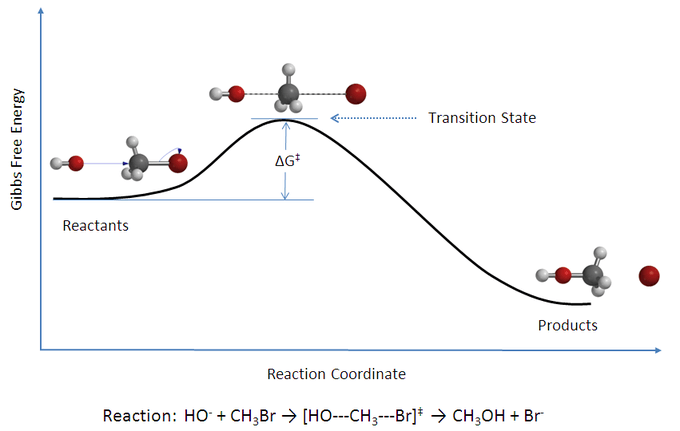
Transition State Theory | Introduction to Chemistry View original
Is this image relevant?
Activation energy - Wikipedia View original
Is this image relevant?
Energy profile (chemistry) - Wikipedia View original
Is this image relevant?
Transition State Theory | Introduction to Chemistry View original
Is this image relevant?
Role of Activation Energy
Activation energy () is the minimum energy that colliding molecules must possess for a reaction to occur. It's the energy needed to stretch and break existing bonds so that new bonds can form.
On a reaction coordinate diagram, activation energy appears as a "hill" between reactants and products. The peak of that hill is the transition state (sometimes called the activated complex), the highest-energy arrangement of atoms along the reaction pathway. The height of the hill, measured from the reactant energy level up to the transition state, is .
- A high means fewer molecules have enough energy to react at a given temperature, so the reaction is slower.
- A low means more molecules can clear the barrier, so the reaction is faster.
Note that is always positive. Whether the overall reaction is exothermic or endothermic doesn't determine the size of . An exothermic reaction can still have a large activation energy barrier.

Components of the Arrhenius Equation
The Arrhenius equation relates the rate constant to activation energy and temperature:
Each piece of this equation has a specific meaning:
- is the rate constant for the reaction. A larger means a faster reaction.
- is the pre-exponential factor (also called the frequency factor). It accounts for how often molecules collide and whether they collide with the right orientation. Even if molecules have enough energy, they won't react if they hit each other at the wrong angle. has the same units as and is typically treated as roughly constant over moderate temperature ranges.
- is the Boltzmann factor. It represents the fraction of collisions that have sufficient energy to overcome the barrier. This is the temperature-sensitive part of the equation.
- is the universal gas constant, .
- is the absolute temperature in Kelvin.
The negative sign in the exponent is critical. As increases, the exponent becomes more negative, making smaller, which makes smaller. Conversely, as increases, the magnitude of the exponent decreases, making larger. This is why heating a reaction speeds it up.
Unit watch: must be in J/mol (not kJ/mol) when you use . If a problem gives in kJ/mol, multiply by 1000 before plugging in. This is one of the most common mistakes on exams.

Calculating Activation Energy
You can determine experimentally by measuring the rate constant at several different temperatures. The key is to take the natural log of both sides of the Arrhenius equation:
This has the form of a straight line (), where:
- slope
- y-intercept
Steps for finding from a graph:
- Measure at several different temperatures.
- Convert each temperature to Kelvin, then calculate and for each data point.
- Plot on the y-axis versus on the x-axis. You should get a straight line (if you don't, the data may not follow simple Arrhenius behavior).
- Determine the slope of the line using two points: .
- Solve for : since slope , then .
Because the slope is negative ( decreases as increases), multiplying by the extra negative sign gives a positive , as expected.
Two-temperature shortcut: If you only have rate constants at two temperatures, you can skip the graph and use this form directly:
This is derived by writing the linearized Arrhenius equation at each temperature and subtracting one from the other (the terms cancel). It lets you solve for if you know both rate constants, or predict at a new temperature if you already know .
Quick example: Suppose at and at . Plugging in:
Solving gives , or about .
Temperature Effects on Reaction Rates
Temperature has an exponential effect on reaction rate, not a linear one. A common rough guideline is that many reactions roughly double in rate for every 10°C increase, though the actual factor depends on the size of .
Why does higher temperature speed things up? At higher temperatures, the Maxwell-Boltzmann distribution of molecular kinetic energies shifts so that a larger fraction of molecules have energy equal to or greater than . More molecules can clear the energy barrier per unit time, so increases.
- For reactions with a large , rate is very sensitive to temperature changes. The exponential term changes dramatically with because even a small shift in the distribution pushes many more molecules past a high barrier.
- For reactions with a small , rate is less sensitive to temperature because most molecules already have enough energy to react.
In the Arrhenius framework, both and are assumed to remain constant across the temperature range you're studying. This assumption holds well for most reactions over moderate temperature ranges and is what allows you to extrapolate rate constants to temperatures you haven't directly measured.
See Fiveable more often in Google
Mark Fiveable as a preferred source and Google is more likely to show you our guides in Top Stories, with a "preferred" badge in AI Mode and AI Overviews.