10.4 Computational chemistry and molecular modeling

⏱️General Chemistry II Unit 10 Review
10.4 Computational chemistry and molecular modeling
⏱️ General Chemistry II
Introduction to Computational Chemistry
Computational chemistry uses math and computer simulations to study chemical systems. By applying theoretical chemistry principles, it can calculate molecular properties and predict how molecules behave without always needing a physical experiment. This makes it a core tool in fields ranging from drug design to materials science.

Top images from around the web for Principles of computational chemistry
Frontiers | Discovering Anti-Cancer Drugs via Computational Methods View original
Is this image relevant?
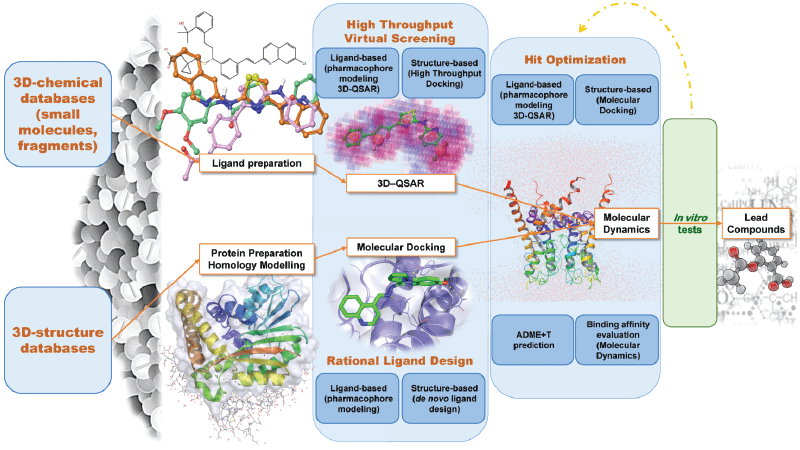
Breakthroughs in Computational Approaches for Drug Discovery View original
Is this image relevant?
Frontiers | QSAR-Based Virtual Screening: Advances and Applications in Drug Discovery View original
Is this image relevant?
Frontiers | Discovering Anti-Cancer Drugs via Computational Methods View original
Is this image relevant?
Breakthroughs in Computational Approaches for Drug Discovery View original
Is this image relevant?
Principles of Computational Chemistry
At its core, computational chemistry relies on mathematical algorithms to model chemical systems. The computer does the heavy lifting of solving equations that would be impossible to work through by hand for anything beyond the simplest molecules.
The applications are broad:
- Drug discovery and design predicts how a drug molecule interacts with its biological target, helping researchers optimize lead compounds before expensive lab testing.
- Materials science uses simulations to design new materials with specific properties, like semiconductors with a particular band gap or polymers with targeted mechanical strength.
- Catalysis and reaction mechanisms maps out reaction pathways step by step, identifying key intermediates and transition states that explain why a reaction proceeds the way it does.
- Environmental chemistry models how pollutants like pesticides or greenhouse gases move through and transform in the environment.
Fundamentals of Molecular Modeling
Molecular modeling is the practical framework behind computational chemistry. Different methods exist because no single approach works well for every problem. The choice depends on the size of the system and the accuracy you need.
Potential Energy Surfaces (PES)
A potential energy surface maps the energy of a molecular system as a function of its geometry. Think of it as a landscape of hills and valleys:
- Minima (valleys) correspond to stable conformations. For example, the chair form of cyclohexane sits at a minimum on its PES.
- Saddle points (mountain passes) represent transition states, the highest-energy points along the path between two stable conformations.
Molecular Mechanics (MM)
Molecular mechanics is a classical approach that uses force fields to describe how atoms interact. Force fields are sets of equations and parameters (calibrated against experimental data or high-level quantum calculations) that approximate bond stretching, angle bending, and other interactions. MM doesn't deal with electrons explicitly, which makes it fast and suitable for large systems like proteins or polymers.
Quantum Mechanics (QM) Methods
QM methods solve the Schrödinger equation to describe electronic structure directly. They're more accurate than MM but far more computationally expensive.
-
Ab initio methods solve the Schrödinger equation without relying on empirical parameters:
- Hartree-Fock (HF) is the simplest ab initio method. It treats each electron as moving in the average field of all other electrons, ignoring electron correlation.
- Møller-Plesset perturbation theory (MP2) is a post-HF method that adds electron correlation as a correction to the HF result.
- Coupled Cluster (CC) includes electron correlation effects more completely, giving high accuracy but at significant computational cost.
-
Density Functional Theory (DFT) takes a different approach by calculating electronic structure based on the overall electron density rather than individual electron wavefunctions. It's less demanding than most ab initio methods and widely used for medium-sized systems like transition metal complexes.
Molecular Dynamics (MD)
MD simulates how atoms and molecules move over time by numerically solving Newton's equations of motion at each time step. This provides insights into dynamic behavior, such as how a protein folds or how molecules diffuse through a membrane.

Applications and Analysis
Prediction of Chemical Properties
Computational methods can predict several types of chemical properties:
- Geometry optimization searches for the lowest-energy conformation of a molecule. This is useful for predicting stable structures, for instance whether a substituent on cyclohexane prefers the axial or equatorial position.
- Transition state searches locate the highest-energy point along a reaction coordinate. From this, you can determine the activation energy and identify the rate-limiting step. A classic example is mapping the reaction pathway.
- Spectroscopic properties like vibrational frequencies (IR), NMR chemical shifts, and UV-Vis absorption spectra can all be calculated. Comparing these computed spectra with experimental data helps confirm molecular structures.
- Thermodynamic properties such as enthalpies (), entropies (), and Gibbs free energies () predict whether a reaction is feasible and spontaneous.

Analysis of Computational Results
Raw numbers from a calculation aren't useful on their own. Interpreting and validating results is a critical step.
- Visualization of molecular structures and orbitals using graphical software lets you examine 3D geometries and electron density maps. Frontier molecular orbitals (the HOMO and LUMO) are particularly important because they govern bonding and reactivity.
- Benchmarking compares computed properties against well-established experimental values. This validates whether a chosen method is reliable for the system you're studying.
- Structure-activity relationships (SAR) correlate specific molecular features with biological activity or material properties. In drug design, this means identifying key functional groups and structural motifs (called pharmacophores) that drive a drug's effectiveness.
- Reaction mechanism elucidation uses computed intermediates, transition states, and energy profiles to propose plausible step-by-step pathways for how a reaction proceeds.
Limitations in Computational Chemistry
No computational method is perfect. Understanding the trade-offs helps you choose the right tool.
- Accuracy vs. computational cost is the central trade-off. Higher-level methods (like Coupled Cluster) give more accurate results but require far more computing power and time. DFT often hits a practical sweet spot between accuracy and efficiency.
- Sampling and timescale limitations affect MD simulations. Biological processes like protein folding can take milliseconds or longer, but simulations may only cover nanoseconds. Enhanced sampling techniques like umbrella sampling help explore conformational space more thoroughly.
- Solvent effects are difficult to model accurately. Implicit solvent models (like the Polarizable Continuum Model, PCM) treat the solvent as a continuous medium, which is efficient but misses specific solvent-solute interactions like hydrogen bonds. Explicit solvent models include individual solvent molecules but are much more computationally demanding.
Emerging directions in the field include:
- Machine learning and AI to accelerate property predictions and screen large chemical libraries faster than traditional methods.
- Quantum computing, which could exploit quantum phenomena to solve electronic structure problems far more efficiently than classical computers.
- Multiscale modeling, which integrates different levels of theory (for example, QM for the active site and MM for the surrounding protein) to give a comprehensive picture of complex systems.
See Fiveable more often in Google
Mark Fiveable as a preferred source and Google is more likely to show you our guides in Top Stories, with a "preferred" badge in AI Mode and AI Overviews.