2.2 Le Chatelier's Principle and factors affecting equilibrium

⏱️General Chemistry II Unit 2 Review
2.2 Le Chatelier's Principle and factors affecting equilibrium
⏱️ General Chemistry II
Le Chatelier's Principle and Equilibrium
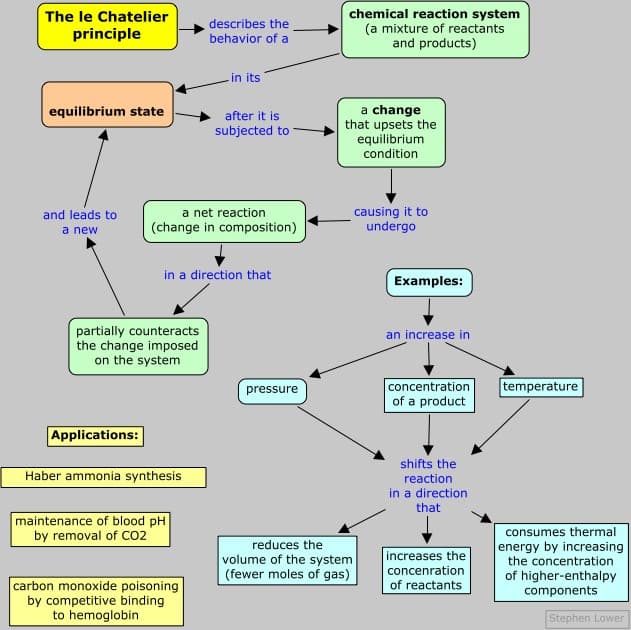
Chemical equilibrium is a dynamic state where the forward and reverse reactions occur at equal rates, so the concentrations of reactants and products stay constant. Le Chatelier's Principle describes how an equilibrium system responds when you disturb it: the system shifts to partially counteract the change and establish a new equilibrium.
Gibbs free energy ties thermodynamics into the picture by telling you whether a reaction is spontaneous and how the equilibrium constant relates to energy. Together, these ideas let you predict which direction a reaction will shift under different conditions.

Top images from around the web for Le Chatelier's principle and equilibrium shifts
Le Chatelier principle View original
Is this image relevant?
Le Chatelier principle View original
Is this image relevant?
Le Chatelier principle View original
Is this image relevant?
Le Chatelier principle View original
Is this image relevant?
Le Chatelier principle View original
Is this image relevant?
Le Chatelier principle View original
Is this image relevant?
Le Chatelier principle View original
Is this image relevant?
Le Chatelier's Principle and Equilibrium Shifts
Le Chatelier's Principle states that when a system at equilibrium experiences a change in concentration, pressure, volume, or temperature, it will shift to partially offset that disturbance and re-establish equilibrium. The Haber process for ammonia synthesis is a classic example where industrial chemists manipulate all of these factors to maximize yield.
Concentration changes shift the equilibrium toward whichever side reduces the disturbance:
- Increasing reactant concentration shifts equilibrium toward products. For example, adding more CO in the water-gas shift reaction () drives more product formation.
- Decreasing reactant concentration shifts equilibrium back toward reactants to replenish what was removed. Removing from the Haber process shifts the system away from products.
- Increasing product concentration shifts equilibrium toward reactants. Adding extra in the water-gas shift reaction pushes the reaction backward.
- Decreasing product concentration shifts equilibrium toward products. Continuously removing in the Haber process drives more ammonia production, which is exactly why industrial plants do this.
Pressure and volume changes matter only for gaseous systems, and the system shifts toward the side with fewer total moles of gas:
- Increasing pressure (decreasing volume) shifts equilibrium toward fewer gas molecules. In , there are 4 moles of gas on the left and 2 on the right, so high pressure favors ammonia production.
- Decreasing pressure (increasing volume) shifts equilibrium toward more gas molecules. In , the side with 3 moles of gas is favored at lower pressure.
- If both sides have the same number of moles of gas, pressure changes have no effect on the equilibrium position.
Temperature changes are unique because they actually change the value of , not just the position of equilibrium. Think of heat as a reactant (endothermic) or product (exothermic):
- Increasing temperature shifts equilibrium in the endothermic direction (absorbs the added heat). The reaction is endothermic, so higher temperatures favor formation.
- Decreasing temperature shifts equilibrium in the exothermic direction (releases heat). The dimerization is exothermic in the forward direction, so cooling favors .
Catalysts and Equilibrium
Catalysts speed up a reaction by lowering the activation energy, but they are not consumed in the process. Common examples include enzymes in biological systems and catalytic converters in automobiles.
The critical point for equilibrium: catalysts increase the rates of both the forward and reverse reactions equally. This means a catalyst does not change the equilibrium constant () or shift the equilibrium position in either direction. It simply helps the system reach equilibrium faster.
In the Haber process, an iron catalyst allows the reaction to reach equilibrium at a practical rate, but the actual equilibrium yield of depends on temperature and pressure, not the catalyst.

Reactant and Product Effects on Equilibrium
This section reinforces the concentration rules above with a clear pattern you can use on exams. For any equilibrium, apply this reasoning:
- Identify what was added or removed (reactant or product).
- Determine whether the concentration of that species increased or decreased.
- The system shifts to oppose that change: toward the opposite side from whatever was added, or toward the same side as whatever was removed.
Quick reference:
- Add reactant → shift toward products
- Remove reactant → shift toward reactants
- Add product → shift toward reactants
- Remove product → shift toward products
The reaction quotient provides a quantitative way to confirm this. After a disturbance, compare to : if , the reaction shifts toward products; if , it shifts toward reactants.
Gibbs Free Energy and Equilibrium
Gibbs Free Energy and Equilibrium Position
Gibbs free energy () tells you whether a reaction is spontaneous at constant temperature and pressure. The key equation connecting to the equilibrium constant is:
where is the gas constant (8.314 J/mol·K) and is the absolute temperature in Kelvin. Note that this equation uses (standard Gibbs free energy), which relates to at standard conditions.
Here's how to interpret the three cases:
- : The reaction is spontaneous in the forward direction under standard conditions, and , meaning products are favored at equilibrium. Example: formation of iron oxide (rust).
- : The reaction is non-spontaneous in the forward direction under standard conditions, and , meaning reactants are favored. Example: decomposition of water into and at 25°C.
- : , meaning neither side is strongly favored.
For a reaction that has already started and is not at standard conditions, you use the full equation:
where is the reaction quotient. When the system reaches equilibrium, and . That's the condition for equilibrium: no net driving force in either direction.
The magnitude of matters too. A more negative corresponds to a larger , meaning a greater proportion of products at equilibrium. For instance, the formation of from and has a very negative , so the reaction essentially goes to completion.
See Fiveable more often in Google
Mark Fiveable as a preferred source and Google is more likely to show you our guides in Top Stories, with a "preferred" badge in AI Mode and AI Overviews.