9.3 Nuclear fission, fusion, and their applications

⏱️General Chemistry II Unit 9 Review
9.3 Nuclear fission, fusion, and their applications
⏱️ General Chemistry II
Nuclear Reactions and Energy
Nuclear fission and fusion are the two main types of nuclear reactions that release energy. Fission splits heavy nuclei apart; fusion joins light nuclei together. Both convert a small amount of mass into a large amount of energy, but they work under very different conditions and have different applications.

Top images from around the web for Nuclear fission vs fusion reactions
Nuclear fission - Wikipedia View original
Is this image relevant?
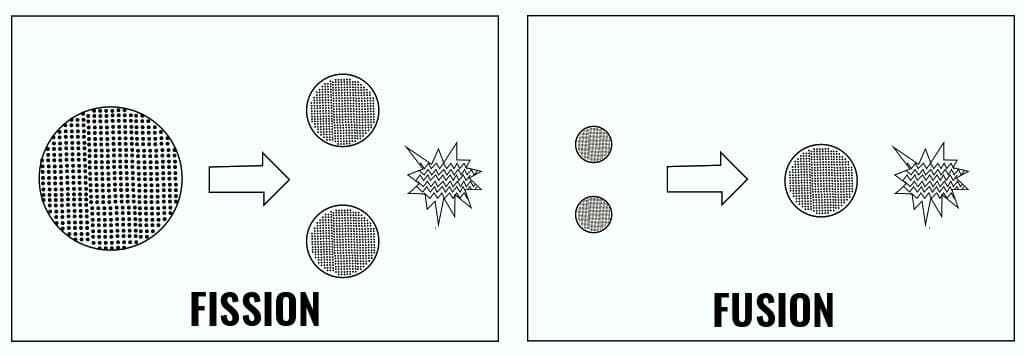
11.6: Fission and Fusion - Chemistry LibreTexts View original
Is this image relevant?
Nuclear fusion - Wikipedia View original
Is this image relevant?
Nuclear fission - Wikipedia View original
Is this image relevant?
11.6: Fission and Fusion - Chemistry LibreTexts View original
Is this image relevant?
Nuclear Fission vs. Fusion Reactions
Nuclear fission is the splitting of a large, heavy nucleus into smaller, lighter nuclei. Common fissionable isotopes include uranium-235 and plutonium-239.
- Energy is released because the total mass of the products is slightly less than the mass of the original nucleus. That "missing" mass becomes energy according to Einstein's equation .
- Fission can happen spontaneously in unstable isotopes, but in reactors it's typically induced by bombarding a nucleus with a neutron. When the neutron is absorbed, the nucleus becomes unstable and splits.
- A single fission event of releases roughly 200 MeV of energy and produces 2–3 additional neutrons, which is what makes chain reactions possible.
Nuclear fusion is the combining of two light nuclei to form a heavier one. The most studied fusion reaction combines deuterium () and tritium () to produce helium-4 and a neutron:
- Fusion releases even more energy per unit mass of fuel than fission because the mass difference between reactants and products is proportionally greater for light nuclei.
- The catch: fusion requires extremely high temperatures (on the order of to K) and pressures to overcome the electrostatic repulsion between positively charged nuclei. This repulsion is called the Coulomb barrier. At these temperatures, matter exists as plasma.
- Fusion occurs naturally in the cores of stars. The Sun, for example, fuses about 600 million tons of hydrogen into helium every second.
- Controlled fusion on Earth remains an active area of research (tokamak reactors, laser confinement), but no facility has yet achieved sustained net energy output from fusion.
To connect both reactions to a single concept: look at the binding energy per nucleon curve. Nuclei near iron-56 have the highest binding energy per nucleon, meaning they're the most stable. Fission moves very heavy nuclei (like uranium) toward iron on the curve, releasing energy. Fusion moves very light nuclei (like hydrogen) toward iron from the other direction, also releasing energy. Both processes produce products that are more tightly bound than the starting materials, and that difference in binding energy is what gets released.

Nuclear Chain Reactions in Power Plants
A nuclear chain reaction is a self-sustaining series of fission events where the neutrons released from one fission trigger additional fissions. Here's how it works:
- A neutron strikes a fissionable nucleus (e.g., ), causing it to split.
- The fission produces 2–3 new neutrons along with energy and fission fragments.
- Those neutrons go on to strike other fissionable nuclei, each producing more neutrons.
- If, on average, exactly one neutron from each fission causes another fission, the reaction is self-sustaining (this is called criticality).
If fewer than one neutron per fission causes another fission, the reaction dies out (subcritical). If more than one does, the reaction rate accelerates (supercritical).
One detail worth knowing: the neutrons released by fission are fast-moving (high kinetic energy), but actually captures slow neutrons much more efficiently. That's why reactors use a moderator, typically water or graphite, to slow neutrons down through collisions. These slowed neutrons are called thermal neutrons.
Nuclear power plants use controlled fission chain reactions to generate electricity:
- Heat generation: The kinetic energy of fission fragments heats the reactor core.
- Steam production: That heat boils water (or heats another coolant), producing steam.
- Electricity generation: The steam drives turbines connected to electrical generators.
- Control rods made of neutron-absorbing materials (such as boron or cadmium) are inserted into or withdrawn from the reactor core to regulate the reaction rate. Pushing them in absorbs more neutrons and slows the reaction; pulling them out speeds it up.
- Moderator: Slows fast neutrons to thermal speeds so they're more likely to be captured by .
- Coolant systems (water, heavy water, or liquid sodium) circulate through the core to carry heat away and prevent overheating. In many reactor designs, water serves as both the moderator and the coolant.

Critical Mass in Nuclear Fission
Critical mass is the minimum amount of fissionable material needed to sustain a chain reaction. Below this threshold, too many neutrons escape the surface of the material without hitting another nucleus, and the chain reaction fizzles out.
Several factors determine critical mass:
- Isotope type: has a different critical mass than because they have different fission cross-sections (the probability of capturing a neutron). Plutonium-239 has a larger cross-section, so its critical mass is smaller (about 10 kg for vs. about 52 kg for as bare spheres).
- Purity/enrichment: Natural uranium is only about 0.7% ; the rest is non-fissile . Reactor fuel is typically enriched to 3–5% . Higher concentrations of the fissionable isotope mean more target nuclei per volume, lowering the critical mass.
- Geometry: A sphere has the smallest surface-area-to-volume ratio, so a spherical configuration minimizes neutron escape and requires the least material. Flattened or irregular shapes lose more neutrons through the surface.
- Neutron reflectors: Surrounding the material with a neutron-reflecting shell (like beryllium) bounces escaping neutrons back in, effectively reducing the critical mass needed.
In nuclear reactors, the fuel is maintained right at criticality for steady energy output. In nuclear weapons, subcritical pieces of fissionable material are rapidly assembled into a supercritical mass, causing an uncontrolled, explosive chain reaction.
Pros and Cons of Nuclear Energy
Advantages:
- High energy density: One kilogram of uranium-235 can release roughly 80 terajoules of energy, millions of times more than a kilogram of coal. This means nuclear plants need far less fuel.
- Low greenhouse gas emissions: Nuclear plants produce no during operation. Lifecycle emissions (mining, construction, waste handling) are comparable to wind and solar.
- Reliable baseload power: Reactors can run continuously for 18–24 months between refueling, providing steady electricity regardless of weather or time of day.
- Advanced reactor designs: Next-generation concepts like molten salt reactors and small modular reactors aim to improve safety features, reduce waste, and lower construction costs.
Disadvantages:
- High upfront costs: Nuclear plants require billions of dollars in capital investment and often take a decade or more to build.
- Safety concerns: Accidents at Three Mile Island (1979), Chernobyl (1986), and Fukushima (2011) demonstrated the potential consequences of reactor failures, though modern designs incorporate passive safety systems to reduce these risks.
- Radioactive waste: Spent fuel rods remain dangerously radioactive for thousands of years and require secure long-term storage. No country has yet opened a permanent deep geological repository for high-level waste, though Finland's Onkalo facility is nearing operation.
- Proliferation risks: The same enrichment technology used to produce reactor fuel can be adapted to produce weapons-grade material, raising international security concerns.
- Public perception: Safety fears and the association with nuclear weapons make it politically difficult to build new plants in many countries.
See Fiveable more often in Google
Mark Fiveable as a preferred source and Google is more likely to show you our guides in Top Stories, with a "preferred" badge in AI Mode and AI Overviews.