9.2 Half-life and radioactive decay kinetics

⏱️General Chemistry II Unit 9 Review
9.2 Half-life and radioactive decay kinetics
⏱️ General Chemistry II
Radioactive Decay and Half-Life
Radioactive decay follows first-order kinetics, meaning the rate of decay depends only on how much radioactive material is present at any moment. Half-life is the central concept here: it's the time required for exactly half of a radioactive sample to decay. Because the decay is first-order, the half-life stays constant regardless of how much material you started with.
These principles show up everywhere, from nuclear medicine dosing to determining the age of fossils and rocks.

Top images from around the web for Half-life in radioactive decay
Radioactive Decay | Chemistry View original
Is this image relevant?
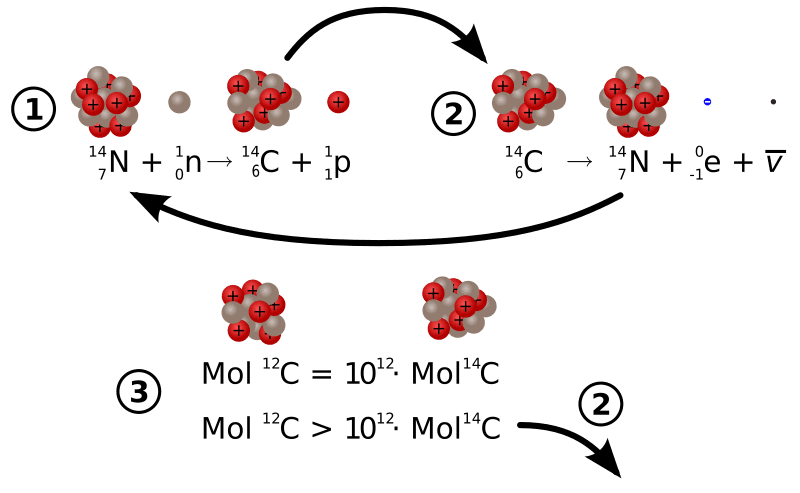
File:Carbon 14 formation and decay.svg - Wikimedia Commons View original
Is this image relevant?
2.2 Absolute age dating | Digital Atlas of Ancient Life View original
Is this image relevant?
Radioactive Decay | Chemistry View original
Is this image relevant?
File:Carbon 14 formation and decay.svg - Wikimedia Commons View original
Is this image relevant?
Half-Life in Radioactive Decay
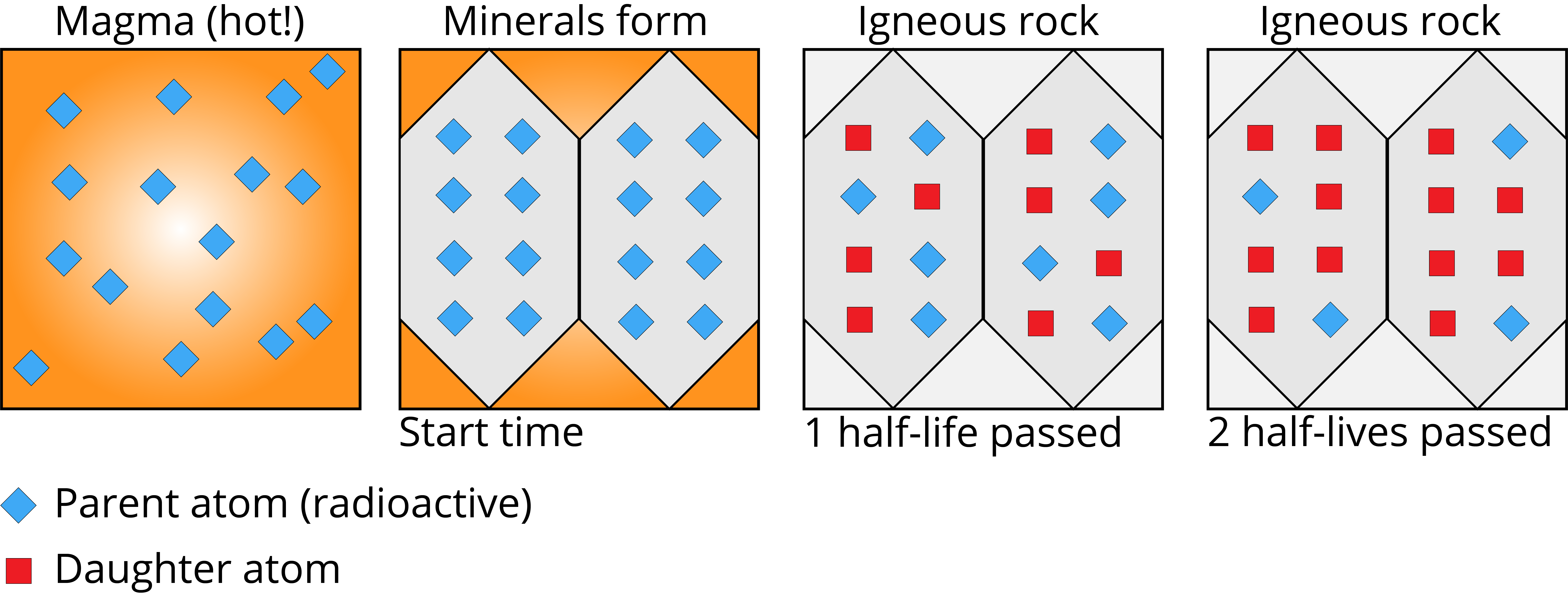
- Half-life () is the time required for half of a given quantity of a radioactive substance to decay into a daughter nuclide
- Remains constant for each specific radioisotope (carbon-14: ~5,730 years; uranium-238: ~4.5 billion years)
- Independent of the initial amount of substance present, temperature, or pressure
- Significance in radioactive decay:
- Determines the rate at which a radioactive substance decays over time
- Allows you to calculate how much of a substance remains after any given time period
- Enables radioactive dating techniques for both organic materials (carbon-14 dating) and inorganic materials (uranium-lead dating)
Calculations with Half-Lives
The amount of a radioactive substance decreases exponentially. Two equivalent formulas let you calculate how much remains:
Formula 1 (using elapsed time):
Formula 2 (using number of half-lives):
where is the number of half-lives elapsed.
In both formulas:
- = amount of substance remaining at time
- = initial amount of substance
- = half-life of the isotope
Example: Suppose you start with 80.0 g of iodine-131 ( = 8.02 days). How much remains after 24.06 days?
- Find the number of half-lives:
- Apply the formula:
After 3 half-lives, only 10.0 g of the original 80.0 g remains. The rest has decayed into xenon-131.
When isn't a whole number, the formula still works the same way. For instance, after 2.5 half-lives: , so about 17.7% of the original sample remains.

Half-Life and the Decay Constant
The decay constant () connects half-life to the rate of decay mathematically:
- has units of inverse time (e.g., , )
- A shorter half-life means a larger , which means faster decay
- A longer half-life means a smaller , which means slower decay
This also gives you the first-order integrated rate law form of the decay equation:
This version is equivalent to the half-life formula and is often more convenient when you're solving for time or when is given directly.
Activity (the number of disintegrations per unit time) is directly proportional to the amount of substance present:
- Measured in becquerels (Bq): 1 Bq = 1 disintegration per second
- Or in curies (Ci): 1 Ci = disintegrations per second
A substance with a short half-life (like radon-222, = 3.8 days) is highly active but depletes quickly. A substance with a long half-life (like potassium-40, = 1.3 billion years) has very low activity per gram but persists for an enormous span of time.
Radioactive Dating Techniques
Radioactive dating works by comparing the ratio of a radioactive parent isotope to its stable daughter product within a sample. The more daughter product has accumulated relative to the parent, the older the sample.
- Carbon-14 dating is used for organic materials (wood, bone, cloth). Carbon-14 has a half-life of ~5,730 years, making it useful for samples up to roughly 50,000 years old. Beyond that, too little carbon-14 remains to measure reliably.
- Uranium-lead dating is used for rocks and minerals. Uranium-238 has a half-life of ~4.5 billion years, making it suitable for dating geological samples billions of years old.
Steps in radioactive dating:
- Measure the amounts of the radioactive parent isotope and its stable decay product in the sample.
- Calculate the ratio of parent to daughter isotope.
- Use the known half-life and decay equations to solve for the elapsed time since the sample formed.
For example, in carbon-14 dating, you compare the ratio of to in the sample against the known ratio in living organisms. A sample with half the expected ratio is approximately 5,730 years old (one half-life).
See Fiveable more often in Google
Mark Fiveable as a preferred source and Google is more likely to show you our guides in Top Stories, with a "preferred" badge in AI Mode and AI Overviews.