1.2 Factors affecting reaction rates

⏱️General Chemistry II Unit 1 Review
1.2 Factors affecting reaction rates
⏱️ General Chemistry II
Factors Affecting Reaction Rates
Chemical reactions proceed at different speeds depending on conditions. Concentration, temperature, pressure, surface area, and catalysts all influence how fast reactants convert to products. Understanding these factors gives you control over reaction rates, whether you're optimizing an industrial process or predicting what happens in a lab.

Top images from around the web for Factors affecting reaction rates
Factors Affecting Reaction Rates · Chemistry View original
Is this image relevant?
Factors that Affect the Rate of Reactions – Introductory Chemistry – 1st Canadian Edition View original
Is this image relevant?
Factors Affecting Reaction Rates · Chemistry View original
Is this image relevant?
Factors that Affect the Rate of Reactions – Introductory Chemistry – 1st Canadian Edition View original
Is this image relevant?
Factors affecting reaction rates
Concentration directly affects how often reactant particles collide. More particles in a given volume means more frequent collisions, which means a faster reaction rate. If you double the concentration of one reactant (say, HCl reacting with NaOH), you can double the rate. But this relationship depends on the reaction's rate law, not just stoichiometry. The actual effect of concentration on rate is determined experimentally through the rate law expression, such as , where the exponents and must be found from data.
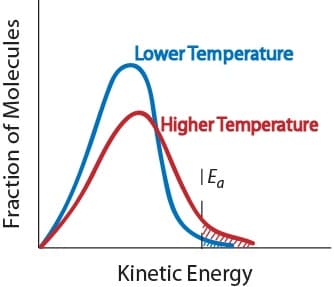
Temperature increases the average kinetic energy of particles. Faster-moving particles collide more often and with greater energy, making it more likely that collisions exceed the activation energy (), the minimum energy needed for a reaction to proceed. A rough rule of thumb (the Q10 rule) says that raising the temperature by 10°C approximately doubles the rate, though this varies by reaction.
The Arrhenius equation captures this relationship mathematically:
- = rate constant
- = frequency factor (related to collision orientation and frequency)
- = activation energy
- = gas constant (8.314 J/mol·K)
- = absolute temperature in Kelvin
As increases, the exponent becomes less negative, so gets larger and the reaction speeds up.
Pressure matters only for reactions involving gases. Increasing the pressure on a gas-phase system compresses the gas into a smaller volume, raising the effective concentration of gas molecules. This leads to more frequent collisions and a faster rate. The Haber process () is a classic example where high pressure is used industrially to increase the rate of ammonia synthesis.
Role of catalysts
A catalyst speeds up a reaction without being consumed. It does this by providing an alternative reaction pathway that has a lower activation energy than the uncatalyzed route. With a lower , a greater fraction of molecular collisions have enough energy to react, so the rate increases.
One critical point: catalysts increase the rate of both the forward and reverse reactions equally. This means a catalyst helps a reaction reach equilibrium faster, but it does not shift the position of equilibrium or change the equilibrium constant ().
There are three main types of catalysts:
- Homogeneous catalysts exist in the same phase as the reactants. For example, an acid dissolved in a liquid-phase reaction mixture acts as a homogeneous catalyst.
- Heterogeneous catalysts are in a different phase from the reactants, typically a solid catalyst with gaseous or liquid reactants. The catalytic converter in a car uses solid platinum and palladium to catalyze gas-phase reactions.
- Enzymes are biological catalysts, usually proteins, that are highly specific to particular reactions. Catalase, for instance, decomposes hydrogen peroxide () extremely efficiently.

Surface area in heterogeneous reactions
When a reaction involves reactants in different phases (like a solid reacting with a liquid or gas), the reaction occurs at the interface between the phases. Increasing the surface area of the solid exposes more of its atoms or molecules to the other reactant, providing more sites where collisions can lead to reaction.
Breaking a solid into smaller pieces dramatically increases the surface-area-to-volume ratio. That's why:
- Powdered sugar dissolves much faster than a sugar cube in water, even though the total mass is the same.
- Porous catalysts like zeolites are used industrially because their internal network of tiny channels creates an enormous surface area for catalysis.
- Dust explosions in grain elevators happen because finely dispersed flour particles react with oxygen far faster than a bulk pile of flour would.
Impact of changing reaction conditions
Here's a summary of how each factor shifts the reaction rate:
- Increasing concentration, temperature, or pressure (gases only) → increases the rate
- Decreasing concentration, temperature, or pressure (gases only) → decreases the rate
- Adding a catalyst → increases the rate by lowering
- Increasing surface area of a solid reactant or catalyst → increases the rate
When you change multiple factors at once, the effects compound. Raising both concentration and temperature simultaneously produces a larger rate increase than either change alone. Keep in mind, though, that this compounding effect follows from the rate law and the Arrhenius equation, not from Le Chatelier's principle. Le Chatelier's principle describes shifts in equilibrium position, not changes in reaction rate.
See Fiveable more often in Google
Mark Fiveable as a preferred source and Google is more likely to show you our guides in Top Stories, with a "preferred" badge in AI Mode and AI Overviews.