1.3 Reaction mechanisms and rate-determining steps

⏱️General Chemistry II Unit 1 Review
1.3 Reaction mechanisms and rate-determining steps
⏱️ General Chemistry II
Reaction Mechanisms and Rate Laws
Most chemical reactions don't happen in a single step. Instead, they proceed through a series of simpler steps called a reaction mechanism. Understanding these mechanisms lets you predict how fast a reaction will go and figure out which step you'd need to speed up to make the whole process faster.
The slowest step in a mechanism acts as a bottleneck for the entire reaction. This rate-determining step controls the overall speed and dictates the form of the rate law. Knowing how to identify it and write a rate law from it is one of the core skills in chemical kinetics.

Top images from around the web for Significance of reaction mechanisms
7.2. Levels of reactions | Organic Chemistry 1: An open textbook View original
Is this image relevant?
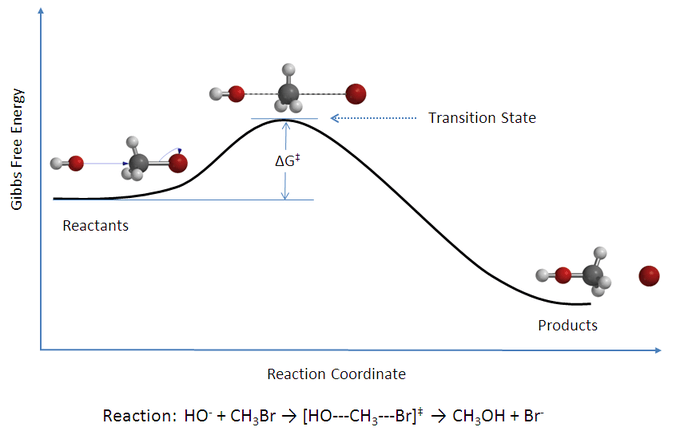
Transition State Theory | Introduction to Chemistry View original
Is this image relevant?
Reaction Mechanisms View original
Is this image relevant?
7.2. Levels of reactions | Organic Chemistry 1: An open textbook View original
Is this image relevant?
Transition State Theory | Introduction to Chemistry View original
Is this image relevant?
Significance of Reaction Mechanisms
A reaction mechanism is the step-by-step sequence of elementary reactions that describes how reactants actually convert into products. Each elementary reaction is a single molecular event with one transition state, like one bond breaking or one bond forming.
- Mechanisms reveal the intermediates (species produced in one step and consumed in a later step) and transition states (unstable, high-energy configurations at the top of each energy barrier) along the reaction pathway.
- They explain why a reaction has a particular rate law, not just what the rate law is.
- This understanding is essential for controlling reactions in organic synthesis, catalysis, and industrial chemistry.
An important distinction: the overall balanced equation tells you the starting materials and final products, but it says nothing about the pathway. Two reactions with identical overall equations can have completely different mechanisms and completely different rate laws.
For a proposed mechanism to be valid, it must satisfy two requirements: (1) the elementary steps must sum to give the overall balanced equation, and (2) the rate law predicted by the mechanism must match the experimentally observed rate law.

Rate-Determining Step Identification
The rate-determining step (RDS) is the slowest elementary step in a multi-step mechanism. Because every step must occur for the reaction to proceed, the slowest step limits the overall rate.
- The RDS typically has the highest activation energy () among all the steps, meaning it has the tallest energy barrier on a reaction energy diagram.
- The overall reaction rate approximately equals the rate of the RDS. Speeding up any other step won't help if the RDS stays the same.
- To identify the RDS, compare the relative rates (or activation energies) of each elementary step. The step with the smallest rate constant or largest is the RDS.
On a multi-step energy diagram, look for the tallest single hill. The peak of that hill corresponds to the transition state of the RDS. Intermediates appear as valleys (local energy minima) between peaks.
For example, if a mechanism has two steps where Step 1 is fast and Step 2 is slow, Step 2 is the RDS. The overall rate depends only on how quickly Step 2 proceeds.

Writing the Rate Law from the Rate-Determining Step
The rate law relates the reaction rate to reactant concentrations and the rate constant :
where and are the reaction orders with respect to each reactant.
To derive the rate law from a mechanism:
- Identify the RDS in the mechanism.
- Write the rate law for that elementary step using the stoichiometric coefficients of its reactants as the exponents. This works because for elementary reactions, the rate law follows directly from the molecularity.
- Check for intermediates. If the RDS rate law includes an intermediate, you need to substitute it out. Use the equilibrium expression from a preceding fast step (the pre-equilibrium approximation): set the forward and reverse rates of that fast step equal, solve for the intermediate's concentration, and plug it back in.
- Verify that the final rate law contains only species that appear in the overall balanced equation (reactants, products, or catalysts).
The resulting expression is the overall rate law for the reaction. The sum of the exponents () gives the overall reaction order. The rate constant depends on temperature and the nature of the reactants.
Worked Example
Consider the reaction with this proposed mechanism:
- Step 1 (fast, reversible):
- Step 2 (slow):
Step 2 is the RDS, so start there:
is an intermediate, so substitute it out. From the fast pre-equilibrium in Step 1:
Substituting back in:
where . The predicted rate law is third-order overall (second-order in NO, first-order in ). If this matches the experimental rate law, the mechanism is consistent with the data.
Molecularity vs. Reaction Order
These two terms sound similar but describe different things.
- Molecularity is the number of reactant molecules (or ions) involved in a single elementary step. It's a theoretical count based on the mechanism, and it's always a positive integer.
- Unimolecular: one molecule (e.g., isomerization or decomposition)
- Bimolecular: two molecules collide and react (most common)
- Termolecular: three molecules collide simultaneously (very rare, because three-body collisions are statistically unlikely)
- Reaction order is the experimentally determined relationship between concentration and rate, given by the exponents in the rate law. It can be an integer, a fraction, or even zero.
For an elementary reaction, molecularity and reaction order are the same. A bimolecular elementary step is second-order; a unimolecular elementary step is first-order.
For an overall reaction with multiple steps, the overall order is determined by the RDS (and any pre-equilibrium substitutions), and it can differ from what you'd guess by looking at the stoichiometric coefficients of the balanced equation. This is exactly why you can't determine a rate law just by looking at the balanced equation. The mechanism is what matters.
See Fiveable more often in Google
Mark Fiveable as a preferred source and Google is more likely to show you our guides in Top Stories, with a "preferred" badge in AI Mode and AI Overviews.