7.4 Electrolysis and Faraday's laws

⏱️General Chemistry II Unit 7 Review
7.4 Electrolysis and Faraday's laws
⏱️ General Chemistry II
Electrolysis

Top images from around the web for Process and applications of electrolysis
Electrolysis | Chemistry View original
Is this image relevant?
Electrolysis | Boundless Chemistry View original
Is this image relevant?
Electrolysis | Chemistry View original
Is this image relevant?
Electrolysis | Chemistry View original
Is this image relevant?
Electrolysis | Boundless Chemistry View original
Is this image relevant?
Process and applications of electrolysis
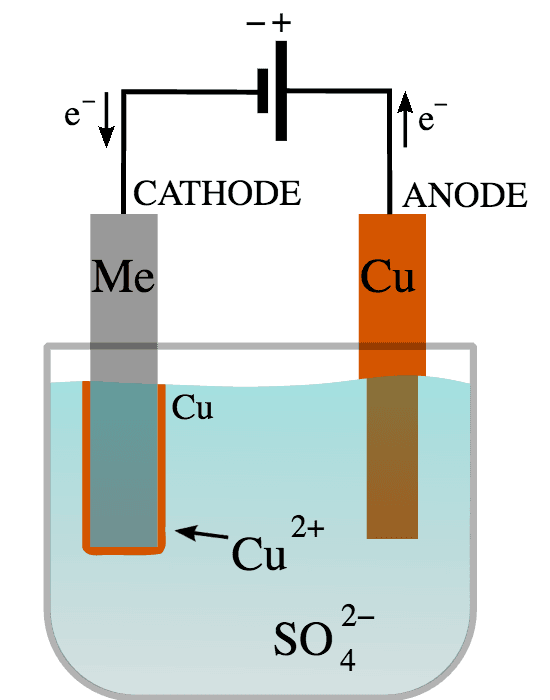
Electrolysis uses electrical energy to force a non-spontaneous redox reaction to occur. While galvanic cells produce electricity from spontaneous reactions, electrolytic cells do the opposite: they consume electricity to make reactions happen that wouldn't occur on their own.
An electrolytic cell requires an external power source (a battery or DC supply) that pushes electrons through the circuit. Pay attention to the electrode polarity here, because it's flipped compared to galvanic cells:
- The anode is the positive electrode, where oxidation occurs
- The cathode is the negative electrode, where reduction occurs
In both galvanic and electrolytic cells, oxidation always happens at the anode and reduction always happens at the cathode. What changes is the sign: in a galvanic cell the anode is negative, but in an electrolytic cell the anode is positive.
Common applications of electrolysis include:
- Electroplating deposits a thin layer of metal onto a surface. The object to be plated serves as the cathode, and the plating metal dissolves from the anode. This is used for jewelry, corrosion protection, and decorative finishes.
- Electrolytic refining purifies metals like copper. Impure copper acts as the anode, dissolves into solution, and pure copper deposits at the cathode.
- Industrial chemical production, such as the chlor-alkali process, which electrolyzes brine (NaCl solution) to produce chlorine gas and sodium hydroxide.
- Electrochemical machining uses electrolysis to precisely remove material from a metal workpiece.

Products of electrolysis in solutions
Predicting what forms at each electrode depends on whether you're electrolyzing a molten salt or an aqueous solution.
Molten salts are straightforward. The cation migrates to the cathode and gets reduced; the anion migrates to the anode and gets oxidized. For example, in molten NaCl:
- Cathode:
- Anode:
Aqueous solutions are trickier because water itself can be oxidized or reduced, so it competes with the dissolved ions. The key is comparing how easily each species is reduced or oxidized.
At the cathode (reduction), the preference order is:
- Less active metal cations like and reduce first (they have more positive reduction potentials)
- Water reduces to form if no easily reduced metal ion is present:
- Active metal cations like , , and are very difficult to reduce in water and typically won't deposit from aqueous solution
At the anode (oxidation), the preference order is:
- Halide anions like , , and oxidize relatively easily
- Water oxidizes to form :
- Oxoanions like and are very resistant to oxidation, so water oxidizes instead
The general rule: the species that's easiest to reduce deposits at the cathode, and the species that's easiest to oxidize reacts at the anode. Comparing standard reduction potentials helps you predict the products.

Faraday's Laws and Electrolytic Cells
Calculations using Faraday's laws
Faraday's laws connect the amount of electric charge passed through a cell to the amount of substance produced or consumed. They're the quantitative backbone of electrolysis calculations.
Faraday's first law states that the mass of substance deposited or dissolved at an electrode is directly proportional to the total charge passed through the cell. The formula is:
where:
- = mass of substance produced (g)
- = total electric charge (coulombs, C)
- = molar mass of the substance (g/mol)
- = number of electrons transferred per ion (from the balanced half-reaction)
- = Faraday's constant = 96,485 C/mol of electrons
Since (current in amps multiplied by time in seconds), you can also write:
Faraday's second law states that when the same quantity of charge passes through different electrolytic cells in series, the masses of substances produced are proportional to their equivalent weights (). This means a given amount of charge deposits more grams of a heavy, low-charge ion than a light, high-charge ion.
Example calculation: How many grams of copper deposit when 5.00 A of current passes through a solution for 1.00 hour?
- Convert time to seconds:
- Calculate total charge:
- Identify variables: , and (from )
- Plug into the formula:
So about 5.93 g of copper would deposit.
Efficiency and overpotential in electrolytic cells
In practice, electrolytic cells rarely achieve 100% of their theoretical yield. Two concepts explain why: current efficiency and overpotential.
Current efficiency is the ratio of the actual product obtained to the theoretical amount predicted by Faraday's laws:
Efficiency drops below 100% for several reasons:
- Side reactions consume some of the current (for example, water being reduced to instead of a metal ion being deposited)
- Back reactions where the product partially re-dissolves or reacts
- Physical losses such as product flaking off the electrode
Overpotential is the extra voltage you need to apply beyond the thermodynamic (calculated) cell potential to make electrolysis proceed at a practical rate. Even if the math says you need 1.23 V to split water, you'll actually need more.
Overpotential has three main sources:
- Activation overpotential: extra energy needed to overcome the activation energy barrier at the electrode surface. This is often the largest contributor, especially for gas-evolving reactions like or production.
- Concentration overpotential: arises when ions near the electrode get depleted faster than they can be replenished from the bulk solution.
- Resistance (ohmic) overpotential: caused by the resistance of the solution, electrodes, and connections in the circuit.
Higher overpotential means more energy consumption per unit of product, which directly reduces the cost-effectiveness of the process. This is why electrode material matters: platinum has low overpotential for hydrogen evolution, while lead or zinc electrodes have much higher overpotential for the same reaction. Industrial processes are carefully designed to minimize overpotential wherever possible.
See Fiveable more often in Google
Mark Fiveable as a preferred source and Google is more likely to show you our guides in Top Stories, with a "preferred" badge in AI Mode and AI Overviews.