3.3 pH scale and calculations for strong and weak acids/bases

⏱️General Chemistry II Unit 3 Review
3.3 pH scale and calculations for strong and weak acids/bases
⏱️ General Chemistry II
pH and the Concentration of Hydronium Ions

Top images from around the web for Definition and significance of pH
File:PH scale 2.png - Wikipedia View original
Is this image relevant?
The pH Scale | Biology for Non-Majors I View original
Is this image relevant?
File:PH scale 2.png - Wikipedia View original
Is this image relevant?
The pH Scale | Biology for Non-Majors I View original
Is this image relevant?
Definition and significance of pH
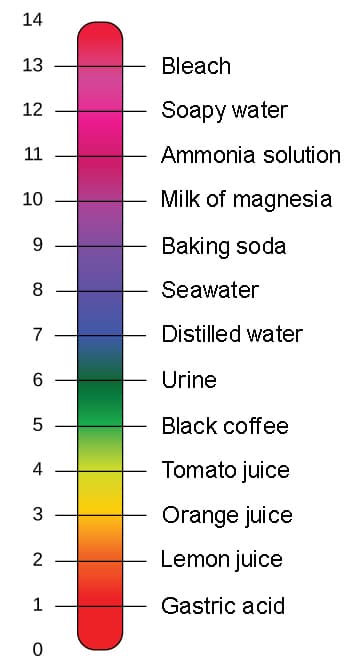
The pH scale is a logarithmic scale that measures how acidic or basic a solution is. Because hydrogen ion concentrations span many orders of magnitude, the log scale compresses those numbers into a manageable 0–14 range.
- pH is defined as the negative base-10 logarithm of the hydronium ion concentration:
- The scale runs from 0 to 14 at 25°C, with 7 being neutral (pure water).
- Lower pH = more acidic (lemon juice ≈ 2, vinegar ≈ 3)
- Higher pH = more basic (baking soda ≈ 8, bleach ≈ 13)
Because the scale is logarithmic, each whole-number change in pH represents a tenfold change in . A solution at pH 3 has ten times more hydronium ions than one at pH 4.
The autoionization of water
In pure water at 25°C, water molecules donate and accept protons from each other in small amounts:
This produces equal concentrations of hydronium and hydroxide ions:
That gives a neutral pH of 7. From here, the classification is straightforward:
- Acidic solutions: M, so
- Basic solutions: M, so
Calculating pH for Strong and Weak Acids and Bases

pH calculations for strong acids and bases
Strong acids and bases completely dissociate in water. That means every molecule that dissolves breaks apart into ions, so the math is direct.
Strong acids (e.g., HCl, , first proton):
Since dissociation is 100%, equals the initial acid concentration.
Strong bases (e.g., NaOH, KOH):
Here equals the initial base concentration. For bases like that release two per formula unit, the initial concentration.
Steps for a strong acid:
- Identify the initial concentration of the acid (e.g., 0.010 M HCl).
- Set equal to that concentration: M.
- Calculate pH: .
Steps for a strong base:
- Identify the initial concentration (e.g., 0.0050 M NaOH).
- Set M.
- Calculate pOH: .
- Convert to pH: .
pH determination for weak acids and bases
Weak acids and bases only partially dissociate, so you can't just set the ion concentration equal to the initial concentration. Instead, you need the equilibrium constant and an ICE table.
Weak acid equilibrium (e.g., acetic acid , ):
Steps for a weak acid (using the approximation method):
- Write the expression and set up an ICE table. Let at equilibrium.
- The equilibrium concentration of HA is , where is the initial concentration.
- Substitute into the expression:
- Apply the 5% approximation: if is much larger than (roughly ), assume . This simplifies the equation to:
- Check the approximation: verify that . If it's not, go back and solve the full quadratic.
- Calculate pH:
Example: Find the pH of 0.10 M acetic acid ().
- M
- Check: ✓ (under 5%)
Weak base equilibrium (e.g., ammonia , ):
The process mirrors the weak acid calculation, but you solve for first:
- Let and set up the ICE table.
- Apply the same approximation:
- Check the 5% rule.
- Calculate pOH:
- Convert:
Converting Between pH, pOH, [H₃O⁺], and [OH⁻]
These four quantities are all connected. If you know any one of them, you can find the other three. Here are the key relationships:
The pH–pOH relationship (at 25°C):
- Given pH, find pOH:
- Given pOH, find pH:
The ion product of water:
- Given , find :
- Given , find :
Converting between pH and concentration:
- and
- and
Quick example: You're given pH = 4.50. Find everything else.
- M
- M
You can also verify: ✓
See Fiveable more often in Google
Mark Fiveable as a preferred source and Google is more likely to show you our guides in Top Stories, with a "preferred" badge in AI Mode and AI Overviews.