
🔟Elementary Algebra Unit 1 Review
1.8 The Real Numbers
1.8 The Real Numbers
Unit & Topic Study Guides
Foundations
Linear Equations and Inequalities
Math Models
Graphs
Systems of Linear Equations
Polynomials
Factoring
Rational Expressions and Equations
Roots and Radicals
Real Number System
Simplification of Square Root Expressions
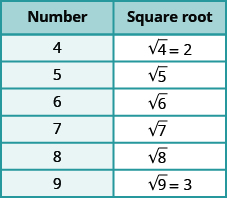
The square root represents a number that, when multiplied by itself, equals . For example, since .
To simplify a square root, factor out the largest perfect square from the radicand (the number under the square root sign):
- Perfect squares (1, 4, 9, 16, 25, 36, ...) simplify cleanly to whole numbers.
- because
- Non-perfect squares require you to find the largest perfect square factor, then split the root.
- because 25 is the largest perfect square that divides evenly into 50
Two useful properties help you simplify expressions with multiple square roots:
- Product property:
- Quotient property:
One thing to remember: square roots always give a value that is positive or zero. You'll never get a negative result from a square root in the real number system.
Types of Numbers in Mathematics
The real number system is built from layers of number types, where each layer includes everything before it.
- Integers are whole numbers and their negatives: ..., -3, -2, -1, 0, 1, 2, 3, ...
- This includes positive integers (1, 2, 3, ...), negative integers (..., -3, -2, -1), and zero.
- Rational numbers can be written as a fraction where and are integers and . All integers are rational too, since you can write any integer as a fraction (like ). Rational numbers also include:
- Fractions like or
- Terminating decimals like 0.5 or -1.25
- Repeating decimals like
- Irrational numbers cannot be written as fractions. Their decimal expansions go on forever without repeating. Common examples include , , and .
- Real numbers encompass all rational and irrational numbers together. Every number you'll encounter in this course is a real number.
A quick way to classify: if a decimal terminates or repeats, it's rational. If it goes on forever with no pattern, it's irrational.

Number Line Representation of Fractions
To plot a fraction like on a number line:
- Identify the two whole numbers the fraction falls between (0 and 1 for ).
- Divide the space between those whole numbers into equal parts based on the denominator (4 equal parts).
- Count from the left whole number by the numerator (3 parts from 0).
Decimals on a number line follow a similar process:
- Identify the two whole numbers the decimal falls between (1 and 2 for 1.6).
- Divide the space between those whole numbers into ten equal parts (tenths).
- Count from the left whole number by the tenths digit (6 tenths past 1).
Ordering Real Numbers on Number Lines
On a number line, numbers increase as you move to the right. So any number to the right of another number is greater.
To order a mixed set of real numbers from least to greatest, convert them to decimal approximations so you can compare directly. For example, to order , , , and :
- , , ,
- From least to greatest: , , ,
Properties of Real Numbers
- Density property: Between any two real numbers, there is always another real number. No matter how close two numbers are, you can always find one in between.
- Completeness property: Every point on the number line corresponds to a real number, and every real number corresponds to a point on the number line. There are no "gaps."