4.2 Graph Linear Equations in Two Variables

🔟Elementary Algebra Unit 4 Review
4.2 Graph Linear Equations in Two Variables
Graphing Linear Equations
Solutions and graph representations
A linear equation in two variables (like and ) represents a straight line when you graph it on a coordinate plane. Every point on that line is a solution to the equation, meaning its and values make the equation true when you plug them in.
The graph gives you a visual picture of the entire solution set. Instead of listing solutions one by one, you can see at a glance:
- The direction of the relationship (is increasing or decreasing as increases?)
- The steepness of the relationship (how quickly changes relative to )
- Specific solutions by reading coordinates off the line
For example, the equation has infinitely many solutions. The point is one of them because . The graph shows all of these solutions at once as a straight line.

Graphing linear equations
To graph a linear equation, you plot points that satisfy the equation and then connect them with a straight line. Here's the process:
- Pick values for . Choose at least two, but three is better for accuracy. Simple values like or tend to keep the arithmetic easy.
- Substitute each -value into the equation and solve for . This gives you ordered pairs .
- Plot the ordered pairs on the coordinate plane. The -coordinate tells you how far left or right to go; the -coordinate tells you how far up or down.
- Connect the points with a straight line using a straightedge, and extend the line in both directions with arrows to show it continues.
Only two points are technically needed to determine a line, but plotting a third point acts as a check. If all three points don't line up, you know there's an arithmetic mistake somewhere.
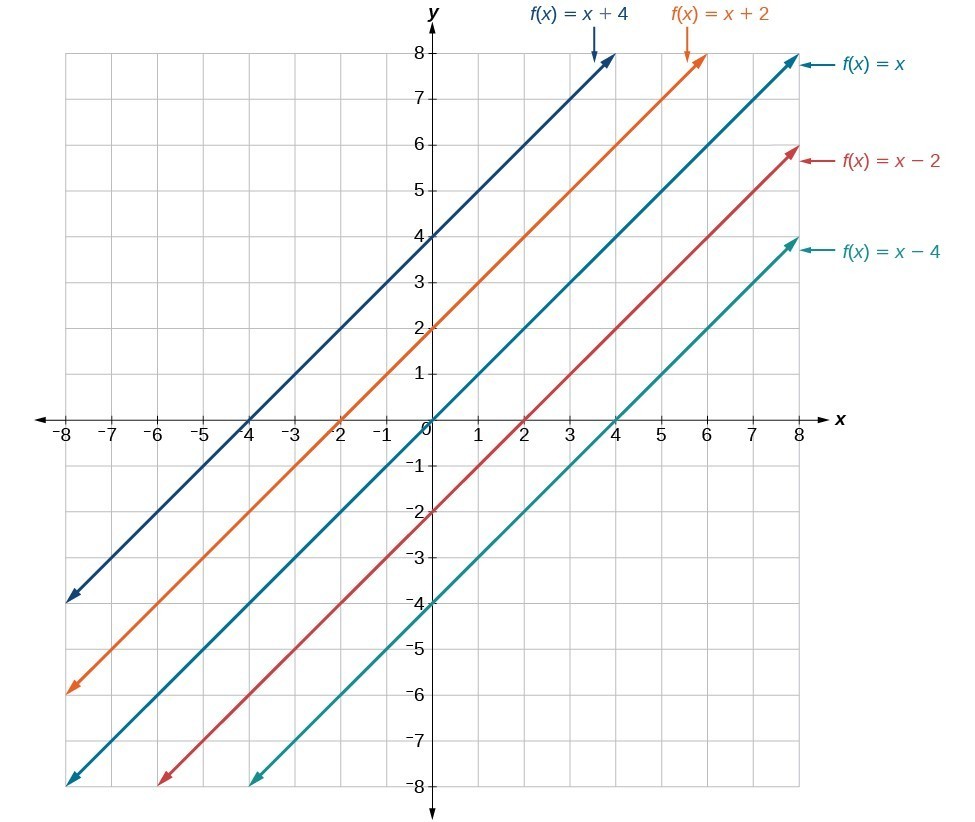
Example: Graph
- If : → point
- If : → point
- If : → point
Plot these three points and draw a straight line through them.
Vertical vs horizontal lines
These two special types of lines trip students up because they look different from typical linear equations.
Vertical lines have equations of the form , where is a constant. The -coordinate is the same for every point on the line, no matter what is.
- passes through , , , and every other point where is 3.
- Vertical lines run straight up and down, perpendicular to the -axis.
- To graph one, find on the -axis and draw a vertical line through it.
Horizontal lines have equations of the form , where is a constant. The -coordinate is the same for every point on the line, no matter what is.
- passes through , , , and every other point where is .
- Horizontal lines run left and right, perpendicular to the -axis.
- To graph one, find on the -axis and draw a horizontal line through it.
A quick way to remember: the equation tells you which coordinate is "locked." If is locked (), the line is vertical. If is locked (), the line is horizontal.
Coordinate Plane Components
The coordinate plane is formed by two number lines crossing at a right angle:
- The x-axis is the horizontal number line.
- The y-axis is the vertical number line.
- The origin is where they intersect, at .
These axes divide the plane into four quadrants, numbered I through IV counterclockwise starting from the upper right.
An intercept is where a line crosses an axis:
- The x-intercept is the point where the line crosses the -axis. At this point, .
- The y-intercept is the point where the line crosses the -axis. At this point, .
Intercepts are useful for graphing because they're easy to calculate and give you two points right away.
Additional Concepts
A function is a relation where each input (-value) produces exactly one output (-value). Most linear equations in two variables are functions: for any you choose, there's only one corresponding .
The one exception among lines is vertical lines. A vertical line like gives infinitely many -values for a single -value, so vertical lines are not functions. You can check this with the vertical line test: if any vertical line you draw would cross the graph more than once, the graph is not a function.
See Fiveable more often in Google
Mark Fiveable as a preferred source and Google is more likely to show you our guides in Top Stories, with a "preferred" badge in AI Mode and AI Overviews.