4.5 Use the Slope-Intercept Form of an Equation of a Line

🔟Elementary Algebra Unit 4 Review
4.5 Use the Slope-Intercept Form of an Equation of a Line
Understanding the Slope-Intercept Form
Slope-Intercept Form and Graphs
The slope-intercept form of a linear equation is . This single equation tells you two things about a line right away:
- is the slope, which describes the steepness and direction of the line. A positive slope means the line rises from left to right. A negative slope means it falls from left to right.
- is the y-intercept, the point where the line crosses the y-axis.
Identifying Slope and Y-Intercept
To pull the slope and y-intercept out of an equation, make sure it's in form. The coefficient of is the slope, and the constant term is the y-intercept.
For example, in :
- The slope is (the line falls from left to right)
- The y-intercept is , so the line crosses the y-axis at
The slope also represents the rate of change: for every 1 unit you move to the right along the x-axis, the y-value changes by units.

Graphing Lines with Slope-Intercept
To graph a line from slope-intercept form:
- Plot the y-intercept on the y-axis.
- Use the slope to find a second point. Write the slope as a fraction . From the y-intercept, move up (or down if negative) by the rise and right by the run. For example, a slope of can be written as , so you'd move down 3 units and right 1 unit.
- Draw a straight line through the two points, extending it in both directions.
Plotting at least two points is all you need, but finding a third point is a good way to check your work.
Efficient Line Graphing Methods
- When the y-intercept is a whole number, the standard method above works smoothly.
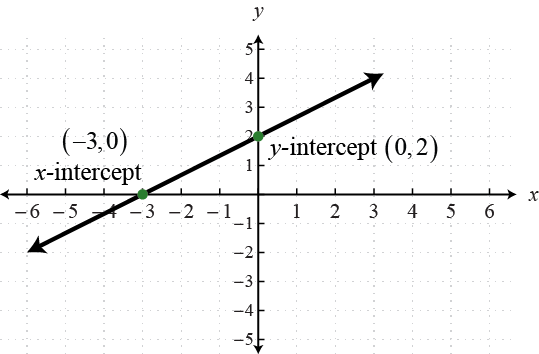
- When the y-intercept is a fraction or decimal, it can be easier to also find the x-intercept. Set and solve for . Then plot both intercepts and draw the line through them.
- Vertical lines can't be written in slope-intercept form because their slope is undefined. Their equation is , where is a constant. Just draw a vertical line through the point .
Real-World Applications of Slope-Intercept
In real-world problems, the slope and y-intercept usually have concrete meanings.
Consider a cost equation like , where is total cost and is the number of items produced:
- The slope is the cost per item (each additional item adds $50).
- The y-intercept is the fixed cost, the amount you pay before producing anything (like equipment or setup fees).
Whenever you see a linear equation in context, ask yourself: What does the slope mean per unit? What does the y-intercept represent at the start?
Parallel Lines and Slopes
Parallel lines have the same slope but different y-intercepts. Because their steepness is identical, they never intersect.
For example, and are parallel. Both have a slope of , but they cross the y-axis at different points ( and ).
Perpendicular Lines and Slopes
Perpendicular lines meet at a 90° angle. Their slopes are negative reciprocals of each other. That means you flip the fraction and change the sign.
- If one line has a slope of , a perpendicular line has a slope of .
- If one line has a slope of (which is ), a perpendicular line has a slope of .
A quick check: multiply the two slopes together. If the product is , the lines are perpendicular. For the first example: .
See Fiveable more often in Google
Mark Fiveable as a preferred source and Google is more likely to show you our guides in Top Stories, with a "preferred" badge in AI Mode and AI Overviews.