4.7 Graphs of Linear Inequalities

🔟Elementary Algebra Unit 4 Review
4.7 Graphs of Linear Inequalities
Graphing Linear Inequalities
Linear inequalities expand on linear equations, showing regions of solutions instead of single lines. They're useful for understanding real-world scenarios with ranges of acceptable values, like budgets or production limits.
Graphing these inequalities involves plotting a boundary line and shading the correct side. The inequality symbol determines which side to shade and whether the line is solid or dashed.
Graphing Linear Inequalities
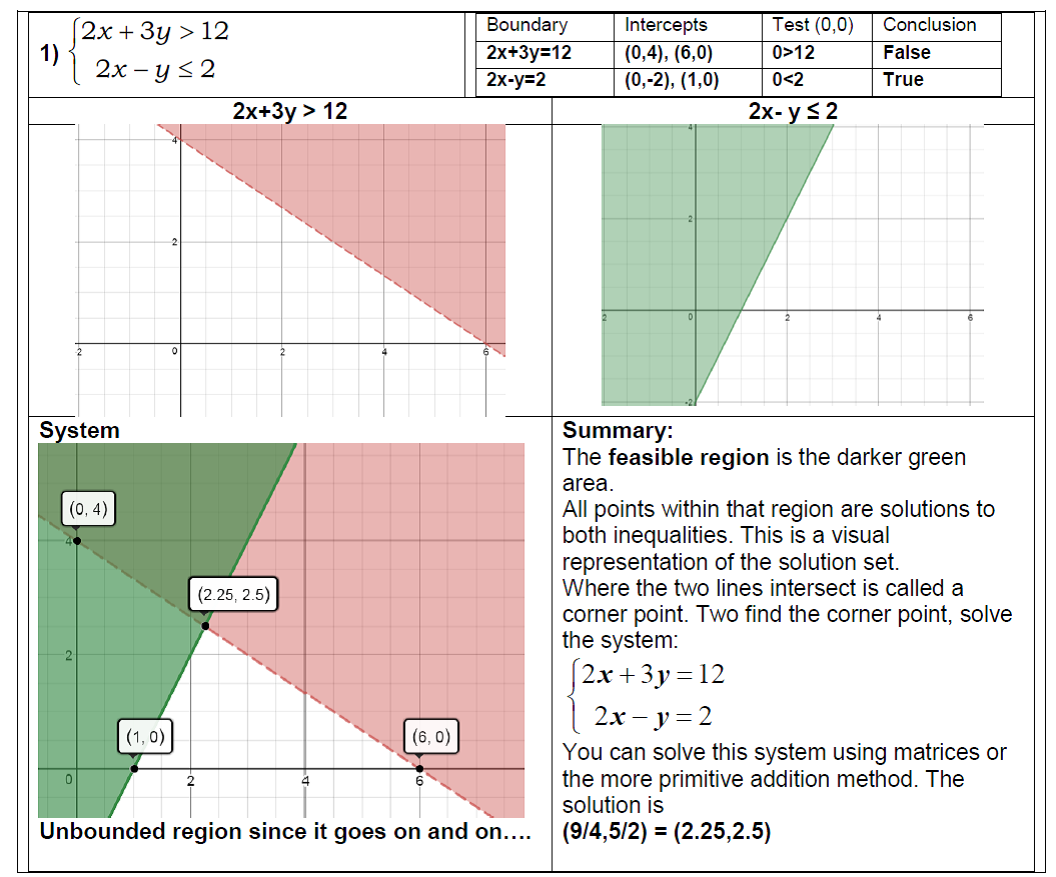
How to graph a linear inequality
Here's the process, step by step:
-
Rewrite in slope-intercept form. Get the inequality into the form , , , or . This makes it easy to identify the slope and y-intercept for graphing.
-
Draw the boundary line using the slope () and y-intercept (), just like you would for a regular linear equation.
- Use a dashed line for strict inequalities ( or ). The dashed line means points on the line are not included in the solution.
- Use a solid line for inclusive inequalities ( or ). The solid line means points on the line are included.
-
Shade the correct side of the boundary line:
- Shade below the line for or
- Shade above the line for or
"Above" and "below" refer to the standard orientation when the inequality is solved for . If you're unsure, use a test point (covered below) to confirm.

Solution sets in inequality graphs
Unlike a linear equation where solutions lie on the line, a linear inequality's solutions fill an entire region. The shaded region represents the solution set, meaning every point in that region makes the inequality true.
- Any point in the shaded region satisfies the inequality when you substitute its coordinates for and .
- Points on the boundary line are solutions only if the inequality is inclusive ( or ).
- For : the point sits on the boundary line since . Because the symbol is , this point is a solution.
- Points on the boundary line are not solutions if the inequality is strict ( or ).
- For : that same point is not a solution, because is not strictly less than .
Testing points to verify your shading
If you're ever unsure which side to shade, the test point method gives you a definite answer.
-
Pick a test point that is clearly not on the boundary line. The origin is the easiest choice because it simplifies the arithmetic. (If the boundary line passes through the origin, pick a different point like .)
-
Substitute the test point's coordinates into the original inequality.
-
Evaluate:
- If the inequality comes out true, shade the side that contains the test point.
- If the inequality comes out false, shade the opposite side.
For example, take . Plugging in : is ? That gives , which is true. So you shade the side of the line that contains .
Now take . Plugging in : is ? That gives , which is false. So you shade the side that does not contain .
Tools and concepts for graphing linear inequalities
- The coordinate plane is where you'll visualize the boundary line and shaded solution region.
- A graphing calculator can plot linear inequalities quickly, which is helpful for checking your work.
- You need a solid understanding of linear functions (slope, y-intercept, graphing lines) before tackling inequalities, since the boundary line is just the corresponding linear equation.
See Fiveable more often in Google
Mark Fiveable as a preferred source and Google is more likely to show you our guides in Top Stories, with a "preferred" badge in AI Mode and AI Overviews.