2.4 Use a General Strategy to Solve Linear Equations

🔟Elementary Algebra Unit 2 Review
2.4 Use a General Strategy to Solve Linear Equations
🔟 Elementary Algebra
2.1
Solve Equations Using the Subtraction and Addition Properties of Equality
2.2
Solve Equations using the Division and Multiplication Properties of Equality
2.3
Solve Equations with Variables and Constants on Both Sides
2.4
Use a General Strategy to Solve Linear Equations
2.5
Solve Equations with Fractions or Decimals
2.6
Solve a Formula for a Specific Variable
2.7
Solve Linear Inequalities
Solving Linear Equations
Linear equations let you find the value of an unknown variable by balancing both sides of an equation. A consistent solving strategy helps you handle longer equations and prepares you for the algebra topics that build on this skill.
Understanding Linear Equations
A linear equation is an equation where the variable has an exponent of 1 (no , no , just ). When graphed, it produces a straight line.
A few terms to keep straight:
- Variable: a letter (usually ) that stands for an unknown value you're solving for.
- Constant: a plain number with no variable attached, like 3 or .
- Coefficient: the number multiplied by a variable. In , the coefficient is 5.
Solving a linear equation means rearranging it until the variable is alone on one side and a number is on the other.
Step-by-Step Strategy
Follow these steps in order every time. Sticking to the same process keeps you from skipping something, especially as equations get longer.
-
Simplify each side separately.
- Distribute any multiplication across parentheses. For example, .
- Combine like terms on each side. For example, becomes .
-
Collect variable terms on one side and constants on the other.
- Add or subtract the same value on both sides to move terms across the equals sign. For example, starting with , subtract 3 from both sides: , which gives .
-
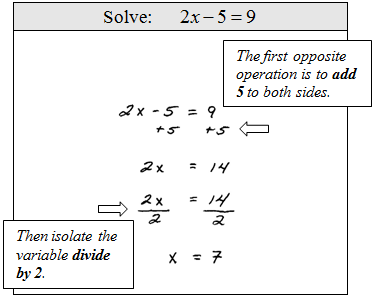
Isolate the variable by dividing both sides by its coefficient.
- If , divide both sides by 2: , so .
-
Check your answer by plugging it back into the original equation.
- Substituting into : . It checks out.
Checking in the original equation (not a simplified version) catches mistakes you might have made during any step.
Types of Linear Equations
Not every linear equation ends with a neat answer like . There are three possible outcomes, and recognizing them will save you from thinking you did something wrong.
- Conditional equation: Has exactly one solution. Most equations you'll solve are this type. Example: gives .
- Identity: True for every value of the variable. When you simplify, both sides reduce to the same thing, and you end up with a statement like . Example: simplifies to . The solution is all real numbers.
- Contradiction: True for no value of the variable. You end up with a false statement like . Example: simplifies to , which is never true. There is no solution.
If you get , don't panic and think you lost the variable. It just means the equation is an identity. If you get something impossible like , that's a contradiction, not an error on your part.
Applying Linear Equations
Word problems are really just linear equations hiding inside sentences. The challenge is translating the words into math.
Solving Word Problems Step by Step
-
Identify the unknown and assign it a variable. For example, "let = the number of apples."
-
Translate the words into an equation. Look for key phrases:
- "twice a number" →
- "5 more than a number" →
- "a number decreased by 3" → Make sure your units are consistent. If represents hours, every term in the equation should relate to hours.
-
Solve the equation using the step-by-step strategy above.
-
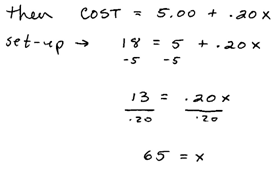
Interpret and check your answer in context. Ask yourself: does this answer make sense for the situation? A negative number of apples or a fractional number of people usually signals a setup error. State your answer with units: "The solution is 5 apples."
-
Verify by substituting your answer back into the original word problem (not just the equation) to confirm it satisfies all the given conditions.
See Fiveable more often in Google
Mark Fiveable as a preferred source and Google is more likely to show you our guides in Top Stories, with a "preferred" badge in AI Mode and AI Overviews.