9.4 Multiply Square Roots

🔟Elementary Algebra Unit 9 Review
9.4 Multiply Square Roots
Multiplying Square Roots
Product property of square roots
The product property of square roots is the foundation for everything in this section. It says that multiplying two square roots is the same as taking the square root of the product of their radicands (the numbers under the radical sign):
This works because square roots are really exponents (), and when you multiply same-base powers, you add exponents.
A few key applications:
- Basic multiplication: Just multiply the radicands and simplify.
- Same radicand: When you multiply a square root by itself, the radical disappears.
- Results that simplify further: Sometimes the product under the radical contains a perfect square factor. Always check for this.
If you don't recognize or right away, factor the radicand to pull out perfect squares. For example, .

Simplification of radical expressions
When coefficients (numbers in front of the radical) are involved, you handle the coefficients and the radicals separately.
Steps for multiplying expressions like :
- Multiply the coefficients together:
- Multiply the radicands together using the product property:
- Simplify the resulting radical by factoring out any perfect squares
Examples:
That second one isn't done yet. , so the final answer is .
You can also convert between coefficient form and radical form when it's helpful:
- (moving the coefficient inside the radical by squaring it)
- Going the other direction: (pulling perfect squares out as coefficients)
Always simplify until no perfect square factors remain under the radical.
Distribution with radicals and polynomials
The distributive property works the same way with radicals as it does with any other term. When you multiply a radical by a sum or difference, distribute it to each term.
For two binomials containing square roots, use FOIL (First, Outer, Inner, Last), then combine like terms:
Example 1:
- First:
- Outer:
- Inner:
- Last:
- Combine:
Notice the middle terms cancel. This always happens when you multiply conjugates (same terms, opposite sign in the middle). The result is just the difference of the squares: .
Example 2:
- First:
- Outer:
- Inner:
- Last:
- Combine:
Advanced techniques for radical expressions
Two things to keep in mind as problems get harder:
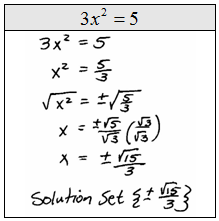
- Rationalization means eliminating radicals from the denominator of a fraction. To do this with a binomial denominator, multiply the numerator and denominator by the conjugate of the denominator. As you saw above, conjugate pairs multiply to give a whole number, which clears the radical from the bottom.
- Exponent rules still apply: and . The absolute value in the second rule matters because the square root function always returns a non-negative result, so if could be negative, you need to keep the answer correct.
See Fiveable more often in Google
Mark Fiveable as a preferred source and Google is more likely to show you our guides in Top Stories, with a "preferred" badge in AI Mode and AI Overviews.