7.3 Factor Trinomials of the Form ax2+bx+c

🔟Elementary Algebra Unit 7 Review
7.3 Factor Trinomials of the Form ax2+bx+c
Factoring Trinomials of the Form

Top images from around the web for Introduction to Polynomial Factoring
OpenAlgebra.com: Free Algebra Study Guide & Video Tutorials: Factoring Trinomials of the Form ax ... View original
Is this image relevant?
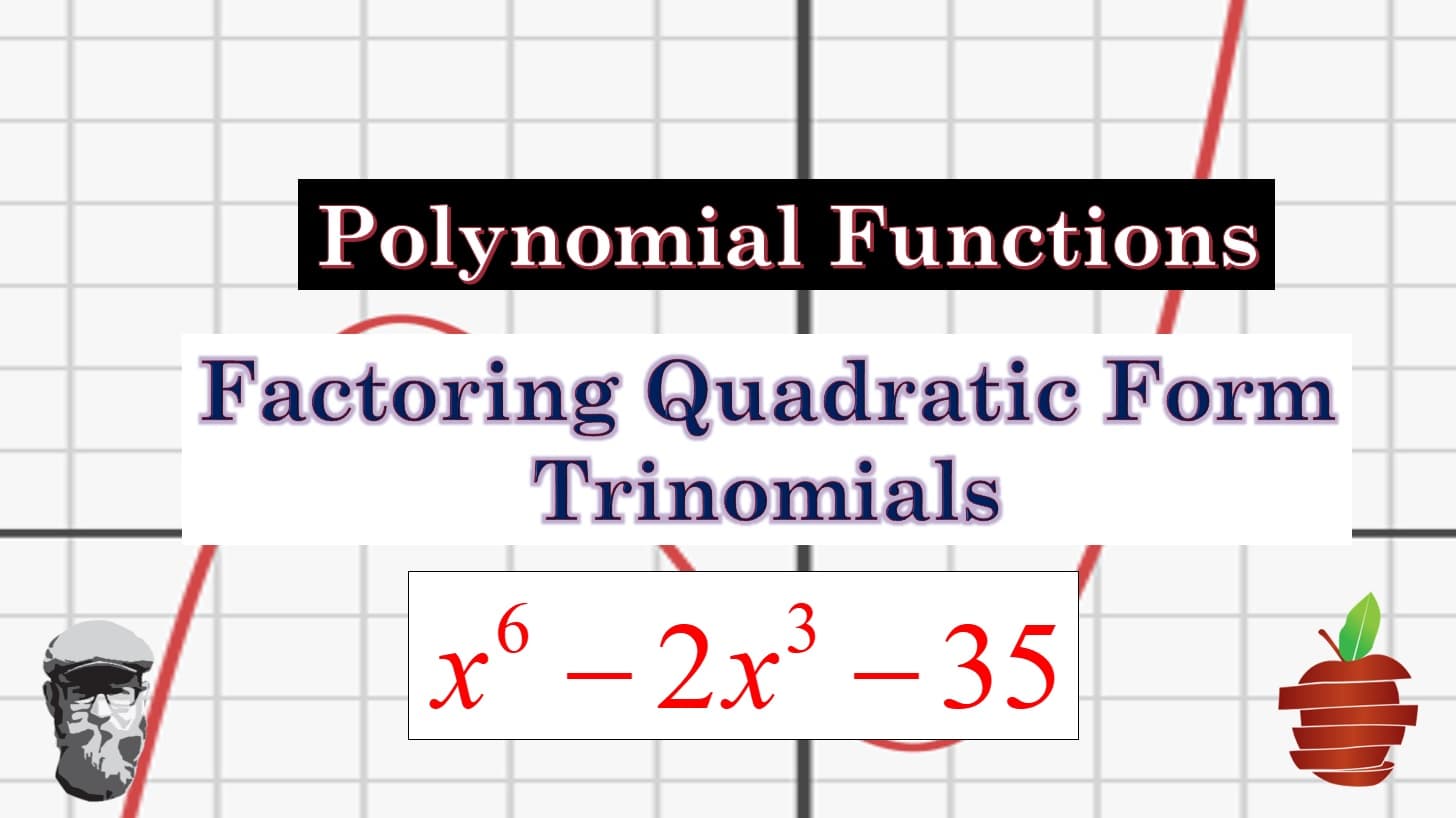
Trinomials in Quadratic Form - The Bearded Math Man View original
Is this image relevant?
OpenAlgebra.com: Free Algebra Study Guide & Video Tutorials: Factoring Trinomials of the Form ax ... View original
Is this image relevant?
OpenAlgebra.com: Free Algebra Study Guide & Video Tutorials: Factoring Trinomials of the Form ax ... View original
Is this image relevant?
Trinomials in Quadratic Form - The Bearded Math Man View original
Is this image relevant?
Introduction to Polynomial Factoring
Factoring breaks a polynomial into simpler expressions that multiply together to give the original. For trinomials of the form , factoring lets you rewrite the expression as a product of two binomials, which helps with solving quadratic equations and simplifying algebraic expressions.
This section focuses on trinomials where , which are trickier than the simpler form. The main technique you'll use here is the ac method (also called factoring by grouping).
Systematic Polynomial Factoring Approach
Before jumping into any specific technique, follow this general process every time you factor:
-
Identify the terms of the polynomial. Determine the coefficients and variables in each term (e.g., , , ).
-
Factor out the GCF first. Always check whether all terms share a greatest common factor before doing anything else (e.g., ).
-
Identify the type of polynomial remaining inside the parentheses. Look for patterns like:
- Difference of squares:
- Perfect square trinomials: or
- General trinomials:
-
Apply the appropriate factoring technique based on what you identified. For general trinomials, the ac method (covered below) is your go-to.

GCF Method for Trinomial Factoring
Pulling out the GCF is always your first step. If you skip this, the remaining trinomial will have larger coefficients, making the rest of the work harder than it needs to be.
- Find the GCF of the coefficients , , and . For example, the GCF of 12, 18, and 6 is 6.
- Find the GCF of the variables. Look at the variable part of each term and take the lowest exponent. For example, the GCF of , , and is .
- Combine the coefficient GCF and the variable GCF. In this example, the overall GCF is .
- Divide each term by the GCF and write the result in parentheses:
Now factor what's left inside the parentheses using the techniques below.
The AC Method (Factoring by Grouping)
This is the most reliable method for factoring trinomials where . Here's how it works, step by step.
Example: Factor
-
Multiply and . Here and , so .
-
Find two numbers that multiply to and add to . You need two numbers whose product is and whose sum is (the coefficient of ).
- List factor pairs of : , , , , ,
- The pair works because
-
Split the middle term using those two numbers:
-
Group into two pairs and factor each group:
-
Factor out the common binomial. Both groups contain :
Check your work: Multiply back out using FOIL. You should get . Always verify by multiplying.

Tips for Choosing the Right Factor Pair
Finding the correct pair in Step 2 is usually the trickiest part. These guidelines help:
- If is positive, both numbers in your pair have the same sign (both positive or both negative). Their shared sign matches the sign of .
- If is negative, the two numbers have opposite signs. The larger absolute value takes the sign of .
For example, in , is negative, so the two numbers have opposite signs. Since is positive, the number with the larger absolute value (4) is positive, giving you .
Common Mistakes to Avoid
- Forgetting to factor out the GCF first. This makes the remaining coefficients unnecessarily large and the factor pairs harder to find.
- Grouping errors in Step 4. When you split the middle term, watch your signs carefully. A sign error in the split will cause the common binomial to not match between the two groups.
- Not checking by multiplying. After you factor, multiply your answer back out. If it doesn't match the original trinomial, something went wrong.
- Assuming every trinomial factors. Some trinomials with integer coefficients are prime (they don't factor over the integers). If no factor pair of adds to , the trinomial can't be factored this way.
See Fiveable more often in Google
Mark Fiveable as a preferred source and Google is more likely to show you our guides in Top Stories, with a "preferred" badge in AI Mode and AI Overviews.