2.3 Solve Equations with Variables and Constants on Both Sides

🔟Elementary Algebra Unit 2 Review
2.3 Solve Equations with Variables and Constants on Both Sides
🔟 Elementary Algebra
2.1
Solve Equations Using the Subtraction and Addition Properties of Equality
2.2
Solve Equations using the Division and Multiplication Properties of Equality
2.3
Solve Equations with Variables and Constants on Both Sides
2.4
Use a General Strategy to Solve Linear Equations
2.5
Solve Equations with Fractions or Decimals
2.6
Solve a Formula for a Specific Variable
2.7
Solve Linear Inequalities
Solving Equations with Variables and Constants on Both Sides
When both sides of an equation have variables and constants, you can't just do one operation and be done. You need a clear strategy to get the variable alone on one side. This section builds directly on solving simpler one-step and two-step equations, so make sure you're comfortable with those first.
The core idea: use inverse operations to move all variable terms to one side and all constant terms to the other, then solve.
Solving Equations with Variables and Constants on Both Sides

Equations with constants on both sides
The golden rule is that whatever you do to one side, you must do to the other. This keeps the equation balanced.
Here's the general process:
- Move variable terms to one side by adding or subtracting them from both sides.
- Combine like terms on each side to simplify.
- Isolate the variable using the inverse operation on whatever constant remains.
For example, solve :
- Subtract from both sides: , which simplifies to
- Subtract 5 from both sides:
Another example with multiplication: if , multiply both sides by 3 to get , then divide both sides by 2 to get .
Balancing equations with variables on both sides
When variables appear on both sides, your first job is to get them all on one side. It doesn't matter which side you choose, but picking the side where the variable term is larger often avoids negative coefficients.
Step-by-step approach:
- Identify the variable terms on each side.
- Add or subtract to move all variable terms to one side.
- Add or subtract to move all constants to the other side.
- Combine like terms.
- Divide (or multiply) to isolate the variable.
Example: Solve
- Subtract from both sides:
- Subtract 3 from both sides:
- Divide both sides by 2:
Example with opposite signs: Solve
- Add to both sides (this eliminates the ):
- Subtract 2 from both sides:
- Divide both sides by 5:
When the variable terms have opposite signs (one positive, one negative), you add to combine them. When they have the same sign, you subtract. This is the most common spot where sign errors happen.
Solving equations that require distribution first
Some equations need simplifying before you can start moving terms around. If you see parentheses, distribute first, then follow the same steps.
Example: Solve
- Distribute on the right side:
- Subtract from both sides:
- Add 1 to both sides:
Example: Solve
- Subtract from both sides:
- Subtract 7 from both sides:
- Divide both sides by 2:
Notice that in this example, moving the smaller variable term () to the other side meant the variable ended up on the right. That's perfectly fine. You could also subtract from both sides to keep on the left, but you'd work with , which gives the same answer.
Key Strategies and Common Mistakes
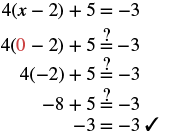
- Always check your answer by plugging it back into the original equation. Both sides should equal the same value.
- Distribute before combining. Don't try to move terms across the equals sign while parentheses are still there.
- Watch your signs. The most frequent errors come from subtracting a negative or forgetting to distribute a negative sign to every term inside parentheses.
- The solution is the value of the variable that makes the equation true. If you substitute it back in and both sides match, you know you got it right.
See Fiveable more often in Google
Mark Fiveable as a preferred source and Google is more likely to show you our guides in Top Stories, with a "preferred" badge in AI Mode and AI Overviews.