8.6 Solve Rational Equations

🔟Elementary Algebra Unit 8 Review
8.6 Solve Rational Equations
🔟 Elementary Algebra
8.1
Simplify Rational Expressions
8.2
Multiply and Divide Rational Expressions
8.3
Add and Subtract Rational Expressions with a Common Denominator
8.4
Add and Subtract Rational Expressions with Unlike Denominators
8.5
Simplify Complex Rational Expressions
8.6
Solve Rational Equations
8.7
Solve Proportion and Similar Figure Applications
8.8
Solve Uniform Motion and Work Applications
8.9
Use Direct and Inverse Variation
Solving Rational Equations
A rational equation is any equation that contains at least one fraction with a variable in the denominator. Solving these equations requires a specific strategy: clear the fractions first, then solve what's left. You'll also need to watch for solutions that break the original equation by making a denominator zero.
These equations show up constantly in word problems involving rates, speed, and shared work, so the techniques here carry forward into many applied problems.
Clearing Fractions in Rational Equations
The core strategy is to multiply every term on both sides by the least common denominator (LCD). This eliminates all the fractions at once, leaving you with a polynomial equation you already know how to solve.
Step-by-step process:
- Find the LCD of all denominators in the equation. For example, if your denominators are and , the LCD is .
- Multiply every term on both sides by the LCD. This cancels out each denominator.
- Simplify and solve the resulting polynomial equation using familiar techniques (combine like terms, isolate the variable, factor if needed).
- Check every solution back in the original equation (more on this below).
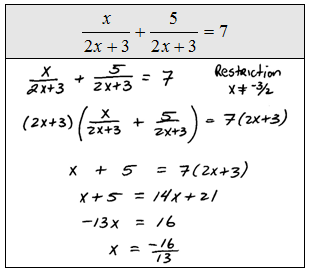
Example: Solve
- The denominators are and , so the LCD is .
- Multiply each term by :
- Subtract from both sides:
- Divide:
- Check: doesn't make any denominator zero, so it's valid.
Checking Solutions and Domain Restrictions
Before you even start solving, identify which values of would make any denominator equal zero. These values are excluded from the domain and can never be solutions.
For , set each denominator equal to zero:
So and . If either of these values comes out of your solving process, you must reject it. A solution that makes a denominator zero is called an extraneous solution.
This check isn't optional. Multiplying by the LCD can introduce false solutions because you're multiplying by an expression that equals zero at the restricted values.

When Solutions Don't Exist (or Are Infinite)
- No solution: If, after clearing fractions, you end up with a contradiction like , the equation has no solution. This can also happen when the only solution you find is extraneous.
- Infinitely many solutions: If the cleared equation simplifies to an identity like (true for every value of ), then every value in the domain is a solution. You'd still exclude any values that make a denominator zero.
Simplification and Preparation
A little prep work before solving can save you a lot of trouble:
- Factor denominators first. If a denominator is , factor it as . This makes finding the LCD much easier and helps you spot domain restrictions right away.
- Find a common denominator when you need to combine rational expressions on one side of the equation.
- Watch for reciprocals. Expressions like and are reciprocals of each other. Recognizing this can simplify certain equations quickly, since their product equals 1.
Applications of Rational Equations
Rational equations frequently appear in two types of word problems:
Distance-Rate-Time Problems use the relationship , which rearranges to . When two trips are involved (say, going somewhere and coming back at different speeds), you'll set up an equation where the time expressions are rational.
Work Rate Problems use the idea that if one person can finish a job in hours and another in hours, their combined rate is:
where is the time to finish the job together.
Solving applied problems:
- Identify the relationship (distance/rate/time, combined work, etc.) and write the equation.
- Substitute known values.
- Solve the rational equation by clearing fractions.
- Check that your answer makes sense in context. A negative time or speed, for instance, signals an error.
- State your answer with appropriate units (miles per hour, hours, etc.).
See Fiveable more often in Google
Mark Fiveable as a preferred source and Google is more likely to show you our guides in Top Stories, with a "preferred" badge in AI Mode and AI Overviews.