1.8 The Real Numbers

🔟Elementary Algebra Unit 1 Review
1.8 The Real Numbers
Real Number System
Simplification of Square Root Expressions
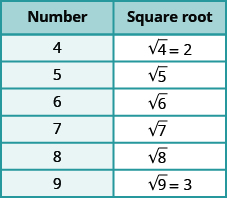
The square root represents a number that, when multiplied by itself, equals . For example, since .
To simplify a square root, factor out the largest perfect square from the radicand (the number under the square root sign):
- Perfect squares (1, 4, 9, 16, 25, 36, ...) simplify cleanly to whole numbers.
- because
- Non-perfect squares require you to find the largest perfect square factor, then split the root.
- because 25 is the largest perfect square that divides evenly into 50
Two useful properties help you simplify expressions with multiple square roots:
- Product property:
- Quotient property:
One thing to remember: square roots always give a value that is positive or zero. You'll never get a negative result from a square root in the real number system.
Types of Numbers in Mathematics
The real number system is built from layers of number types, where each layer includes everything before it.
- Integers are whole numbers and their negatives: ..., -3, -2, -1, 0, 1, 2, 3, ...
- This includes positive integers (1, 2, 3, ...), negative integers (..., -3, -2, -1), and zero.
- Rational numbers can be written as a fraction where and are integers and . All integers are rational too, since you can write any integer as a fraction (like ). Rational numbers also include:
- Fractions like or
- Terminating decimals like 0.5 or -1.25
- Repeating decimals like
- Irrational numbers cannot be written as fractions. Their decimal expansions go on forever without repeating. Common examples include , , and .
- Real numbers encompass all rational and irrational numbers together. Every number you'll encounter in this course is a real number.
A quick way to classify: if a decimal terminates or repeats, it's rational. If it goes on forever with no pattern, it's irrational.

Number Line Representation of Fractions
To plot a fraction like on a number line:
- Identify the two whole numbers the fraction falls between (0 and 1 for ).
- Divide the space between those whole numbers into equal parts based on the denominator (4 equal parts).
- Count from the left whole number by the numerator (3 parts from 0).
Decimals on a number line follow a similar process:
- Identify the two whole numbers the decimal falls between (1 and 2 for 1.6).
- Divide the space between those whole numbers into ten equal parts (tenths).
- Count from the left whole number by the tenths digit (6 tenths past 1).
Ordering Real Numbers on Number Lines
On a number line, numbers increase as you move to the right. So any number to the right of another number is greater.
To order a mixed set of real numbers from least to greatest, convert them to decimal approximations so you can compare directly. For example, to order , , , and :
- , , ,
- From least to greatest: , , ,
Properties of Real Numbers
- Density property: Between any two real numbers, there is always another real number. No matter how close two numbers are, you can always find one in between.
- Completeness property: Every point on the number line corresponds to a real number, and every real number corresponds to a point on the number line. There are no "gaps."
See Fiveable more often in Google
Mark Fiveable as a preferred source and Google is more likely to show you our guides in Top Stories, with a "preferred" badge in AI Mode and AI Overviews.