9.8 Rational Exponents

🔟Elementary Algebra Unit 9 Review
9.8 Rational Exponents
Properties and Notation
Rational exponents let you write roots as exponents. Instead of using radical signs, you express the root as a fraction in the exponent. This matters because once a root is written as an exponent, you can use all the same exponent rules you already know.
The core idea: the denominator of the fractional exponent is the root index, and the numerator is the power. So means "take the cube root of , then square it" (or equivalently, "square , then take the cube root").
Simplification of rational exponents
Rational exponents follow the exact same laws as integer exponents. The only difference is that you're adding, subtracting, or multiplying fractions instead of whole numbers.
- Product rule (same base, multiply → add exponents):
- Quotient rule (same base, divide → subtract exponents):
- Power rule (raise a power to a power → multiply exponents):
Here's how these look with fractional exponents:
The trickiest part is usually the fraction arithmetic. If you're getting wrong answers, double-check that you're finding common denominators when adding or subtracting the exponents.
Laws of exponents for fractional powers
Every fractional exponent can be rewritten as a radical, and vice versa:
Negative fractional exponents work the same way negative integer exponents do: flip the base into a reciprocal, then apply the positive exponent.
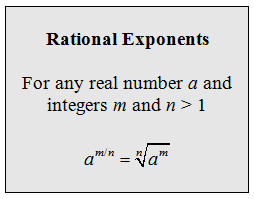
Conversion
Radical to rational exponent notation
Converting between the two forms is one of the most-tested skills in this section. Follow these steps:
Radical → Rational exponent:
- Identify the root index (the small number in front of the radical sign). If there's no number, it's 2 (square root).
- That root index becomes the denominator of the exponent.
- If the expression under the radical has a power, that power becomes the numerator. If there's no visible power, the numerator is 1.
Rational exponent → Radical:
- The denominator of the exponent becomes the root index.
- The numerator becomes the power on the expression under the radical.
Key Concepts
- The base is the number or variable being raised to a power.
- The exponent (or power) tells you the operation to perform on the base. With rational exponents, the denominator specifies a root and the numerator specifies a power.
- A negative exponent means "take the reciprocal." So , whether is a whole number or a fraction.
- Simplification means applying exponent laws to combine terms with the same base and reducing the resulting fraction if possible. Always check whether your final exponent can be simplified (for example, should be written as ).
See Fiveable more often in Google
Mark Fiveable as a preferred source and Google is more likely to show you our guides in Top Stories, with a "preferred" badge in AI Mode and AI Overviews.