9.1 Simplify and Use Square Roots

🔟Elementary Algebra Unit 9 Review
9.1 Simplify and Use Square Roots
Square roots let you find a value that, when multiplied by itself, gives a specific number. They show up often when solving equations, so simplifying and manipulating square roots is a skill you will reuse throughout algebra.
Simplifying and Using Square Roots
Simplification of square root expressions
The core idea behind simplifying a square root is pulling out perfect square factors from under the radical sign. If you can spot a perfect square hiding inside the radicand, you can simplify.
Simplifying with numbers:
- Factor the radicand into a perfect square times whatever is left over.
- Take the square root of the perfect square and move it outside the radical.
It helps to know your perfect squares cold: 4, 9, 16, 25, 36, 49, 64, 81, 100. When you look at 48, you want the largest perfect square that divides it evenly. Here, 16 goes into 48, so you use that.
Simplifying with variables:
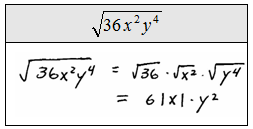
Variables raised to even powers are perfect squares. For instance, is a perfect square because (assuming ). Similarly, is a perfect square because .
Combining like terms under a radical:
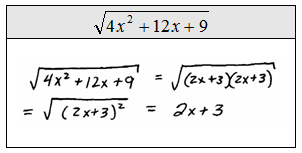
If you have terms under the same square root that can be combined first, do that before simplifying.
Rationalizing denominators:
A simplified expression shouldn't have a square root in the denominator. To fix this, multiply the top and bottom by the square root in the denominator:
You're really just multiplying by 1 in a clever form, so the value doesn't change.
Estimation of square root values
When you need to estimate a square root without a calculator, find the two consecutive perfect squares it falls between.
For :
- and , so is between 3 and 4.
- Since 10 is much closer to 9 than to 16, the answer is just a little above 3. A good estimate is about 3.16.
This technique works for any square root. For : you know and , and 50 is very close to 49, so .
Application of square root properties
Two properties make working with square roots much easier:
Product Property:
You can combine two square roots being multiplied into one:
Quotient Property:
You can combine a division of square roots into one:
Solving equations with square roots:
- Isolate the square root term on one side of the equation.
- Square both sides to eliminate the square root.
- Solve the resulting equation for the variable.
- Square both sides:
- Simplify:
- Solve:
Always check your answer by plugging it back in: ✓. Squaring both sides can sometimes introduce answers that don't actually work (called extraneous solutions), so checking is a good habit.
Radical vs exponential forms
Square roots can be written two ways, and you should be able to switch between them.
- Radical form uses the square root symbol:
- Exponential form uses a fractional exponent:
These mean the exact same thing. To convert:
- Radical to exponential:
- Exponential to radical:
The exponential form becomes especially useful later when you need to apply exponent rules to expressions involving roots.
Number Systems and Square Roots
- Square roots of perfect squares (like ) are rational numbers because they can be written as fractions of integers.
- Square roots of non-perfect squares (like or ) are irrational numbers. Their decimal forms go on forever without repeating.
- Both rational and irrational numbers are part of the real number system.
- You can add, subtract, multiply, and divide square roots, but you can only add or subtract them when they have the same radicand (just like combining like terms). For example, , but cannot be simplified further.
See Fiveable more often in Google
Mark Fiveable as a preferred source and Google is more likely to show you our guides in Top Stories, with a "preferred" badge in AI Mode and AI Overviews.