7.2 Factor Trinomials of the Form x2+bx+c

🔟Elementary Algebra Unit 7 Review
7.2 Factor Trinomials of the Form x2+bx+c
Factoring Trinomials of the Form
Factoring trinomials reverses the multiplication of two binomials, breaking a quadratic expression back into simpler pieces. This skill supports solving quadratic equations and simplifying algebraic expressions throughout the rest of the course.

Top images from around the web for Finding factors for x2+bx+c
OpenAlgebra.com: Free Algebra Study Guide & Video Tutorials: Factoring Trinomials of the Form x ... View original
Is this image relevant?
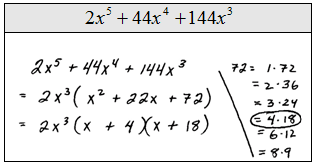
OpenAlgebra.com: Free Algebra Study Guide & Video Tutorials: Factoring Trinomials of the Form x ... View original
Is this image relevant?
OpenAlgebra.com: Free Algebra Study Guide & Video Tutorials: Factoring Trinomials of the Form x ... View original
Is this image relevant?
OpenAlgebra.com: Free Algebra Study Guide & Video Tutorials: Factoring Trinomials of the Form x ... View original
Is this image relevant?
OpenAlgebra.com: Free Algebra Study Guide & Video Tutorials: Factoring Trinomials of the Form x ... View original
Is this image relevant?
Factoring Trinomials of the Form

Finding factors for
The core idea: you need two numbers that multiply to give you (the constant term) and add to give you (the coefficient on ). Once you find those two numbers, you write the factored form as .
Example: Factor
- Ask: what two numbers multiply to 6 and add to 5?
- Try factor pairs of 6: (1, 6) and (2, 3).
- Since , those are your numbers.
- Write the answer:
You can always check your work by FOILing the result back out. ✓

Factoring with negative terms
Negative signs change which factor pairs you're looking for, but the same core method applies. Pay close attention to the signs of and .
When is negative and is positive, both numbers must be negative. That's because two negatives multiply to a positive (giving you ) and add to a negative (giving you ).
- Factor : you need two numbers that multiply to and add to .
- The pair and works: and .
- Factored form:
When is negative, one number is positive and the other is negative. Their product must be negative (giving you ), and their sum must equal .
- Factor : you need two numbers that multiply to and add to .
- The pair and works: and .
- Factored form:
Quick sign guide:
- positive, positive → both numbers positive
- positive, negative → both numbers negative
- negative → one positive, one negative (the larger number takes the sign of )
AC method for complex trinomials
The AC method handles trinomials where the leading coefficient isn't 1, like with . This goes beyond the form, but it builds directly on the same find-two-numbers strategy.
Steps for the AC method:
- Multiply to get the product .
- Find two numbers that multiply to and add to .
- Rewrite the middle term () as two separate terms using those numbers.
- Factor by grouping (split into two pairs and factor each pair).
Example: Factor
- Two numbers that multiply to 6 and add to 7: 1 and 6.
- Rewrite the middle term:
- Factor by grouping:
- Group:
- Factor each group:
- Factor out the common binomial:
The grouping step works because both groups share the same binomial factor . If your groups don't share a common binomial, double-check your number pair from step 2.
See Fiveable more often in Google
Mark Fiveable as a preferred source and Google is more likely to show you our guides in Top Stories, with a "preferred" badge in AI Mode and AI Overviews.