6.3 Multiply Polynomials

🔟Elementary Algebra Unit 6 Review
6.3 Multiply Polynomials
Multiplying polynomials is how you combine two or more polynomial expressions into a single, expanded expression. This skill shows up constantly in algebra, whether you're finding the area of a shape with variable side lengths or simplifying equations. It builds directly on the distributive property you already know from arithmetic.
Multiplying Polynomials
Polynomial-monomial multiplication
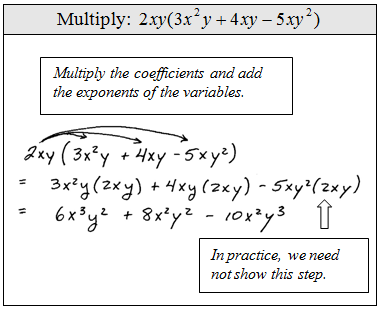
When you multiply a polynomial by a monomial, you distribute the monomial to every term in the polynomial. For each pair of terms, you multiply the coefficients together and add the exponents of matching variables.
Two rules drive the whole process:
- Multiply the coefficients: (because )
- Add exponents of like bases:
After multiplying everything out, combine any like terms ().
Example: Multiply by
Result:
Watch the signs here. A negative times a negative gives a positive, which is how step 2 produces .
FOIL method for binomials
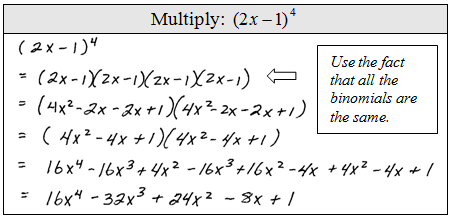
FOIL is a shortcut for multiplying two binomials. The letters stand for the order you multiply: First, Outer, Inner, Last. It's really just the distributive property applied twice, but the acronym helps you keep track so you don't miss any terms.
- First: Multiply the first terms of each binomial
- Outer: Multiply the outermost terms (first of the first binomial, second of the second)
- Inner: Multiply the innermost terms (second of the first binomial, first of the second)
- Last: Multiply the last terms of each binomial
Then add all four results together and combine like terms.
Example: Multiply
- First:
- Outer:
- Inner:
- Last:
Add the terms:
Combine like terms:
The middle terms (Outer and Inner) are where like terms usually appear, so that's where most of your combining happens.
Trinomial-binomial expansion
FOIL only works for two binomials. When one factor has three or more terms, you use the full distributive property: multiply each term of the trinomial by each term of the binomial.
Example: Multiply
- Multiply by each term in : and
- Multiply by each term in : and
- Multiply by each term in : and
Add all the terms:
Combine like terms:
A trinomial times a binomial produces six individual products (3 terms × 2 terms). Keeping your work organized, one term at a time, prevents sign errors and missed terms.
Alternative Multiplication Methods
- Vertical multiplication: Stack the polynomials and multiply term by term, just like long multiplication with numbers. This format makes it easier to line up like terms for combining.
- Area model (box method): Draw a grid where each row represents a term from one polynomial and each column represents a term from the other. Fill in each cell with the product, then add all the cells together. This is especially helpful for visual learners or larger polynomials.
- Factoring: The reverse of multiplication. Where multiplying expands into , factoring takes and breaks it back into . You'll use this skill heavily in upcoming units.
See Fiveable more often in Google
Mark Fiveable as a preferred source and Google is more likely to show you our guides in Top Stories, with a "preferred" badge in AI Mode and AI Overviews.