8.3 Motional EMF

🔋Electromagnetism II Unit 8 Review
8.3 Motional EMF
🔋 Electromagnetism II
Motional EMF
When a conductor moves through a magnetic field, the magnetic force on the charges inside it drives them apart, creating a voltage across the conductor. This voltage is the motional EMF, and it's the core principle behind electric generators: mechanical motion in, electrical energy out.
Motional EMF connects the Lorentz force on individual charges to Faraday's law at the circuit level. Getting comfortable with both perspectives will make the rest of electromagnetic induction click.

Top images from around the web for Straight conductor moving in uniform field
23.1 Induced Emf and Magnetic Flux – College Physics: OpenStax View original
Is this image relevant?
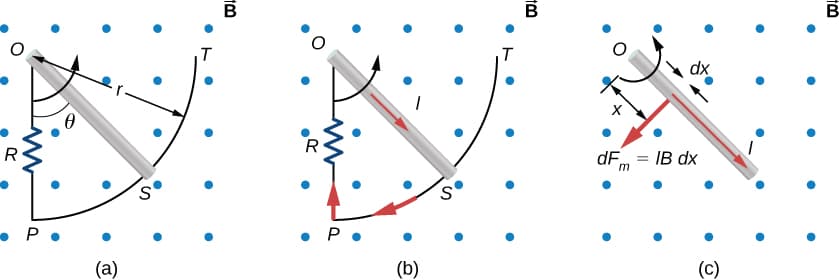
13.3 Motional Emf – University Physics Volume 2 View original
Is this image relevant?
Induced Emf and Magnetic Flux | Physics II View original
Is this image relevant?
23.1 Induced Emf and Magnetic Flux – College Physics: OpenStax View original
Is this image relevant?
13.3 Motional Emf – University Physics Volume 2 View original
Is this image relevant?
Conductor Motion in Magnetic Fields
Straight conductor moving in a uniform field
Picture a straight conductor of length moving at velocity perpendicular to a uniform magnetic field . Every free charge inside the conductor feels the Lorentz force . That force pushes positive charges toward one end and negative charges toward the other, building up a potential difference across the conductor.
Once the charge separation creates an electric field that exactly balances the magnetic force, equilibrium is reached and the EMF across the conductor is:
This holds when , , and are all mutually perpendicular.
Conducting rails in a magnetic field
A classic setup: two parallel conducting rails separated by distance , sitting in a uniform field directed out of (or into) the plane. A conducting bar slides along the rails at velocity .
The sliding bar acts as the moving conductor. It completes a circuit with the rails and any resistor connected across them, so the induced EMF
can actually drive a current. As the bar moves, the enclosed circuit area changes, which ties directly into the flux perspective discussed below.
Motional EMF Calculation
Deriving the motional EMF equation
Starting from the force on a single charge inside the conductor:
- A charge moving with the conductor at velocity through field experiences a magnetic force , where is the angle between and .
- This force acts along the length of the conductor, pushing the charge from one end to the other.
- The work done on the charge as it traverses the full length is .
- EMF is work per unit charge: .
- When the conductor moves perpendicular to the field (), , giving the standard result:
Note the factor. If the conductor's velocity has a component parallel to , only the perpendicular component contributes to the EMF.

Motional EMF polarity and direction
To find which end of the conductor is at higher potential, use the Lorentz force directly:
- Identify the direction of (conductor's velocity).
- Identify the direction of .
- Compute for a positive charge. The force direction tells you where positive charges accumulate, which is the higher-potential end.
You can also use the right-hand rule: point your fingers along , curl them toward , and your thumb points in the direction of the force on a positive charge (toward the positive terminal).
Reversing either the direction of motion or the field direction flips the polarity.
Motional EMF and change in flux
The force-per-charge derivation and Faraday's law give the same answer, and seeing why is important.
As the conductor on the rail setup moves a distance in time , it sweeps out an area . The change in magnetic flux through the circuit is:
Faraday's law says:
The magnitude matches the Lorentz-force result exactly. The negative sign encodes Lenz's law: the induced current opposes the change in flux. This equivalence isn't a coincidence; motional EMF is simply Faraday's law applied to a circuit whose area is changing because part of it is moving.
Motional EMF Applications
Generators
Electric generators rotate conducting coils in a magnetic field. As the coil spins, the component of velocity perpendicular to changes sinusoidally, producing an alternating EMF. For a coil of turns, area , rotating at angular frequency :
- AC generators use slip rings to deliver this sinusoidal output directly.
- DC generators use a split-ring commutator to flip the connection every half-cycle, producing a pulsating (but single-polarity) output.
Motors
A motor is essentially a generator run in reverse: you supply current to a coil in a magnetic field, and the resulting torque spins the coil. As the coil rotates, it generates a motional EMF that opposes the applied voltage. This is called the back-EMF.
Back-EMF is why a motor draws large current at startup (the coil isn't spinning yet, so back-EMF is zero) and progressively less current as it speeds up. At steady state, the back-EMF nearly equals the supply voltage, and the current is just enough to overcome friction and the load.

Transformers
Transformers don't involve physical motion of a conductor, so they don't use motional EMF in the strict sense. Instead, an AC current in the primary winding creates a time-varying magnetic flux in a shared iron core, and that changing flux induces an EMF in the secondary winding via Faraday's law.
The voltage ratio is:
Both motional EMF and transformer EMF are consequences of Faraday's law, but the physical mechanism differs: one changes flux by moving the conductor, the other by varying the field itself.
Motional EMF Experiments
Demonstration setup
A straightforward demonstration needs three things: a straight conductor (a metal rod works), a region of magnetic field (a pair of strong permanent magnets with a gap between them), and a sensitive galvanometer or millivoltmeter connected to the rod's ends.
Move the rod quickly through the gap and the galvanometer deflects. Reverse the direction of motion and the deflection reverses. This directly shows that the EMF depends on the direction of relative to .
Measuring and verifying the motional EMF equation
To test quantitatively:
- Vary by driving the conductor at known speeds (e.g., with a motorized track). Keep and fixed. Plot vs. ; you should get a straight line through the origin with slope .
- Vary using an electromagnet with adjustable current, or by changing the gap between permanent magnets (and measuring with a Hall probe). Keep and fixed.
- Vary by using conductors of different lengths.
In each case, plotting the measured EMF against the single varied quantity should yield a linear relationship. Plotting against the product for all data points should give a straight line with slope 1.
Motional EMF vs. Transformer EMF
Both are instances of electromagnetic induction, and both obey Faraday's law. The distinction is in how the flux changes.
| Motional EMF | Transformer EMF | |
|---|---|---|
| Source of flux change | Conductor moves through a static field (changing area) | Field varies in time through a stationary conductor (changing ) |
| Typical devices | Generators, motors, rail guns | Transformers, inductors, induction coils |
| Key equation variable | Velocity of the conductor | or rate of change of current in the primary |
| Energy conversion | Mechanical ↔ electrical | Electrical ↔ electrical (different voltage levels) |
Both types reduce to the same Faraday's law expression . The "motional" vs. "transformer" labels just describe which part of the flux product is changing: the area or the field.
See Fiveable more often in Google
Mark Fiveable as a preferred source and Google is more likely to show you our guides in Top Stories, with a "preferred" badge in AI Mode and AI Overviews.