11.3 Shielding effectiveness

🔋Electromagnetism II Unit 11 Review
11.3 Shielding effectiveness
🔋 Electromagnetism II
Shielding fundamentals
Electromagnetic shielding uses conductive or magnetic materials to block electromagnetic fields from coupling into or out of a space. Shielding effectiveness (SE) quantifies how well a shield reduces field strength, and it's one of the most practical topics in electromagnetic compatibility (EMC) design. This section covers the physics behind shielding, how to calculate SE, design considerations, and measurement techniques.

Top images from around the web for Electromagnetic interference (EMI)
Stretchable electromagnetic-interference shielding materials made of a long single-walled carbon ... View original
Is this image relevant?
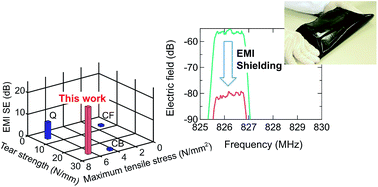
Stretchable electromagnetic-interference shielding materials made of a long single-walled carbon ... View original
Is this image relevant?
Stretchable electromagnetic-interference shielding materials made of a long single-walled carbon ... View original
Is this image relevant?
Stretchable electromagnetic-interference shielding materials made of a long single-walled carbon ... View original
Is this image relevant?
Electromagnetic interference (EMI)
EMI is unwanted electromagnetic energy that disrupts the normal operation of electronic devices. Sources range from natural phenomena (lightning, solar flares) to man-made devices (power lines, motors, switching digital circuits).
The consequences of unmanaged EMI include signal corruption, device malfunctions, and degraded system performance. Shielding is one of the primary tools for controlling EMI, alongside filtering and grounding.
Shielding materials
The choice of shielding material depends on the frequency range, required attenuation, weight constraints, and environmental conditions.
- Conductive materials (copper, aluminum, steel) reflect and absorb electromagnetic waves. Copper offers excellent conductivity; aluminum provides a good balance of conductivity and low weight; steel adds magnetic permeability.
- Magnetic materials (mu-metal, permalloy) have high permeability and are effective at redirecting low-frequency magnetic field lines. These are the go-to choice when you need to shield against quasi-static magnetic fields.
- Composite materials (conductive polymers, metal-coated fabrics) combine conductivity with mechanical flexibility, useful in applications like wearable electronics or irregularly shaped enclosures.
Skin depth
Skin depth () is the distance into a conductor at which the electromagnetic wave amplitude decays to (about 37%) of its surface value. It determines how deeply fields penetrate a shielding material.
where is the angular frequency, is the permeability, and is the conductivity.
As frequency increases, skin depth decreases. This means thin sheets of highly conductive material can provide excellent shielding at high frequencies. For example, the skin depth of copper at 1 GHz is only about 2.1 µm, so even a few micrometers of copper foil attenuates GHz-range signals substantially.
Absorption loss
Absorption loss occurs when electromagnetic energy is converted to heat inside the shielding material through induced currents and ohmic dissipation. It increases with:
- Greater material thickness
- Higher frequency (smaller skin depth means more attenuation per unit thickness)
- Higher conductivity and permeability
Absorption is the dominant shielding mechanism at higher frequencies and for thicker shields.
Reflection loss
Reflection loss arises from the impedance mismatch between the surrounding medium (typically free space, ) and the shielding material (which has much lower intrinsic impedance for good conductors).
- Reflection loss is more significant at lower frequencies and for highly conductive materials.
- It does not depend on shield thickness, only on the impedance contrast at the surface.
- Multiple internal reflections within the shield can provide additional attenuation, though this effect is often small when the shield is much thicker than one skin depth.
Shielding effectiveness (SE)
SE quantifies the ratio of incident field strength to transmitted field strength through a shield. It's the single most important metric for comparing shielding solutions.
Definition of SE
SE is defined as:
where is the field strength without the shield and is the field strength with the shield in place. The same definition applies using fields or power (with a factor of 10 instead of 20 for power ratios).
A higher SE value in dB means better shielding. Some reference points:
- 20 dB corresponds to a field reduction by a factor of 10
- 40 dB corresponds to a factor of 100
- 60 dB corresponds to a factor of 1000
Each additional 20 dB represents another order-of-magnitude reduction.
Electric vs. magnetic fields
SE can differ for electric (E) and magnetic (H) fields depending on the material and frequency.
- Electric fields are relatively easy to attenuate with conductive materials. Free charges in the conductor redistribute to cancel the external E-field.
- Magnetic fields are harder to shield, especially at low frequencies, because they penetrate conductive materials more readily. Effective low-frequency magnetic shielding requires high-permeability materials (mu-metal, permalloy) that provide a low-reluctance path to redirect field lines around the shielded region.
Near-field vs. far-field
Shielding behavior depends on whether the source is in the near-field or far-field.
- The near-field region extends to roughly from the source. Here, E and H fields are not necessarily perpendicular, and the wave impedance depends on the source type (high-impedance for electric dipoles, low-impedance for magnetic loops). Shielding requirements differ accordingly.
- In the far-field, the wave propagates as a plane wave with and a fixed wave impedance of 377 Ω. Far-field shielding is more predictable and generally easier to design for.
This distinction matters in practice: a shield that works well against a far-field plane wave may perform poorly against a nearby magnetic loop source.
Factors affecting SE
- Frequency: Skin depth, absorption, and reflection all vary with frequency, so SE is frequency-dependent.
- Material properties: Conductivity (), permeability (), and thickness () directly determine absorption and reflection losses.
- Geometry: Enclosure shape, size, and the presence of apertures or seams all affect real-world SE.
- Incident angle: Oblique incidence changes the effective impedance mismatch and can reduce SE compared to normal incidence.
- Multiple reflections: Internal reflections within the shield can either enhance or slightly reduce SE depending on shield thickness relative to skin depth.
Calculating shielding effectiveness
The total SE of a solid, continuous shield is the sum of absorption loss and reflection loss. Understanding how to compute each component lets you predict shielding performance before building anything.
Absorption loss calculation
Absorption loss for a shield of thickness :
where the skin depth is:
This tells you that each skin depth of material thickness contributes about 8.7 dB of absorption loss. To calculate absorption loss step by step:
- Determine the frequency , material conductivity , and permeability .
- Compute the skin depth .
- Divide the shield thickness by .
- Multiply by 8.686 to get absorption loss in dB.
For example, a 1 mm copper sheet ( S/m, ) at 1 MHz has mm, giving dB of absorption loss.
Reflection loss calculation
For a plane wave incident on a conductive shield:
More precisely, accounting for both interfaces:
where is the wave impedance (377 Ω for a plane wave in free space) and is the shield impedance:
Since for good conductors, the impedance mismatch is large, producing significant reflection loss. Reflection loss is highest at low frequencies (where is smallest) and decreases as frequency rises.
Multiple reflections
When the shield thickness is comparable to or less than one skin depth, electromagnetic waves reflected from the back surface can re-reflect off the front surface and partially cancel the initial reflection. This multiple reflection correction () reduces the total SE:
where is negative (a loss of shielding). When (typically dB), the wave is sufficiently attenuated before reaching the back surface, and becomes negligible. For thin shields at low frequencies, though, ignoring can lead to overestimating SE.
Total SE calculation
For a solid, continuous shield with no openings:
Steps to compute total SE:
- Calculate absorption loss from the thickness and skin depth.
- Calculate reflection loss from the impedance mismatch.
- If dB, set . Otherwise, compute the multiple reflection correction.
- Sum all three contributions.
For multi-layer shields, calculate the contribution of each layer separately and sum them.
Apertures and seams
Real enclosures have openings (ventilation holes, cable penetrations, display windows, seams between panels), and these are almost always the limiting factor for SE in practice.
- An aperture acts like a slot antenna that allows fields to leak through. The leakage becomes significant when the aperture dimension approaches .
- A single aperture of maximum linear dimension reduces SE approximately by:
This means a 3 cm slot limits SE to about 20 dB at 5 GHz ( cm).
- Multiple small apertures leak less than one large aperture of the same total area. Replacing one large hole with smaller holes of the same total open area improves SE.
- Seams and joints must maintain electrical continuity. Techniques include welding, conductive gaskets (finger stock, wire mesh, conductive elastomers), and overlapping joint designs.
Shielding design considerations
Designing a shield involves balancing electromagnetic performance against practical constraints like weight, cost, manufacturability, and thermal management.

Frequency range
The frequency range of the threat determines material selection:
- Low frequencies (below ~100 kHz): Magnetic fields dominate and are hard to shield with conductors alone. High-permeability materials (mu-metal, permalloy) are often required. Multiple nested shells can improve low-frequency magnetic shielding.
- High frequencies (MHz to GHz): The skin effect makes thin conductive materials very effective. Copper and aluminum are common choices. Aperture control becomes the primary design challenge.
Shielding geometry
- Smooth, continuous enclosures with minimal openings provide the best SE.
- Corners, edges, and protrusions concentrate fields and can create leakage paths.
- Minimizing the number of seams and joints reduces potential leakage points.
- Spherical or cylindrical enclosures are theoretically optimal but rarely practical; rectangular boxes are standard, with attention paid to edge sealing.
Thickness and weight
Increasing shield thickness improves absorption loss but adds weight and cost. The tradeoff is especially important in aerospace and portable electronics.
- At high frequencies, a few skin depths of copper (tens of micrometers) may suffice.
- At low frequencies, thicker material or high-permeability alloys are needed.
- Multi-layer designs (e.g., alternating conductive and magnetic layers) can optimize SE-to-weight ratio.
Joints and gaskets
Joints are often the weakest link in a shielding enclosure. Maintaining electrical continuity across joints requires careful design:
- Permanent joints: Welding, soldering, or brazing create low-impedance connections.
- Removable joints: Conductive gaskets (finger stock, knitted wire mesh, conductive elastomers) seal gaps while allowing disassembly. Gasket selection depends on frequency range, compression force, corrosion environment, and required SE.
- Joint overlap length should be several times the slot width to reduce leakage.
Conductive coatings
For non-conductive enclosures (plastic housings, composite structures), conductive coatings add shielding capability without switching to metal:
- Electroless plating deposits a thin metal layer (typically copper or nickel) with good uniformity.
- Conductive paints (silver, copper, or nickel-filled) are easy to apply but may have lower conductivity than solid metal.
- Vacuum metallization (sputtering, evaporation) produces thin, uniform coatings with good adhesion.
Coating thickness, uniformity, and adhesion to the substrate all affect long-term SE performance. Surface preparation is critical for durability.
Measurement techniques
Measuring SE validates designs and ensures compliance with EMC standards (e.g., IEEE 299 for shielded enclosures, ASTM D4935 for planar materials). Different methods suit different sample types and frequency ranges.
Shielded enclosures
A Faraday cage or shielded room provides a controlled environment free from external EMI. The test procedure:
- Measure the field strength or received power at the test point without the shield sample.
- Insert the shield sample between the source and receiver.
- Measure the field strength or received power again.
- Compute SE from the ratio of the two measurements.
This approach works well for small to medium samples at frequencies up to several GHz.
Reverberation chambers
Reverberation chambers use highly reflective walls and a mechanical or electronic stirrer to create a statistically uniform, isotropic field environment. SE is measured as the difference in average power levels with and without the shield.
These chambers are particularly useful for testing larger samples, higher frequencies, and for simulating the multi-path, multi-polarization conditions found in real environments.
Coaxial transmission line method
The shielding material is placed as a barrier in a coaxial fixture (e.g., a flanged coaxial holder per ASTM D4935). SE is determined from the insertion loss measured with a network analyzer.
- Best suited for flat, thin material samples.
- Provides broadband measurements up to tens of GHz.
- Compact, repeatable, and easy to automate.
Shielded room method
For evaluating complete enclosures (not just material samples), a transmitting antenna is placed outside the enclosure and a receiving antenna inside (or vice versa). SE is the difference in received power with and without the enclosure.
This method captures the real-world effects of apertures, seams, cable penetrations, and ventilation openings that material-level tests miss.
Limitations and challenges
- Test setup details (antenna placement, grounding, cable routing) can significantly influence results.
- The dynamic range of the measurement equipment sets an upper limit on measurable SE. At high frequencies, cable losses and connector leakage can reduce dynamic range.
- Sample preparation matters: wrinkles, poor contact at edges, or oxidation on the sample surface can skew results.
- Translating lab measurements to real-world performance requires accounting for differences in geometry, source characteristics, and environmental conditions.
- Numerical simulations (FDTD, FEM, MoM) complement physical measurements and help predict SE for complex geometries that are difficult to test directly.
Applications of shielding
Shielding is used across nearly every industry that relies on electronic systems. The specific requirements vary widely depending on the electromagnetic environment and the sensitivity of the equipment.
Electronic devices
Consumer electronics (smartphones, laptops, tablets) use board-level shield cans, conductive gaskets, and shielded cables to minimize interference between internal components and meet regulatory emission limits. PCB-level shielding isolates sensitive RF front-ends from noisy digital circuits, reducing crosstalk and improving signal integrity.
Medical equipment
Medical devices operate in electromagnetically complex environments and often have strict immunity requirements. MRI suites require RF-shielded rooms to contain the strong RF excitation fields and prevent external interference from degrading image quality. Implantable devices like pacemakers incorporate shielding to protect against external fields that could cause malfunction or tissue heating.
Military and aerospace
Military communication systems, radar, and electronic warfare equipment must function reliably in hostile electromagnetic environments, including intentional jamming. Aerospace applications demand lightweight, high-performance shielding to protect avionics and satellite electronics from EMI and space radiation, while withstanding temperature extremes, vibration, and outgassing requirements. Conductive composites and multi-layer designs are common in these applications.
Telecommunications
Base stations, data centers, and satellite ground stations use shielding to maintain signal integrity and prevent crosstalk between adjacent channels. Data center racks often incorporate shielded enclosures to contain emissions from densely packed servers. Telecommunications equipment must meet strict EMC standards to coexist with other wireless services operating in nearby frequency bands.
Automotive industry
Modern vehicles contain dozens of electronic control units (ECUs), infotainment systems, and advanced driver-assistance systems (ADAS). Shielding protects these systems from EMI generated by the ignition system, electric motors (especially in EVs and hybrids), and power electronics. Automotive EMC standards (e.g., CISPR 25) set limits on both emissions and immunity, making shielding an integral part of vehicle electronic design.
See Fiveable more often in Google
Mark Fiveable as a preferred source and Google is more likely to show you our guides in Top Stories, with a "preferred" badge in AI Mode and AI Overviews.