2.2 Plane waves

🔋Electromagnetism II Unit 2 Review
2.2 Plane waves
🔋 Electromagnetism II
Wave propagation in free space
Wave propagation in free space describes how electromagnetic waves move through a vacuum or non-conducting medium with no obstacles or boundaries. In free space, EM waves travel at the speed of light ( m/s), and their behavior here sets the foundation for everything else in this unit.
Uniform plane waves
A uniform plane wave is an idealized model where the wavefronts are infinite parallel planes perpendicular to the direction of propagation. The electric and magnetic fields are both perpendicular to each other and to the propagation direction, making this a transverse electromagnetic (TEM) wave. "Uniform" means the amplitude, phase, and polarization are constant across any given wavefront. No real wave is truly uniform and infinite, but this model is extremely useful because it closely approximates the behavior of real waves far from their source.
Transverse electromagnetic waves
In a TEM wave, both and lie entirely in the plane transverse to propagation. Their magnitudes are linked by the intrinsic impedance of the medium:
For free space, . This means if you know the electric field amplitude, you can immediately find the magnetic field amplitude via . TEM waves show up in plane waves in free space, coaxial cables, and parallel plate waveguides.
Wave equation derivation
The wave equations for and come directly from Maxwell's equations. Here's the derivation outline:
-
Start with Faraday's law () and Ampère's law () in source-free free space.
-
Take the curl of Faraday's law. On the left side, use the vector identity .
-
Since in source-free space, the first term vanishes.
-
Substitute Ampère's law into the right side to eliminate .
-
You arrive at the wave equation for :
The same procedure applied to Ampère's law yields the identical form for :
The propagation speed falls out naturally as , confirming that EM waves in free space travel at the speed of light.
Plane wave characteristics
The properties below describe how a plane wave behaves in space and time, and how it interacts with matter.
Amplitude and phase
The amplitude is the peak value of the electric (or magnetic) field and determines the wave's intensity. The phase specifies where in its oscillation cycle the wave is at a given point and time, expressed in radians or degrees. The phase difference between two points on a wavefront controls the relative timing of oscillations, which is central to interference and superposition.
A general plane wave traveling in the direction can be written as:
where is the amplitude and is the initial phase offset.
Wavelength and frequency
- Wavelength (): the spatial distance between two consecutive points of identical phase (e.g., crest to crest).
- Frequency (): the number of complete oscillations per second, measured in hertz (Hz).
These are tied together by:
In free space, is fixed, so higher frequency means shorter wavelength and vice versa.
Polarization
Polarization describes the orientation and behavior of the electric field vector as the wave propagates. There are three types:
- Linear polarization: oscillates along a single fixed direction (e.g., always along ).
- Circular polarization: traces a circle in the transverse plane as the wave advances.
- Elliptical polarization: the general case where traces an ellipse. Linear and circular are special cases of elliptical.
Linear vs circular polarization
Linear polarization is the simplest case: the tip of the vector moves back and forth along one line.
Circular polarization arises when you superpose two linearly polarized waves of equal amplitude with a phase difference. For example, combining and produces a circularly polarized wave. The handedness (right-hand or left-hand circular polarization) depends on the sign of that phase difference: if the vector rotates clockwise when viewed from behind (looking in the direction of propagation), it's right-handed.
Plane wave parameters
These parameters quantify the spatial and temporal structure of a plane wave and govern how it behaves in different media.
Wave vector and propagation constant
The wave vector points in the direction of propagation and has magnitude equal to the wavenumber:
The propagation constant is a complex quantity that captures both attenuation and phase variation:
- : attenuation constant (how quickly the amplitude decays, in Np/m)
- : phase constant (how quickly the phase advances, in rad/m)
In a lossless medium, , so and the wave propagates without losing amplitude.
Dispersion relation
The dispersion relation links wavenumber to angular frequency for a given medium. In free space it's simply:
This is linear, meaning all frequency components travel at the same speed. There's no dispersion in free space.
In a dispersive medium, depends nonlinearly on . Different frequency components then travel at different speeds, causing effects like pulse broadening and chromatic dispersion.
Phase velocity vs group velocity
- Phase velocity : the speed at which a single-frequency wavefront advances.
- Group velocity : the speed at which the envelope of a wave packet (and thus the energy/information) propagates.
In non-dispersive media (like free space), . In dispersive media they differ. Note that can exceed in some situations (e.g., in a waveguide above cutoff), but remains at or below , consistent with the requirement that information cannot travel faster than light.
Energy and power
EM waves carry energy as they propagate. The key quantities here are the Poynting vector, energy density, and time-averaged power flow.
Poynting vector
The Poynting vector gives the instantaneous power density (W/m²) and direction of energy flow:
For a plane wave, always points in the direction of propagation and is perpendicular to both and .
Energy density
The total electromagnetic energy density is the sum of electric and magnetic contributions:
For a plane wave in free space, the electric and magnetic energy densities are exactly equal. This is a direct consequence of the relation combined with . The energy density and Poynting vector are related by , where is the energy propagation velocity.
Power flow
In practice, you usually care about the time-averaged power flow, not the instantaneous value. For time-harmonic (phasor) fields:
where is the complex conjugate of the magnetic field phasor. This gives the average power per unit area flowing through a surface and is the quantity you'd use to calculate, for example, how much power an antenna radiates through a given solid angle.
Reflection and transmission
When a plane wave hits a boundary between two media, part of the energy reflects and part transmits. The split depends on the media properties, the angle of incidence, and the wave's polarization.
Plane wave at dielectric interface
At a dielectric interface (boundary between two non-conducting media with different permittivities), the incident wave splits into a reflected wave and a transmitted wave. The angles follow Snell's law:
The amplitudes of the reflected and transmitted waves are determined by the Fresnel equations.
Fresnel equations
The Fresnel equations give the amplitude reflection and transmission coefficients at a dielectric interface. You need to treat the two polarization cases separately:
s-polarization ( perpendicular to the plane of incidence):
p-polarization ( parallel to the plane of incidence):
Here are the refractive indices and are the incidence and transmission angles.
Reflection vs transmission coefficients
The reflection coefficient is the ratio of reflected to incident field amplitude. It can be positive or negative (a negative value means a phase flip on reflection). The transmission coefficient is the ratio of transmitted to incident field amplitude and is always positive.
To get power ratios, you need the reflectance and transmittance:
The factor involving the cosines and refractive indices in accounts for the change in beam cross-section and wave impedance across the interface. Energy conservation requires .

Brewster angle
The Brewster angle is the incidence angle at which the p-polarized reflection coefficient vanishes (). At this angle, all p-polarized light is transmitted. The condition is:
Physically, this occurs when the reflected and refracted rays are perpendicular to each other. A practical consequence: if unpolarized light hits a surface at Brewster's angle, the reflected light is purely s-polarized. This is the principle behind polarizing filters and glare-reducing techniques.
Plane waves in conducting media
In conducting media (metals, lossy dielectrics), the wave interacts with free charges. This introduces attenuation and phase shifts that don't exist in lossless dielectrics.
Propagation constant in conductors
The propagation constant in a conducting medium becomes complex:
- The real part (attenuation constant) causes exponential amplitude decay.
- The imaginary part (phase constant) governs the spatial phase variation.
The ratio determines whether the medium behaves more like a conductor or a dielectric at a given frequency. When (good conductor limit), the attenuation is strong and .
Skin depth and attenuation
The skin depth is the distance over which the wave amplitude drops to (about 37%) of its surface value:
This formula applies in the good conductor approximation. Notice that skin depth decreases with increasing frequency and increasing conductivity. For copper at 1 GHz, , which is why high-frequency currents flow only in a thin surface layer (the skin effect).
The attenuation constant is related to skin depth by .
Surface impedance
The surface impedance relates the tangential electric and magnetic fields at a conductor's surface:
For a good conductor at high frequencies, this simplifies to:
The equal real and imaginary parts (the factor) mean the electric and magnetic fields at the surface are out of phase. Surface impedance is central to calculating reflection from conductors and losses in waveguides and transmission lines.
Plane wave applications
Plane wave analysis underpins the design and understanding of many electromagnetic systems.
Waveguides and transmission lines
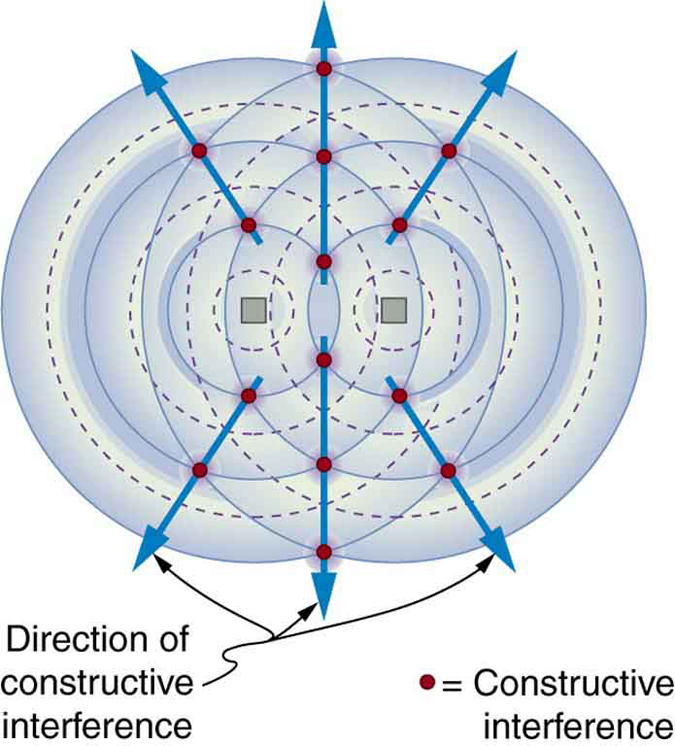
Waveguides and transmission lines confine and guide EM energy along a specific path. Plane wave concepts are used to determine propagation modes, cutoff frequencies, and dispersion characteristics. Common examples include rectangular and circular waveguides, coaxial cables, microstrip lines, and striplines. The cutoff condition for a waveguide mode, for instance, can be understood as the frequency below which the plane wave components can no longer constructively interfere to sustain propagation.
Antennas and radiation patterns
Antennas convert guided waves into free-space waves (transmit) or the reverse (receive). In the far-field region, the wavefronts from any antenna are well-approximated as plane waves. The radiation pattern describes the angular distribution of radiated power in this region. Plane wave analysis is used to characterize directivity, gain, and polarization, and to design antennas for specific applications like wireless communication, radar, and radio astronomy.
Optics and imaging systems
In optics, plane waves model light propagation through lenses, mirrors, and other components. Reflection, refraction, and interference of plane waves at optical interfaces form the basis for understanding cameras, telescopes, and microscopes. Plane wave decomposition (via Fourier optics) is also used in the design of diffraction gratings, polarizers, and wave plates for applications in spectroscopy, holography, and optical data storage.
See Fiveable more often in Google
Mark Fiveable as a preferred source and Google is more likely to show you our guides in Top Stories, with a "preferred" badge in AI Mode and AI Overviews.