8.1 Faraday's law of induction

🔋Electromagnetism II Unit 8 Review
8.1 Faraday's law of induction
🔋 Electromagnetism II
Faraday's law of induction
Faraday's law of induction explains how changing magnetic fields create electric fields. This principle is the foundation for transformers, generators, and motors, and it connects the electric and magnetic parts of electromagnetic theory into a unified picture.
The core idea: an electromotive force (EMF) is induced whenever the magnetic flux through a loop changes with time. The rest of this guide unpacks what that means, how to calculate it, and where it shows up across electromagnetism.

Top images from around the web for Magnetic flux and flux linkage
Magnetic Flux, Induction, and Faraday’s Law | Boundless Physics View original
Is this image relevant?
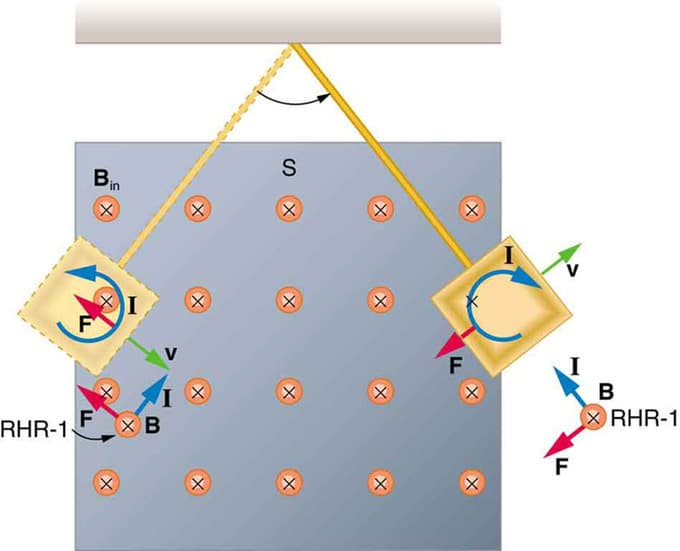
Magnetic Flux, Induction, and Faraday’s Law | Boundless Physics View original
Is this image relevant?
22.1: Magnetic Flux, Induction, and Faraday’s Law - Physics LibreTexts View original
Is this image relevant?
Magnetic Flux, Induction, and Faraday’s Law | Boundless Physics View original
Is this image relevant?
Magnetic Flux, Induction, and Faraday’s Law | Boundless Physics View original
Is this image relevant?
Magnetic flux and flux linkage
Magnetic flux () quantifies how much magnetic field passes through a given surface. Think of it as counting how many field lines thread through the area.
The dot product matters here: only the component of perpendicular to the surface contributes. If is uniform and the surface is flat, this simplifies to , where is the angle between and the surface normal. Flux is measured in webers (Wb).
Flux linkage () extends this to coils with multiple turns:
where is the number of turns. Each turn contributes its own flux, so the total linkage scales linearly with . A change in either or (though is usually fixed) can induce an EMF.
Faraday's law: induced EMF
Faraday's law states that the induced EMF in a closed loop equals the negative time rate of change of the magnetic flux through that loop:
For a coil with turns:
The negative sign encodes Lenz's law (discussed next). The magnitude of the induced EMF depends on how quickly the flux changes, not on the flux itself. A large steady flux through a loop produces zero EMF; a rapidly changing small flux can produce a large one.
There are three ways to change :
- Change the magnitude of
- Change the area of the loop
- Change the angle between and the surface normal
Any combination of these will induce an EMF.
Lenz's law: direction of induced EMF
Lenz's law determines the direction of the induced EMF: it always opposes the change in flux that caused it.
If the flux through a loop is increasing, the induced current flows in the direction that creates a magnetic field opposing the increase (i.e., opposing the external field). If the flux is decreasing, the induced current creates a field that tries to maintain the flux.
This is a direct consequence of conservation of energy. If the induced current reinforced the flux change instead of opposing it, you'd get a runaway process: more flux → more current → even more flux → infinite energy from nothing. Lenz's law prevents this.
In practice, Lenz's law tells you the polarity of induced voltages in transformers and the direction of braking torques in motors and eddy-current systems.
Motional EMF vs. transformer EMF
These are two distinct physical mechanisms, both described by Faraday's law.
Motional EMF arises when a conductor physically moves through a magnetic field. The magnetic force on the charge carriers inside the conductor () drives them along the conductor, creating a potential difference. For a straight conductor of length moving at velocity perpendicular to a uniform field :
This is the mechanism at work in generators and rails problems.
Transformer EMF arises when a stationary conductor sits in a time-varying magnetic field. Here, it's the changing that directly induces a non-conservative electric field, which drives current. The EMF is:
This is the mechanism in transformers and induction coils.
In the most general case (a moving conductor in a time-varying field), both contributions are present. The integral form of Faraday's law handles both simultaneously.

Applications of Faraday's law
- Transformers: Step AC voltages up or down by coupling two coils with different turn counts through a shared magnetic core. The voltage ratio equals the turns ratio.
- Generators: A coil rotating in a magnetic field experiences a continuously changing flux, producing an alternating EMF. This is how most electrical power is generated.
- Motors: The reverse of a generator. Current through a coil in a magnetic field produces torque, converting electrical energy to mechanical energy.
- Induction heating: A rapidly alternating magnetic field induces eddy currents in a conducting material, heating it through resistive dissipation. Used in induction cooktops and industrial heat treatment.
- Electromagnetic braking: A conductor moving through a magnetic field develops eddy currents whose fields oppose the motion, producing a braking force with no physical contact.
Generators and motors
Generators convert mechanical energy into electrical energy. A coil of area with turns rotates at angular frequency in a uniform field . The flux is , so the induced EMF is:
This naturally produces a sinusoidal AC voltage. The peak EMF is . Examples: hydroelectric turbines, wind turbines, car alternators.
Motors run on the same physics in reverse. Current through a coil in a magnetic field creates a torque () that spins the rotor. As the coil rotates, it also generates a back-EMF that opposes the driving voltage. At steady state, the back-EMF nearly equals the supply voltage, and the current drawn is just enough to sustain the mechanical load.
Eddy currents and damping effects
When a bulk conductor (not just a wire loop) is exposed to a changing magnetic field, Faraday's law induces circulating currents throughout the material. These are eddy currents.
They flow in closed loops within the conductor, oriented to oppose the flux change (Lenz's law). This opposition produces:
- Damping forces: A conducting plate swinging through a magnetic field slows down because eddy currents dissipate kinetic energy as heat. This is exploited in electromagnetic brakes on trains and roller coasters.
- Resistive heating losses: In transformer cores, eddy currents waste energy as heat.
To reduce eddy current losses in devices like transformers:
- Laminate the core with thin, insulated sheets of iron. The insulation breaks up the eddy current loops, increasing their path resistance.
- Use high-resistivity core materials (e.g., silicon steel or ferrites) to further suppress the currents.
Self-inductance and mutual inductance
Self-inductance () quantifies how much a coil resists changes in its own current. When current flows through a coil, it creates a magnetic flux through itself. If changes, the flux changes, and by Faraday's law an EMF is induced that opposes the change:
depends on the coil's geometry (number of turns, cross-sectional area, length) and the permeability of the core material. It's measured in henries (H).
Mutual inductance () describes the coupling between two coils. A changing current in coil 1 changes the flux through coil 2, inducing an EMF in coil 2:
By the Neumann formula, is symmetric: the mutual inductance of coil 1 on coil 2 equals that of coil 2 on coil 1. depends on the geometry, relative positioning, and orientation of the coils, as well as the permeability of the medium between them.
Both and are central to the analysis of transformers, coupled circuits, and energy storage in inductors.

Energy stored in magnetic fields
Building up current through an inductor requires work against the back-EMF. That work gets stored as energy in the magnetic field:
This is the magnetic analog of for capacitors.
The energy can also be expressed in terms of the field itself. The energy density (energy per unit volume) of a magnetic field is:
This expression holds for any magnetic field, not just inside inductors. Integrating over all space gives the total stored energy.
When the current through an inductor is interrupted suddenly, the collapsing magnetic field releases its stored energy rapidly, which can produce very large voltage spikes. This is the principle behind spark gaps, automotive ignition systems, and pulsed power devices.
Faraday's law in Maxwell's equations
Faraday's law is one of the four Maxwell's equations. It has two equivalent forms.
Differential form:
This says that a time-varying magnetic field is a source of curl in the electric field. Unlike electrostatic fields (which are curl-free), the electric fields produced by changing magnetic fields form closed loops. They are non-conservative.
Integral form:
The left side is the EMF around a closed loop; the right side is the negative rate of change of flux through any surface bounded by that loop. The two forms are related by Stokes' theorem.
For reference, the complete set of Maxwell's equations:
- Gauss's law (electric):
- Gauss's law (magnetic):
- Faraday's law:
- Ampère-Maxwell law:
Faraday's law and the Ampère-Maxwell law together show that time-varying electric and magnetic fields generate each other, which is what makes electromagnetic wave propagation possible.
Limitations and extensions of Faraday's law
Faraday's law as stated above is exact within classical electrodynamics, but there are contexts where you need to be careful:
- Moving circuits in non-uniform fields: The simple form (the "flux rule") works for most situations, but it can be subtle when the circuit itself is deforming or when parts of the circuit are sliding. In those cases, you need to carefully account for both the motional and transformer contributions, or work directly from the Lorentz force law.
- Displacement current and radiation: For rapidly oscillating fields, the displacement current term () in the Ampère-Maxwell law becomes essential. Without it, you can't describe electromagnetic waves or radiation from antennas.
- Quantum regime: Classical Faraday's law doesn't capture phenomena like the Aharonov-Bohm effect, where a charged particle is affected by a vector potential even in a region where . Quantum electrodynamics (QED) provides the deeper framework.
- Relativistic effects: Electromagnetism is already Lorentz-covariant, so special relativity is built in. But in strong gravitational fields, general relativity modifies the spacetime geometry, and Maxwell's equations must be written in covariant form on curved spacetime.
Experimental verification of Faraday's law
Faraday's original 1831 experiments were straightforward: moving a permanent magnet into and out of a coil of wire produced a deflection on a galvanometer. He showed that the induced EMF depended on the rate of motion, not just the presence of the magnet.
Since then, every transformer, generator, and motor ever built serves as a continuous verification. The predicted voltage ratios, phase relationships, and power transfers all match Faraday's law to high precision.
Modern precision tests use superconducting quantum interference devices (SQUIDs), which can detect flux changes as small as a fraction of a flux quantum ( Wb). SQUID measurements confirm Faraday's law at extraordinary sensitivity, and no deviations have been found.
Historical context and significance
Michael Faraday discovered electromagnetic induction in 1831 through a series of experiments. He had no formal mathematical training, so he described his results in terms of "lines of force," a physical picture that turned out to be remarkably powerful.
James Clerk Maxwell, in the 1860s, translated Faraday's physical intuition into precise mathematical form. Faraday's law became one of the four Maxwell's equations, which together predicted electromagnetic waves and unified optics with electricity and magnetism.
The technological impact has been enormous. Electromagnetic induction is the operating principle behind electrical power generation and distribution, and it enabled the development of radio, television, and essentially all wireless communication. Faraday's law remains one of the most consequential results in all of physics.
See Fiveable more often in Google
Mark Fiveable as a preferred source and Google is more likely to show you our guides in Top Stories, with a "preferred" badge in AI Mode and AI Overviews.