3.2 Rectangular waveguides

🔋Electromagnetism II Unit 3 Review
3.2 Rectangular waveguides
🔋 Electromagnetism II
Modes of propagation
Electromagnetic waves inside a rectangular waveguide don't propagate as simple plane waves. Instead, they travel in distinct patterns called modes, each with its own field configuration and propagation characteristics. The waveguide dimensions and operating frequency together determine which modes can exist.
TE vs TM modes
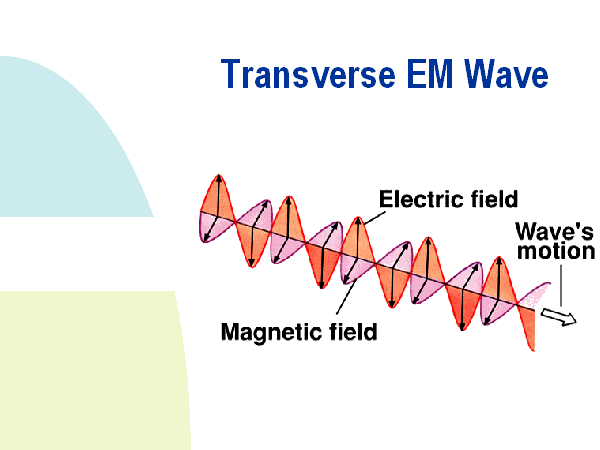
The two families of modes in a rectangular waveguide are distinguished by which field component is absent along the propagation direction (taken as ):
- Transverse Electric (TE) modes have . All electric field components lie in the transverse plane. These are denoted , where and count the number of half-wavelength variations in the and directions, respectively.
- Transverse Magnetic (TM) modes have . All magnetic field components lie in the transverse plane. They follow the same indexing convention.
A key difference: for TM modes, neither nor can be zero (the fields would vanish identically), so the lowest TM mode is . For TE modes, one index (but not both) can be zero, which is why the mode exists. TE modes also tend to have lower attenuation in practice, making them the more common choice.
Dominant mode
The dominant mode is the mode with the lowest cutoff frequency. For a rectangular waveguide with , this is the mode. It has the simplest field pattern, the lowest loss, and the widest usable bandwidth before the next mode turns on. Virtually all single-mode waveguide systems operate in .
Higher order modes
Modes with larger values of or are called higher order modes. They have:
- More complex field patterns (more lobes and nulls across the cross-section)
- Higher cutoff frequencies
- Greater susceptibility to loss
If the operating frequency is high enough to excite multiple modes simultaneously, energy can couple between them at bends, discontinuities, or imperfections. This leads to signal distortion and unpredictable power distribution. That's why single-mode operation is strongly preferred in most designs.
Cutoff frequencies
Each mode has a cutoff frequency , below which it cannot propagate (the fields decay exponentially instead). The cutoff frequency for the or mode is:
where is the broad dimension, is the narrow dimension, and is the speed of light in the filling medium. Note that this formula is identical for TE and TM modes with the same indices; the difference is that TM modes require and .
For single-mode operation, you want the operating frequency to sit above the cutoff but below the cutoff of the next mode (usually or , depending on the aspect ratio).
Field configurations
The spatial distribution of and inside the waveguide depends entirely on which mode is propagating. Getting comfortable with these patterns is essential for understanding coupling, excitation, and loss mechanisms.
Electric field patterns
- TE modes: The electric field lies entirely in the transverse plane. For the mode specifically, has a half-sinusoidal variation across the broad wall (-direction) and is uniform along the narrow wall (-direction). There is no or component.
- TM modes: The electric field has both transverse components and a longitudinal component . The patterns are more complex because itself varies sinusoidally in both and .
Magnetic field patterns
- TE modes: The magnetic field has a longitudinal component plus transverse components. For , varies sinusoidally across the broad wall while has a cosinusoidal variation.
- TM modes: The magnetic field is purely transverse (), forming closed loops in the cross-sectional plane.
Field components
All transverse field components can be derived from the longitudinal component of the surviving field:
- For TE modes (): solve for from the Helmholtz equation with Neumann boundary conditions, then obtain using the standard relations involving the transverse wavenumber .
- For TM modes (): solve for with Dirichlet boundary conditions, then derive the transverse components the same way.
The transverse wavenumber is , and the propagation constant is , where .
Boundary conditions
On perfectly conducting walls:
- The tangential electric field must vanish: at all wall surfaces.
- The normal derivative of must vanish at the walls for TE modes (Neumann condition), while itself must vanish at the walls for TM modes (Dirichlet condition).
These boundary conditions are what quantize the allowed values of and and produce the discrete set of modes.
Waveguide dimensions
The physical size of the waveguide directly controls which modes propagate, the usable bandwidth, and the power capacity. Choosing dimensions carefully is one of the most important steps in waveguide design.
Cross-sectional geometry
A rectangular waveguide has broad dimension and narrow dimension , with the convention . Standard waveguide sizes are cataloged by WR (Waveguide Rectangular) designations. For example, WR-90 has inches (22.86 mm) and is designed for X-band operation (8.2 to 12.4 GHz).
Aspect ratio
The standard aspect ratio is roughly . This choice maximizes the frequency separation between the cutoff and the next mode's cutoff ( or ), giving you the widest single-mode bandwidth. A larger ratio pushes the cutoff higher but reduces power handling (smaller means higher peak fields for the same transmitted power). The 2:1 ratio is a practical compromise.

Frequency range
For single-mode () operation, the usable band runs from the cutoff up to the cutoff of the next mode. In practice, you don't operate right at either edge because attenuation rises sharply near cutoff and higher-order modes can be weakly excited near the upper limit. The recommended operating range is roughly 1.25 to 1.9 times the cutoff frequency.
Attenuation and losses
Real waveguides aren't lossless. Understanding where losses come from helps you choose materials, dimensions, and operating points that minimize signal degradation.
Conductor losses
The waveguide walls have finite conductivity, so currents flowing on the inner surfaces dissipate power. This is the dominant loss mechanism in air-filled waveguides. Conductor loss depends on the wall material's surface resistance , which increases as . Loss also spikes near the cutoff frequency of the operating mode because the group velocity drops and the wave "bounces" more times per unit length.
Dielectric losses
If the waveguide is filled with a dielectric (not just air), the material's loss tangent causes additional attenuation. For air-filled guides, dielectric loss is negligible. For dielectric-loaded guides, it can become significant, especially at higher frequencies.
Attenuation constant
The total attenuation constant (in Np/m or dB/m) is the sum of conductor and dielectric contributions:
The value of depends on the mode, frequency, waveguide dimensions, and materials. Converting between units: .
Quality factor
The quality factor measures how efficiently the waveguide (or a resonant cavity formed from it) stores energy relative to what it dissipates per cycle:
Higher means lower loss and a narrower resonant bandwidth. Waveguide cavities can achieve very high values (on the order of thousands to tens of thousands), which is why they're used in high-performance filters and oscillators.
Impedance and power
Matching impedances and understanding power flow are critical for integrating a waveguide into a larger system without excessive reflections or wasted energy.
Characteristic impedance
The wave impedance for a TE mode relates the transverse field components:
where is the intrinsic impedance of the filling medium. Notice that is always greater than and diverges as . For TM modes, the wave impedance is:
which is always less than and goes to zero at cutoff. Be aware that "characteristic impedance" in waveguides is not as uniquely defined as in TEM transmission lines; the wave impedance above is the most physically meaningful definition.
Power handling capacity
The maximum power a waveguide can carry is limited by dielectric breakdown. The peak electric field for the mode occurs at the center of the broad wall. For air at standard conditions, breakdown occurs around 3 MV/m. Larger cross-sections and lower frequencies reduce the peak field for a given power level, so they handle more power. Pressurizing the waveguide with dry air or gas can significantly increase the breakdown threshold.
Impedance matching
When a waveguide connects to a source, load, or another waveguide section with a different impedance, you need to match impedances to avoid reflections. Common techniques:
- Tapered transitions gradually change the waveguide dimensions over many wavelengths.
- Quarter-wave transformers use an intermediate section whose length is and whose impedance is the geometric mean of the two impedances being matched.
- Matching irises or posts introduce a reactive discontinuity that cancels the mismatch.
Reflection coefficient
The reflection coefficient at a discontinuity is:
where is the load impedance and is the waveguide impedance. means a perfect match (no reflection); means total reflection. The voltage standing wave ratio is related by . Minimizing is essential for efficient power transfer and clean signal transmission.
Excitation and coupling
Getting energy into and out of a waveguide requires structures that convert between the waveguide mode and whatever feeds it (coaxial cable, microstrip, free space, etc.).
Waveguide ports
A waveguide port is the open end or flange where the waveguide interfaces with external components. The port geometry must support the desired mode's field pattern. Standard flanges (like UG-style flanges) ensure repeatable, low-reflection connections between waveguide sections.
Coaxial-to-waveguide transitions
These are among the most common feed structures. A coaxial cable's center conductor extends as a probe into the waveguide, typically positioned at the center of the broad wall (where has its electric field maximum) and roughly from a short-circuited end wall. The short circuit reflects the backward wave so it adds constructively with the forward wave. Probe length and position are tuned for minimum reflection over the desired bandwidth.
Aperture coupling
Energy can also enter a waveguide through an aperture (slot or hole) in a shared wall with another waveguide or cavity. The shape, size, and orientation of the aperture control the coupling strength and which modes are excited. Aperture coupling is widely used in:
- Directional couplers (two waveguides sharing a common broad wall with coupling slots)
- Slot antenna arrays (slots cut in the waveguide wall radiate into free space)
Probe coupling
A conducting probe inserted into the waveguide excites modes whose electric field aligns with the probe. Probe coupling is conceptually similar to the coaxial transition but can also refer to standalone probes used in filters or measurement setups. The probe's length, diameter, and depth of insertion all affect coupling strength and bandwidth.
Discontinuities and obstacles
Any deviation from a uniform waveguide cross-section creates a discontinuity that scatters the incident wave, potentially generating reflections and exciting higher-order (evanescent) modes near the discontinuity.
Irises and windows
Irises are thin metallic plates partially blocking the waveguide cross-section. They introduce reactive impedance:
- An iris that narrows the broad dimension acts as a shunt inductance.
- An iris that narrows the narrow dimension acts as a shunt capacitance.
- A combination (small rectangular aperture) produces a resonant element.
Windows are thin dielectric sheets spanning the cross-section. They're used to seal waveguide sections (for pressurization) while allowing wave transmission. A well-designed window is a half-wavelength thick (in the dielectric) to minimize reflection.
Posts and ridges
Posts are cylindrical conductors extending between the broad walls. A thin post near the center of the broad wall acts approximately as a shunt capacitance; a post spanning the full height acts as an inductive element. Ridges are longitudinal protrusions from one or both broad walls. Ridge waveguides lower the cutoff frequency and increase bandwidth compared to a standard rectangular guide, at the cost of higher loss and reduced power handling.
Bends and twists
Waveguide routing often requires changes in direction or polarization:
- E-plane bends curve the waveguide in the plane of the electric field (narrow wall plane for ).
- H-plane bends curve in the plane of the magnetic field (broad wall plane).
- Twists gradually rotate the cross-section to change the polarization orientation.
Sharp bends cause large reflections, so bends are either made gradual (large radius) or mitered (with a flat cut at 45°) to reduce mismatch. A well-designed bend introduces less than 0.1 dB of loss.
Junctions and splitters
T-junctions split or combine power and come in two varieties:
- E-plane tee: The branch arm is in the narrow wall plane. Power entering the branch splits into two out-of-phase outputs.
- H-plane tee: The branch arm is in the broad wall plane. Power splits into two in-phase outputs.
- Magic tee (hybrid tee): Combines both E-plane and H-plane branches, providing simultaneous sum and difference outputs. It's a four-port device widely used in balanced mixers and measurement systems.
Y-junctions and Wilkinson-style dividers are also used, though the latter is more common in planar circuits. Proper impedance matching at the junction is critical to avoid reflections back toward the source.
Applications and devices
Rectangular waveguides form the backbone of many microwave and millimeter-wave systems. The devices below exploit the waveguide's low loss, high power handling, and well-defined modal structure.
Waveguide filters
Waveguide filters select or reject frequency bands using resonant structures inside the guide. Common implementations include:
- Iris-coupled cavity filters: A series of resonant cavities separated by inductive or capacitive irises. Each cavity is roughly half a guide wavelength long.
- Post filters: Conducting posts create reactive elements that define the filter response.
- Waffle-iron filters: Used for harmonic suppression, these have a corrugated structure on both broad walls.
Waveguide filters achieve very low insertion loss and high power handling, making them standard in satellite communication transponders and radar front ends.
Directional couplers
A directional coupler transfers a controlled fraction of power from a main waveguide to an auxiliary waveguide while maintaining isolation in the reverse direction. The coupling factor (in dB) specifies how much power is coupled, and the directivity measures how well the coupler distinguishes forward from backward waves. Bethe-hole couplers (single aperture) and multi-hole couplers (multiple apertures for broadband performance) are common designs.
Isolators and circulators
Both devices rely on ferrite materials biased by a static magnetic field, which breaks time-reversal symmetry:
- Isolators pass power in one direction and absorb it in the other. They protect sources from reflections.
- Circulators route power from port 1 to port 2, port 2 to port 3, and port 3 to port 1. A common use is connecting a transmitter and receiver to a shared antenna: the transmitter feeds port 1, the antenna connects to port 2, and the receiver sits at port 3.
Typical isolation values are 20 to 30 dB, with insertion loss under 0.5 dB.
Antennas and arrays
Waveguides can radiate directly or feed more complex antenna structures:
- Horn antennas flare the waveguide aperture to produce a controlled beam. Pyramidal horns (flared in both planes) are standard gain references.
- Slot antennas use slots cut in the waveguide wall. By varying slot spacing and orientation, you can control the radiation pattern and achieve beam steering.
- Leaky-wave antennas use a partially open waveguide structure that radiates continuously along its length, producing a beam whose direction changes with frequency.
Waveguide-fed arrays are used in radar, satellite communications, and radio astronomy, where their low loss and high power handling are essential.
See Fiveable more often in Google
Mark Fiveable as a preferred source and Google is more likely to show you our guides in Top Stories, with a "preferred" badge in AI Mode and AI Overviews.