10.2 Boundary conditions for magnetic fields

🔋Electromagnetism II Unit 10 Review
10.2 Boundary conditions for magnetic fields
🔋 Electromagnetism II
Boundary conditions at material interfaces
Boundary conditions describe how magnetic field components behave when crossing from one material into another. Without them, you can't solve for field distributions in any realistic geometry involving different media. These conditions follow directly from Maxwell's equations applied to the interface between two regions with different electromagnetic properties.

Top images from around the web for Normal component of B
Inductance | Physics View original
Is this image relevant?
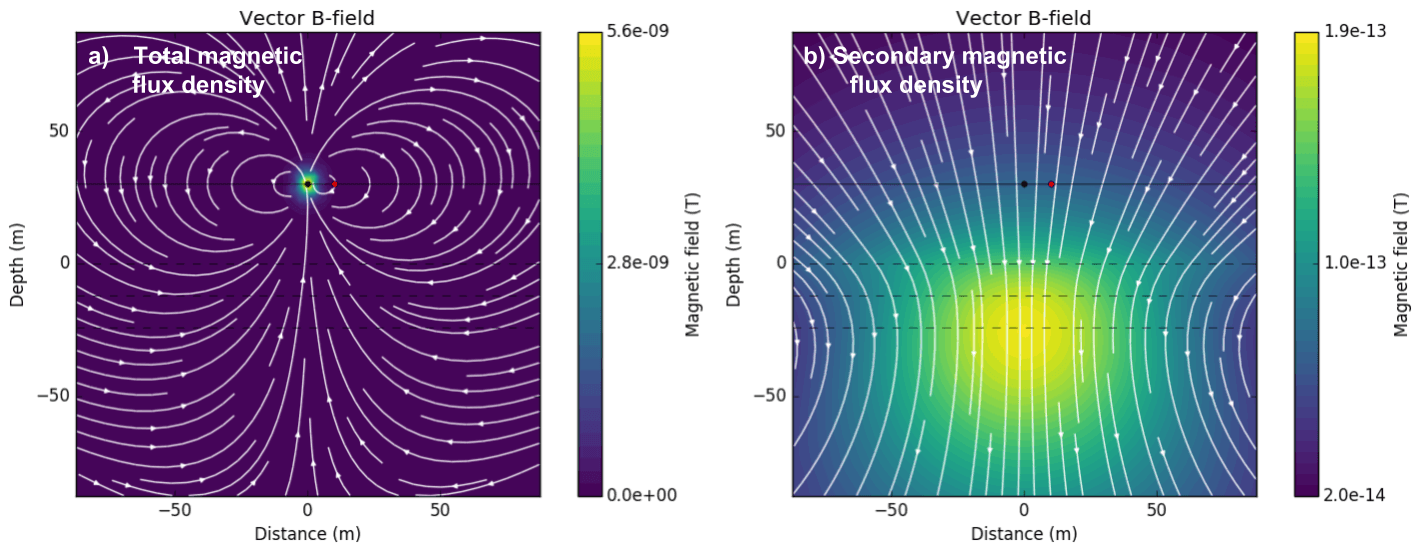
Half-space — Electromagnetic Geophysics View original
Is this image relevant?
8.1 Induced Emf and Magnetic Flux – Douglas College Physics 1207 View original
Is this image relevant?
Inductance | Physics View original
Is this image relevant?
Half-space — Electromagnetic Geophysics View original
Is this image relevant?
Normal component of B
The normal component of is always continuous across any material interface:
This comes from Gauss's law for magnetism, . Apply the divergence theorem to a thin pillbox straddling the interface: the flux entering one face must equal the flux leaving the other. Since magnetic monopoles don't exist, there's no "magnetic charge" at the surface to create a discontinuity.
This holds universally, regardless of what materials sit on either side.
Tangential component of H
The tangential component of can be discontinuous if a surface current density exists at the interface. The general condition is:
where is the unit normal pointing from region 1 into region 2. In scalar form for a specific tangential direction:
If no surface current is present (), the tangential component of is continuous: .
This condition is derived by applying Ampère's circuital law to a narrow rectangular loop straddling the boundary. As the loop height shrinks to zero, only the tangential components and the enclosed surface current survive.
Magnetic permeability μ
Magnetic permeability relates and within a linear material:
where is the relative permeability. The permeability of free space is .
Permeability directly connects the two boundary conditions. Since and , you get a relationship between the normal components of :
So while is continuous, generally is not. Similarly, if is continuous (no surface current), then jumps:
Ferromagnetic materials () dramatically amplify , while diamagnetic materials ( slightly less than 1) weakly oppose applied fields.
Boundary conditions in magnetostatics
In magnetostatics, all fields are time-independent. There are no time-varying electric fields and no displacement currents. The relevant Maxwell's equations reduce to:
- (Gauss's law for magnetism)
- (Ampère's law, no displacement current term)
Ampère's law at boundaries
To derive the tangential boundary condition, construct a thin rectangular Amperian loop with its long sides parallel to the interface, one in each medium. As the loop height :
- The contributions from the short sides vanish (they scale with ).
- The remaining line integrals give .
- The enclosed current becomes , where is the surface current density threading the loop.
This yields:
With no surface current, .
Magnetic field discontinuity
The discontinuity in tangential is controlled entirely by the surface current density . In vector form:
The cross product means the discontinuity in is perpendicular to both and . Physically, the surface current "absorbs" the difference in tangential field between the two sides.
Surface currents can originate from:
- Free currents: actual charge flow on a thin conducting sheet
- Bound currents: magnetization discontinuities at the surface of a magnetized material, where
Surface current density K
The surface current density has units of A/m and represents current per unit width flowing along the interface. It's a true surface quantity, distinct from the volume current density (A/m²).
You can think of as the limiting case of a volume current confined to a layer of vanishing thickness :
Surface currents are central to magnetic shielding analysis and appear whenever you model thin conducting shells or idealized current sheets.
Boundary conditions in magnetodynamics
When fields vary with time, you need the full Maxwell's equations. The electric and magnetic fields become coupled through Faraday's law and the Ampère-Maxwell law, and the boundary conditions must account for this coupling.
Faraday's law at boundaries
Apply Faraday's law to a thin rectangular loop straddling the interface, similar to the Ampère's law derivation. As the loop height shrinks to zero, the flux of through the loop vanishes (the area goes to zero), giving:
The tangential component of is continuous across any interface. A discontinuity would imply an infinite EMF around an infinitesimal loop, which is unphysical.

Displacement current at boundaries
The Ampère-Maxwell law includes the displacement current density:
At a boundary, the normal component of the total current (conduction plus displacement) must be continuous to avoid unbounded charge accumulation. For the displacement field , the boundary condition on the normal component is:
where is the free surface charge density. If no free surface charge exists, .
Electromagnetic boundary conditions vs. electrostatic
In electrostatics, you only deal with and , and the boundary conditions come from Gauss's law and the curl-free nature of .
In the full electromagnetic case, you must simultaneously satisfy boundary conditions on all four field quantities:
| Condition | Equation |
|---|---|
| Normal | |
| Tangential | |
| Tangential | |
| Normal |
The coupling between and through Faraday's law and the Ampère-Maxwell law means these conditions are no longer independent of each other. Satisfying one constrains the others.
Magnetic fields at perfect conductor boundaries
A perfect conductor has , which forces all fields inside it to zero. The boundary conditions at its surface follow from this constraint combined with Maxwell's equations.
Vanishing tangential E and normal B
At the surface of a perfect conductor:
- Tangential : . Since inside, and tangential must be continuous, it must also vanish just outside the surface.
- Normal : . Since inside, and normal must be continuous, it vanishes at the outer surface as well.
These two conditions together mean that is purely normal and is purely tangential at the surface of a perfect conductor.
Surface charge and current densities
The fields that can be nonzero just outside the surface are supported by surface sources:
- A surface charge density supports the discontinuity in normal :
- A surface current density supports the discontinuity in tangential :
Since inside, the full external tangential is "absorbed" by the surface current.
Magnetic shielding with perfect conductors
When an external magnetic field is applied to a perfect conductor, surface currents are induced that exactly cancel the field inside. The mechanism:
- A time-varying external induces an field (Faraday's law).
- The induced drives surface currents on the conductor.
- These currents produce their own that opposes and cancels the external field inside.
For a static field applied before the conductor becomes perfect, the field is "frozen in." A perfect conductor maintains whatever flux was present when it became perfectly conducting. Superconductors (Type I) go further: the Meissner effect actively expels all flux, regardless of the field history.
Magnetic fields at ferromagnetic boundaries
Ferromagnetic materials have (often to ), which profoundly affects how field lines behave at their surfaces.
High permeability μ effects
The boundary conditions remain the same as for any interface, but the large permeability ratio creates dramatic consequences. Combining with :
If region 2 is a ferromagnet with , then . The field inside the ferromagnet is almost entirely tangential.
For the tangential components (assuming no surface current):
So . The field inside the ferromagnet is strongly enhanced in the tangential direction.
Refraction of field lines: At a ferromagnetic boundary, magnetic field lines bend sharply toward the surface normal in the low- region and become nearly tangential inside the high- material. The refraction law is , where is measured from the normal.
Tangential H and normal B continuity
To summarize the conditions at a ferromagnetic boundary (no surface currents):
- (normal continuous)
- (tangential continuous)
- (derived consequence)
- (derived consequence)
Note that the normal component of is continuous, not . That incorrect relation would violate .

Ferromagnetic shielding applications
Ferromagnetic shielding works differently from perfect conductor shielding. Rather than inducing opposing currents, a high- shell provides a low-reluctance path that "attracts" field lines into the shell material, diverting them away from the interior.
The shielding effectiveness depends on:
- The relative permeability of the material
- The shell thickness relative to its radius
- The frequency of the field (at higher frequencies, eddy currents contribute additional shielding)
Common shielding materials include mu-metal () and soft iron. Applications range from protecting sensitive magnetometers to shielding CRT displays and transformer cores.
Boundary value problems in magnetostatics
Solving for the magnetic field distribution in a region with specified boundary conditions is a boundary value problem. These problems are the practical payoff of understanding boundary conditions: they let you calculate actual field configurations in realistic geometries.
Uniqueness theorem for magnetic fields
The uniqueness theorem guarantees that if you specify the correct boundary conditions and sources, there is exactly one solution for the magnetic field in a given region. Specifically, the solution to:
is unique once you fix either the tangential or the normal on all bounding surfaces. This is analogous to the uniqueness theorem in electrostatics and is what justifies using any valid solution method (guessing, symmetry arguments, separation of variables) since the answer you find must be the answer.
Solving Laplace's equation with boundary conditions
In current-free regions, , so can be written as the gradient of a scalar potential. The magnetic scalar potential then satisfies Laplace's equation:
The solution procedure:
- Identify the geometry and choose an appropriate coordinate system (Cartesian, cylindrical, spherical).
- Write the general solution to Laplace's equation using separation of variables.
- Apply boundary conditions (continuity of and at interfaces, behavior at infinity, symmetry constraints) to determine the unknown coefficients.
- Reconstruct and then .
Numerical methods like finite element analysis (FEA) handle geometries where analytical solutions aren't feasible.
Magnetic scalar potential approach
The magnetic scalar potential is defined by:
This is valid only in regions free of conduction currents (), since and the curl of a gradient is always zero.
The boundary conditions translate to conditions on :
- Continuity of tangential means is continuous across the interface.
- Continuity of normal becomes .
This is directly analogous to the electrostatic potential problem with different dielectrics, making the mathematical machinery of Laplace's equation (Green's functions, image methods, multipole expansions) fully available.
Reflection and transmission of waves at boundaries
When an electromagnetic wave hits an interface between two media, part of the wave reflects and part transmits. The boundary conditions on and at the interface determine exactly how the wave energy splits.
Fresnel equations for magnetic fields
The Fresnel equations give the reflection and transmission coefficients for the field amplitudes. For the magnetic field at an interface between media with wave impedances and :
Normal incidence:
where is the intrinsic impedance of the medium. Note that the magnetic field reflection coefficient has the opposite sign from the electric field reflection coefficient.
For oblique incidence, the coefficients depend on polarization (s-polarization vs. p-polarization) and involve the angles of incidence and transmission through Snell's law: .
Normal incidence vs. oblique incidence
At normal incidence (), there's no distinction between s- and p-polarization. The reflection and transmission coefficients depend only on the impedance ratio . The reflected and transmitted waves propagate along the interface normal.
At oblique incidence, the problem splits into two independent polarization cases:
- s-polarization (TE): is perpendicular to the plane of incidence. The magnetic field has components both parallel and perpendicular to the interface.
- p-polarization (TM): is perpendicular to the plane of incidence. The electric field has components both parallel and perpendicular to the interface.
Each polarization has its own Fresnel coefficients, and they behave differently as a function of angle.
Brewster's angle for magnetic waves
Brewster's angle is the incidence angle at which the reflection coefficient for p-polarized light vanishes. For non-magnetic media ():
At this angle, the reflected and transmitted rays are perpendicular to each other (), and the reflected wave is purely s-polarized.
For magnetic media where , a Brewster's angle can also exist for s-polarization. The generalized condition is:
In practice, for most optical materials where , only the p-polarization Brewster's angle is observed. The magnetic Brewster's angle becomes relevant for metamaterials or at microwave frequencies where engineered magnetic responses are possible.
See Fiveable more often in Google
Mark Fiveable as a preferred source and Google is more likely to show you our guides in Top Stories, with a "preferred" badge in AI Mode and AI Overviews.