10.3 Fresnel equations

🔋Electromagnetism II Unit 10 Review
10.3 Fresnel equations
🔋 Electromagnetism II
Fresnel equations describe how electromagnetic wave amplitudes split into reflected and transmitted components at an interface between two media. They connect directly to Maxwell's boundary conditions and Snell's law, giving you quantitative predictions for reflection and transmission as functions of angle, polarization, and material properties. For an Electromagnetism II course, the derivation from boundary conditions matters just as much as the final formulas.
Fresnel equations overview
The Fresnel equations relate the amplitudes of reflected and transmitted waves to the amplitude of an incident wave at a planar interface. They emerge from enforcing electromagnetic boundary conditions, and they depend on two things: the angle of incidence and the polarization state of the incoming wave.

Top images from around the web for Reflection and transmission coefficients
Fresnel-Gleichungen - Fresnel equations - abcdef.wiki View original
Is this image relevant?
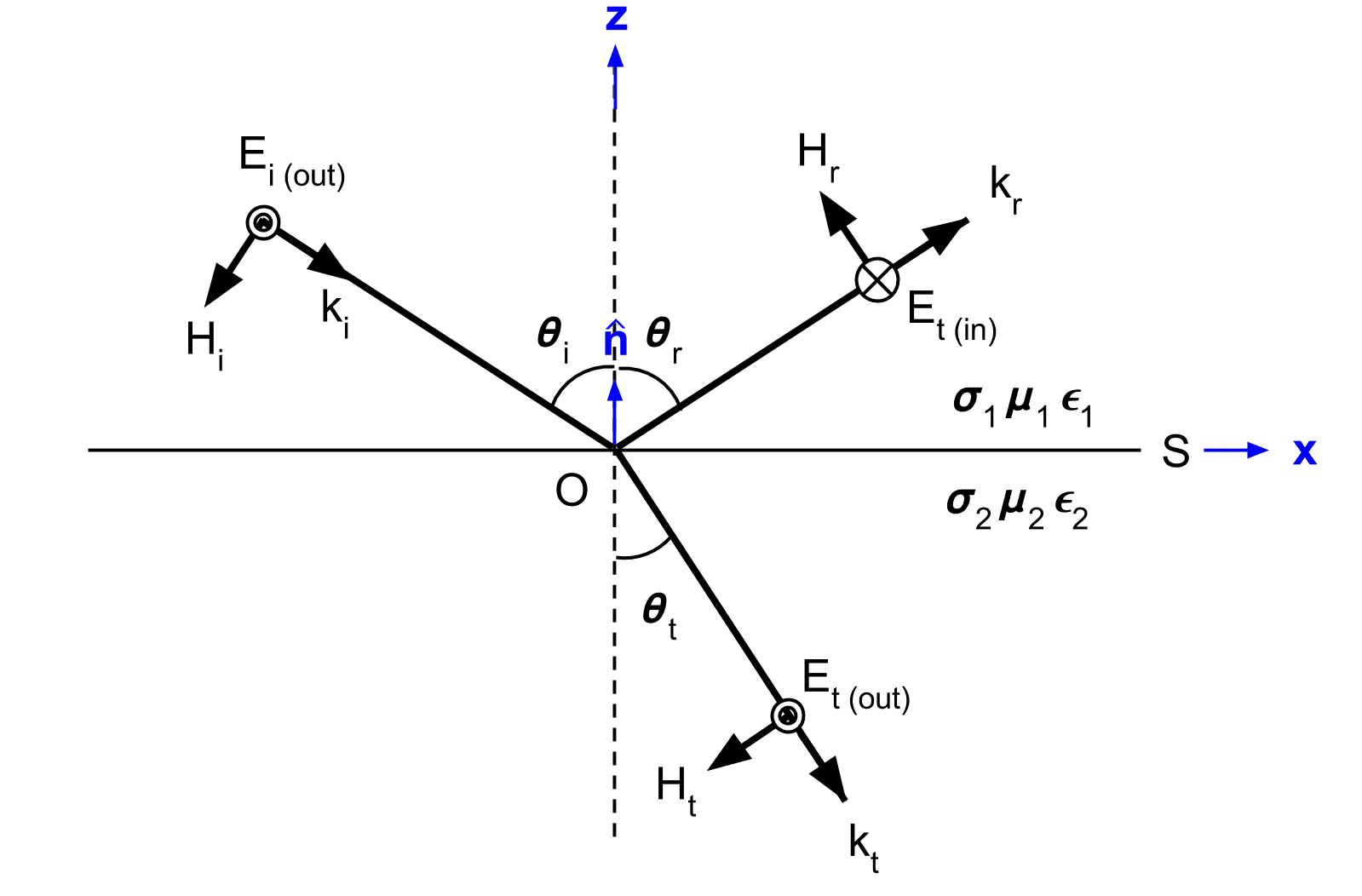
Fresnel Equations — Electromagnetic Geophysics View original
Is this image relevant?
Fresnel equations - Wikipedia View original
Is this image relevant?
Fresnel-Gleichungen - Fresnel equations - abcdef.wiki View original
Is this image relevant?
Fresnel Equations — Electromagnetic Geophysics View original
Is this image relevant?
Reflection and transmission coefficients
The reflection coefficient is the ratio of reflected to incident electric field amplitude. The transmission coefficient is the ratio of transmitted to incident electric field amplitude. Both are generally complex-valued, meaning the reflected and transmitted waves can pick up phase shifts relative to the incident wave.
- and depend on polarization (s vs. p) and angle of incidence
- A negative real value of indicates a phase shift on reflection
- These are amplitude ratios, not intensity ratios; for intensities you need reflectance and transmittance
Polarization states
Fresnel equations treat two orthogonal linear polarization states separately:
- s-polarization (from German senkrecht, "perpendicular"): the electric field oscillates perpendicular to the plane of incidence
- p-polarization (parallel): the electric field oscillates within the plane of incidence
The plane of incidence is defined by the incident wave vector and the surface normal. Because the boundary conditions couple differently to field components parallel and perpendicular to the interface, and in general. This polarization dependence is what gives rise to Brewster's angle and explains partial polarization upon reflection.
Derivation of Fresnel equations
The derivation starts from Maxwell's equations, applies boundary conditions at the interface, and uses Snell's law to eliminate the transmitted angle. Here's the logic in sequence:
- Write the incident, reflected, and transmitted fields as plane waves with appropriate wave vectors.
- Apply boundary conditions: tangential and tangential must be continuous across the interface.
- Use Snell's law to relate and .
- Solve the resulting system of equations for and in terms of the refractive indices and angles.
You do this separately for s- and p-polarization because the field components that are tangential to the interface differ between the two cases.
Maxwell's equations at the interface
Maxwell's equations in their integral form lead to the boundary conditions you need. The key equations are Faraday's law and Ampère's law (with Maxwell's displacement current). Applying them to a thin pillbox or rectangular loop straddling the interface yields continuity conditions on the tangential field components.
For non-magnetic dielectrics (), the relevant conditions reduce to continuity of tangential and tangential .
Boundary conditions
For a charge-free, current-free interface between two linear media:
- Tangential is continuous:
- Tangential is continuous:
- Normal is continuous: (no free surface charge)
- Normal is continuous:
For deriving Fresnel equations, the tangential conditions on and are the ones that do the heavy lifting. The normal conditions are automatically satisfied once the tangential conditions and Snell's law are imposed.
Snell's law
Snell's law,
follows from requiring that the phase of the incident, reflected, and transmitted waves match at every point along the interface (phase matching). This constraint also tells you that the reflected angle equals the incident angle. In the Fresnel derivation, you use Snell's law to express in terms of :
This expression can become imaginary when , which is exactly the condition for total internal reflection.
Fresnel equations for dielectrics
For non-absorbing dielectric media with real refractive indices, the Fresnel equations take their cleanest form.
Normal incidence
At , the distinction between s- and p-polarization disappears (the plane of incidence is undefined). Both polarizations give the same coefficients:
Notice that is negative when , indicating a phase shift upon reflection from a denser medium. The intensity quantities are:
At normal incidence this simplifies to . The factor of accounts for the different wave impedances and beam cross-sections in the two media. You can verify that .

Oblique incidence
For arbitrary angle of incidence, the coefficients split by polarization:
s-polarization:
p-polarization:
A useful way to remember the structure: has and , while swaps which index goes with which angle. The angles are always related through Snell's law.
Sign convention note: Different textbooks use different sign conventions for . The convention above (Griffiths, Hecht) defines positive such that at normal incidence . Some authors (Born & Wolf) flip the sign. Always check which convention your course uses.
Brewster's angle
At Brewster's angle, exactly. This happens when the numerator of vanishes:
Combined with Snell's law, this yields:
Geometrically, Brewster's angle corresponds to the condition where the reflected and transmitted rays are perpendicular to each other (). At this angle:
- Reflected light is purely s-polarized
- Transmitted light contains both polarizations but is enriched in p-polarization
- There is no Brewster's angle for s-polarization in non-magnetic media ( never reaches zero for real )
For an air-glass interface (), Brewster's angle is about .
Fresnel equations for conductors
When one of the media is a conductor, free carriers cause absorption, and the refractive index becomes complex.
Complex refractive index
A conductor is characterized by , where:
- is the real part, governing the phase velocity
- is the extinction coefficient, governing absorption
The complex refractive index is related to the complex dielectric function by (in Gaussian-like notation) or more precisely , where is the conductivity. For good conductors at optical frequencies, can be comparable to or larger than .
Reflection coefficients
You obtain the Fresnel equations for a dielectric-conductor interface by replacing with in the dielectric formulas. Using the convention where medium 1 is a dielectric with real (air):
These coefficients are now complex, so both the amplitude and phase of the reflected wave change. Transmission coefficients are rarely useful here because the transmitted wave decays exponentially.
Skin depth
The skin depth is the penetration depth of the electric field amplitude into the conductor:
where is the free-space wavelength. For copper at optical frequencies ( nm, ), nm. This is why metals are opaque: virtually all the transmitted energy is absorbed within a few tens of nanometers.
At lower frequencies (RF, microwave), the skin depth is better expressed using the conductivity directly:
Reflectance and transmittance
Reflectance and transmittance are the measurable intensity ratios. They relate to the Fresnel amplitude coefficients but are not simply and .
Reflectance vs. angle of incidence
For a typical air-glass interface:
- At :
- As increases, increases monotonically toward 1
- first decreases, hits zero at Brewster's angle, then increases toward 1
- At grazing incidence (): both and approach 1
For conductors, reflectance is high across all angles (often 90%+ for metals) and varies less dramatically with angle.

Transmittance vs. angle of incidence
The transmittance for dielectrics is:
The prefactor accounts for two things: the different wave impedances in the two media and the change in beam cross-section due to refraction. Without this factor, energy conservation would not hold.
- decreases as increases, reaching zero at grazing incidence
- At Brewster's angle, (all p-polarized light is transmitted)
- For conductors, is negligible at all angles
Energy conservation
For non-absorbing dielectrics:
for each polarization separately. This is a direct consequence of the Poynting vector flux being conserved across the interface. You can verify this algebraically using the Fresnel coefficients.
For absorbing media:
where is the absorptance. In the limit of a good conductor (large ), and .
Applications of Fresnel equations
Optical coatings
Anti-reflection (AR) coatings work by introducing a thin dielectric layer so that reflections from the top and bottom of the layer interfere destructively. For a single-layer AR coating at normal incidence, the optimal design requires:
- Layer refractive index:
- Layer thickness: (quarter-wave thickness)
This gives zero reflectance at the design wavelength. High-reflection (HR) coatings use alternating quarter-wave layers of high and low index materials to build up constructive interference of reflected waves. The Fresnel equations at each interface determine the amplitude and phase of each partial reflection.
Thin film interference
When light reflects from the top and bottom surfaces of a thin film, the two reflected beams interfere. The Fresnel equations give you the amplitude and phase at each interface, and the path difference through the film determines whether the interference is constructive or destructive.
The total reflection from a thin film of thickness and index can be calculated using the Airy formula, which sums the multiply-reflected beams. This is the basis for Fabry-Pérot interferometers, dichroic filters, and the colorful patterns you see in soap bubbles and oil films.
Polarizing filters
Brewster-angle polarizers exploit the vanishing of at Brewster's angle. A stack of glass plates oriented at Brewster's angle transmits p-polarized light with minimal loss while reflecting away s-polarized light at each surface. After several plates, the transmitted beam is highly p-polarized.
Polarizing beam splitters in optics labs often use multilayer coatings designed so that one polarization is reflected and the other transmitted, with the Fresnel equations governing the design of each layer.
Limitations and extensions
Rough surfaces
The standard Fresnel equations assume a perfectly flat, smooth interface. Real surfaces have roughness that scatters light away from the specular direction. When the root-mean-square roughness is much smaller than , the Fresnel equations still give a good approximation for the specular component. As roughness approaches , you need scattering theories:
- Rayleigh-Rice theory: valid for roughness much less than , treats scattering as a perturbation
- Beckmann-Kirchhoff theory: handles larger roughness using scalar diffraction
Anisotropic media
In anisotropic materials (birefringent crystals like calcite, liquid crystals), the refractive index is a tensor rather than a scalar. The Fresnel equations must be generalized: an incident beam can split into two transmitted beams (ordinary and extraordinary rays) with different propagation directions and polarizations. The reflection and transmission coefficients depend on the orientation of the crystal's optic axis relative to the interface and the plane of incidence.
Nonlinear optics
The Fresnel equations assume a linear relationship between polarization and electric field . At high intensities (pulsed lasers, for example), nonlinear susceptibility terms (, ) become significant. This leads to phenomena like second-harmonic generation, where light at frequency generates light at upon reflection or transmission. Nonlinear Fresnel equations incorporate the intensity-dependent refractive index and are needed to calculate conversion efficiencies at interfaces.
See Fiveable more often in Google
Mark Fiveable as a preferred source and Google is more likely to show you our guides in Top Stories, with a "preferred" badge in AI Mode and AI Overviews.